Bachata rhythm3 minutes

Hearing Bachata syncopations: A guide to musical understanding

In a nutshell
  • A Bachata syncopation is a rhythmic shift where the emphasis unexpectedly falls on the beats between the main counts.
  • To learn to hear Bachata syncopations, you need to focus on the rhythmic interplay of the bongos and güira.
  • Consciously recognizing these rhythm changes trains your ear and allows for much more musical dancing beyond just counting along.

The magic of Bachata lies between the beats. If you learn to consciously perceive the syncopations in the rhythm, you no longer just dance rigidly to the beat, but literally breathe in the music.

What you need beforehand

  • A classic Bachata song with clear percussion
  • Good headphones or speakers for clear sound
  • A basic understanding of the 4/4 time signature
  • A few minutes of undisturbed time for active listening

Why the syncopation makes Bachata come alive

Anyone starting with Bachata quickly learns the classic counting from one to eight. But while the basic step works wonderfully on the downbeats, the music repeatedly breaks out of this rigid grid in between. The Bachata syncopation is responsible for this: a deliberate rhythmic shift where the emphasis moves from the heavy, expected beats to the light spaces in between. When you learn to consciously perceive these musical surprises, your entire feeling for the dance changes.

Recognizing these rhythmic accents has nothing to do with advanced footwork, it is purely ear training. As soon as your ear understands when the instruments interrupt the familiar flow, you can move much more harmoniously to the music. You stop just mechanically executing steps and start to really feel the music. To develop this ear, a look at the typical instruments helps. A deeper understanding of the 5 most important Bachata instruments and their sound is the first step to untangling the dense web of bongos and güira and accurately filtering out the syncopations.

Hear the syncopation in 4 steps

  1. Stabilizing the basic beat

    Before you look for the syncopations, you must have the basic beat securely in your ear. Use the guide on counting Bachata rhythm to tap along to the beats from one to eight without any errors.

  2. Isolating the rhythm section

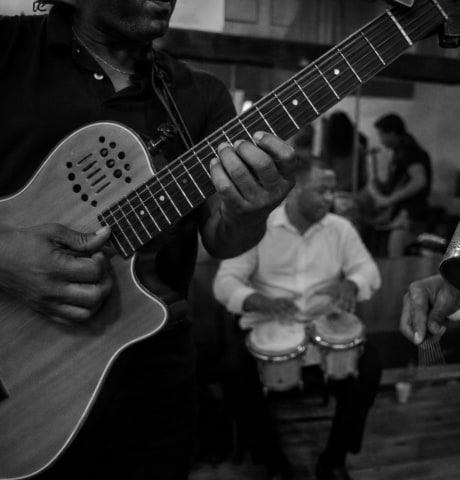
    Mentally tune out the vocals and the lead guitar. Instead, direct your full attention to the metallic scraping of the güira and the tapping of the bongo drums.

  3. Listen to the spaces in between

    Count along out loud to the beat and pay close attention to the short, fast pulses that lie exactly between the numbers you are counting. These intermediate beats, often counted as "and", carry the syncopation.

  4. Catching the rhythmic shift

    Pay attention to moments where the drum seems to anticipate or skip a beat, causing the emphasis to shift. If the rhythm feels "shifted" for a moment, you have caught the syncopation.

The path to a refined ear

Correct

  • Pay attention to the spaces between the beats
  • Focus entirely on a single instrument
  • Enjoy the music loudly through good headphones

Wrong

  • Only listening rigidly to the heavy beats one and five
  • Trying to process all instruments at the same time
  • Being distracted by other noises on the side

Your checklist for rhythm training

Before listening

Preparation

While listening to music

Meanwhile

Frequently Asked Questions

  1. A syncopation in Bachata is a shift in rhythm where the emphasis moves from the heavy beats to the beats in between. This creates a rhythmic tension that makes the song dynamic.

Salsa and Bachata courses near you

Find the right course now to test your sense of rhythm directly on the dance floor.

View all suitable courses

Find your rhythm together

On udansa, you will find like-minded people who, just like you, want to dive deeper into the music. Find your perfect dance partner or the right course in your area now!

Find your rhythm together