

Find your rhythm together
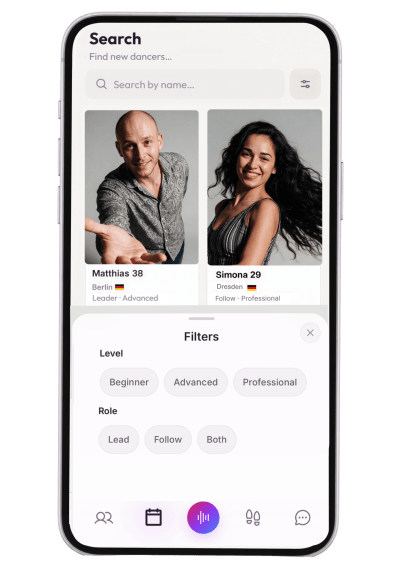
Find like-minded dance partners and the best Bachata courses near you on udansa to try out your new sense of rhythm directly on the dance floor.

Decoding the Bachata rhythm by ear is the most important milestone for every beginner. With the right focus on the structure of the music, you turn uncertainty into pure sense of rhythm.
The music structure describes the composition and arrangement of the rhythmic and melodic elements of a piece of music. In Bachata, it determines the interplay of the instruments in a 4/4 time signature.
Anyone starting to dance often faces the same challenge: the music is playing, everyone is moving in harmony, but your own ears only perceive an inextricable tangle of sounds. To learn to hear the Bachata beat, it helps to look at the rhythmic foundation. Bachata is based on a classic 4/4 time signature. This means that four steady basic beats follow one another before a new measure begins. For us dancers, this structure is a blessing, because it gives the entire body a reliable orientation.
In practice, we usually combine two of these measures into a larger unit of eight beats in total when dancing. That is the magic number you hear in almost every dance school. If you want to understand the Bachata basic step and dance technique, you must first learn to count these eight beats in your mind. The rhythm is surprisingly constant and runs like a common thread through every song, regardless of whether it is traditional or modern.
Why do many beginners find it difficult to isolate the beat at first? This is usually due to the dense instrumentation of Dominican music. In addition to the dominant lead guitar, the requinto, the bongo drums and the güira, a metallic scraper, create a high-frequency rhythmic web. Anyone who tries to pay attention to every single sound will quickly lose the thread. To be able to hear the Bachata beat, you have to train your ear to fade out the playful melodies of the guitar for a moment and focus on the deep, steady beats.
A valuable reference point in the rhythm and beat theory of Latin American dances is the bass. The bass in Bachata plays a very distinctive, repetitive figure that forms the heartbeat of the song. It particularly emphasizes the heavy counts and helps you to identify the one, i.e., the beginning of the bar, without a doubt. As soon as you have learned to follow these low frequencies in the background, the apparent chaos of the music organizes itself as if by magic.
When listening to music at home, just close your eyes and tap the deep bass beat with your index finger to train your ear without any distractions.
If you can pick out the individual instruments in Bachata, you are no longer just dancing steps, but moving in dialogue with the band.
Every Bachata measure has a very special dynamic that finds its climax on the fourth and eighth beat. While beats one, two, and three signal a fluid movement, the four is a moment of brief pause or accentuation. In the music, this fourth beat is often highlighted by a concise, dull strike on the bongo drum. This rhythmic signal is extremely easy for the ear to grasp once you know what to listen for.
This cyclical pattern of three fluid beats and one pointed conclusion repeats continuously. When you look at the typical development of Bachata music styles, you will notice that this rhythmic stopper on the four and the eight is the connecting element of all eras. It gives the music its typical swaying character. As soon as your ear has internalized this structure, you no longer move according to visual signals from your partner, but are carried directly by the music.
The starting point of the beat
The first beat, the one, marks the beginning of the musical cycle. This is where the strongest emphasis of the bar lies, signaling the starting point to the dancer.
The rhythmic accent
The fourth beat brings the rhythmic pattern to a short, concise stop. It prepares the ear for the change of direction in the next measure.
Focus entirely on the deep bass and the bongo drum. Consciously tune out the fast, bright notes of the guitar to find the heavy main beat on the one.
Bring your new sense of rhythm directly to the dance floor and learn Bachata from scratch.
 Bachata Basic Step and Dance Technique for BeginnersGetting started is easy: With our simple guide to the Bachata basic step and proper hip technique, you will master your first steps in partner dancing effortlessly.
 Latin dances: Understanding rhythm and beatRhythm is the heart of Latin dances. Learn how to understand the timing of Rumba, Cha-Cha, Jive, and Paso Doble and apply it confidently in partner dance.
 Bachata styles and history comparedDiscover the fascinating history of Bachata and learn the differences between the traditional Dominican style and modern variations like Bachata Sensual.