Find your rhythm together with udansa
Whether you want to refine your sense of rhythm or are still looking for the right dance partner: on udansa you will find like-minded people and the best courses in your region.

By Bernhard De LucaUpdated
Whether you want to refine your sense of rhythm or are still looking for the right dance partner: on udansa you will find like-minded people and the best courses in your region.
Find out with our playful self-test how deeply the Dominican beat is already anchored in you and how you can take your musicality to the next level.
The gentle hip movement, the typical emphasis on the fourth beat, the melodic sounds of the guitar: Bachata captivates people all over the world. But while the steps are quickly learned in a dance class, the true art reveals itself on the dance floor in the interaction with the music. Many beginners and even advanced dancers ask themselves whether they have truly internalized the beat or are just moving mechanically through the figures. A genuine understanding of rhythm is the key to letting go of counting and letting the music flow.
To find out how your natural feel for the Dominican sounds is doing, a targeted Bachata rhythm test helps. This tracks your habits when listening to music and your instinctive reactions to beats. If you want to deepen the basics, it is worth taking a look at our guide Learning to understand Bachata rhythm and music. Because only those who grasp the structure behind the sounds can completely let go on the dance floor and merge harmoniously with their partner.
When dancing, you rely heavily on your logical thinking and meticulously count the steps in your head. This gives you security, but sometimes it blocks your emotional connection to the music. In your next class, try closing your eyes and focusing entirely on the sound of the instruments instead of just playing the numbers one through eight in your head.
You react very sensitively to the mood and melody of a song, but sometimes you lose the rhythmic thread. Your dance is expressive, but it would benefit from a bit more structure. Listen specifically to traditional tracks and try to follow only the hard beat of the güira to strengthen your grounding in the rhythm.
Congratulations, the Bachata rhythm is already flowing through your veins! You hear syncopations, instrument changes, and tempo changes instinctively and translate them directly into movement. Use this talent to play with different dynamics at socials and develop your own, unmistakable style.
| Feature | A: Structured counter | B: Emotional melodist | C: Rhythm artist |
|---|---|---|---|
| Focus when listening | Numbers and basic beat | Vocals and mood | Instruments and syncopations |
| Greatest strength | Very precise timing | High emotionality | Intuitive musicality |
| Challenge | Sometimes seems stiff | Easily loses the beat | Tends to overdo it |
| Best exercise | Close your eyes while dancing | Focus on the Güira | Play with tempo variations |
The classification is based on typical behavioral patterns in social dance and dance classes.
Find the right course to test your sense of rhythm directly on the dance floor.
Your test result shows you where you are already intuitively on the right track and where your ear could use a little support. No one is born a perfect dancer, and the beauty of Bachata is that your ear can be trained excellently. If you notice that picking out the instruments is difficult for you, you can incorporate targeted exercises into your daily routine to sharpen your Bachata sense of rhythm step by step.
An excellent next step is getting to know the typical movement patterns. Take a look at our guide Bachata basic step and dance technique for beginners. Once you have the theory down, only practice helps: go to socials, listen to Dominican playlists in the car, and seek out exchanges with other dancers. Over time, the counting in your head will fade away and the rhythm will go directly into your feet.
You can best recognize the beat by the rhythmically concise güira, a metal scraper, and the strikes of the bongo. In Bachata, the fourth and eighth beats are usually highlighted by a duller, emphasized bass beat or a distinct accent.
Yes, an absolute sense of rhythm can be built through active listening and targeted ear training. By focusing on individual instruments like the bass guitar or the güira in your everyday life, you sharpen your perception of the rhythmic structures.
If you fall out of rhythm, it is best to stop briefly, bounce loosely on the spot, and look for the prominent bass beat on the one or five. As soon as you feel the beat in your body again, simply step back into the basic step.
 Mastering Bachata rhythm and music
 Hearing Bachata syncopations: A guide to musicality
 Derecho, Majao, Mambo: The typical Bachata song structure in detail
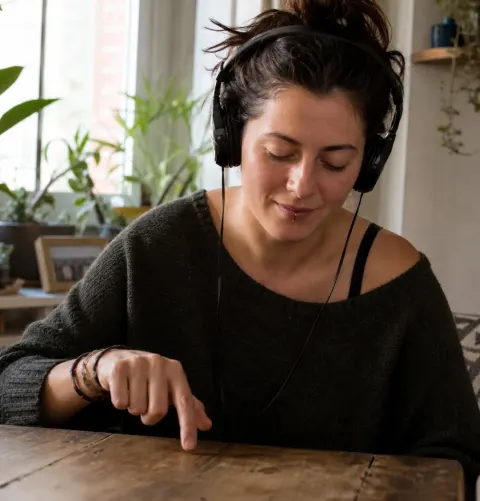 Training your Bachata rhythm: 5 ear training exercises for home
 Dominican Bachata Rhythm: Hearing the Difference
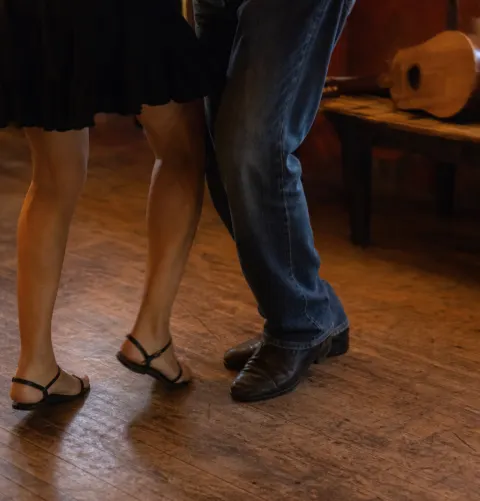 Classic Bachata albums: Music for a true sense of rhythm
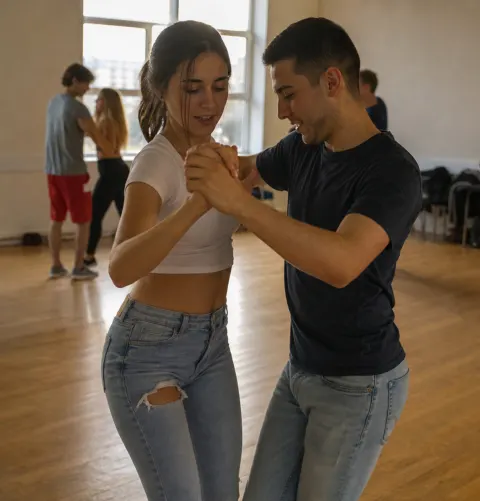 Bachata Music Trends: How modern beats are changing the dance