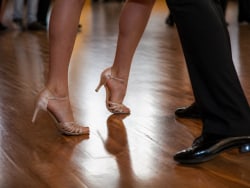
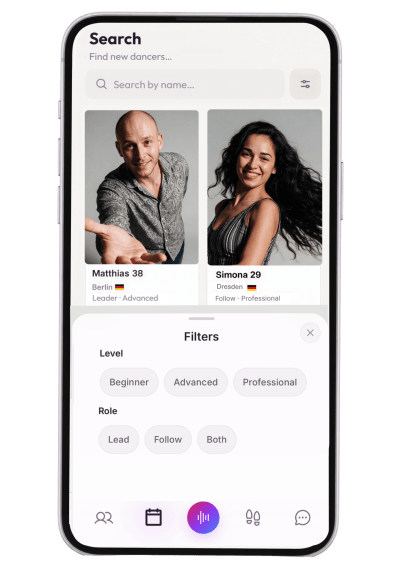
Find your dance partner with rhythm
On udansa connect, you will meet other dance enthusiasts who have rhythm in their blood or want to discover it together with you. Find your perfect dance partner for your next course now.

In partner dance, the right rhythm determines whether there is harmony or misunderstanding. Learn how to hear the subtle beats of Latin music and perfectly coordinate your steps to them.
Latin dance music timing describes the systematic distribution of accented and unaccented beats within a piece of music, which serves as a guide for dancers for their steps. It determines the tempo and the character of the respective dance style.
Anyone hearing Latin American music for the first time often perceives only a captivating, energetic interplay of drums, rattles, and bass. However, to move harmoniously with a partner on the dance floor, simply bobbing along is not enough. The foundation for every dance step is a conscious understanding of the timing. In the international dance program, we primarily encounter four dances that differ significantly from one another musically: Cha-Cha-Cha, Rumba, Jive, and Paso Doble. Each of these styles is based on its own unique distribution of accented and unaccented beats within the measure.
The key to success lies in viewing Latin American dances in the international dance program not just as a sequence of steps, but in using the music as a timekeeper for every weight transfer. While some dances are in the classic four-four time, each style brings its own rhythmic peculiarities. Anyone who understands these subtleties will never lose the beat on the dance floor again.
The two closely related dances Cha-Cha-Cha and Rumba share the same historical origin, but show a striking difference when listening to the music. The Cha-Cha-Cha is lively, fast, and is usually danced at a Cha Cha Cha tempo of 30 to 32 BPM (beats per minute). The characteristic chasse step sequence falls on the counts "4-and-1". Here, the music becomes noticeably dense and driving.
Rumba, on the other hand, is the emotional counterpart: it is interpreted much more slowly, which makes recognizing the Rumba beat an exciting task for beginners. The music flows, and the first step of the basic step is set on the count "2", while the count "1" is used as a rhythmic pause or for a slow hip movement. Anyone who internalizes this rhythmic difference in a Latin American way can immediately distinguish the two dances by the music, even before the first step is danced.
Close your eyes for a moment before dancing and try to pick out only the instruments in the background. The claves or congas will show you the rhythm much more clearly than the vocals.
If you feel the rhythm in your body instead of just counting it in your head, you will move in harmony with your partner all on your own.
Completely different worlds open up with Jive and Paso Doble. To be able to count the fast Jive rhythm, you have to adjust to a high tempo. Jive is based on an infectious six-count rhythm, which is layered over a four-four time signature. It is usually counted as "1, 2, 3-and-4, 5-and-6", with the accented beats falling on the off-beats two and four. This gives the dance its typical bouncy, carefree character.
The Paso Doble music structure breaks completely with these patterns. As the only one of the four Latin dances, it is in two-four time and is structured like a Spanish march. The music tells the story of a bullfight and is divided into fixed phases, the so-called highlights. At these musical peaks, the dance couple freezes in a dramatic pose. Anyone who understands the Latin dance music timing here does not just dance steps, but interprets an entire drama in harmony with the music.
The art of the conscious pause
Rumba thrives on deceleration. The first beat of the measure is not occupied by a step in dance, but is instead used for an expressive weight shift. This requires patience and a fine ear.
Focus on quick steps
Cha-Cha-Cha requires quick, precise actions on the counts of four and one. The chasse step pattern divides the beat and provides the typically lively dynamics on the dance floor.
You can recognize the beat by listening to the deep drum or the bass. The first beat in the measure is usually the most emphasized, however, the first step of the Rumba only starts on the second count.
Find the right course to test your sense of rhythm directly on the dance floor.
Sunday · 14:30-16:00 · Nov 15, 2026 - Jan 17, 2027
Limbach-Oberfrohna
Sunday · 14:30-16:00 · Sep 6 - Nov 8
Limbach-Oberfrohna
Sunday · 14:30-16:00 · Nov 15 - Nov 29
Limbach-Oberfrohna