Rhythm and beat4 minutes

Determining BPM for Latin dances: How to measure the tempo

By Bernhard De LucaUpdated

In short
  • The four Latin American dances of the world dance program differ significantly in their tempo, measured in beats per minute (BPM).
  • Rumba is the slowest dance at 25 to 27 BPM, followed by Cha-Cha-Cha at 30 to 32 BPM.
  • Samba moves in a faster range of 50 to 52 BPM, while Jive sets the highest tempo at 40 to 44 BPM (in four-four time).
  • The tempo can be precisely determined manually by counting the beats within 15 seconds and then multiplying by four.

The right music tempo decides whether you dance a soulful Rumba or a lively Jive. With the right technique, you measure the beats per minute in seconds and hit the perfect step immediately.

What you need to measure the tempo

  • A music player
  • A stopwatch or a smartphone with a timer function
  • Quiet, so you can focus entirely on the beat
  • A basic understanding of the difference between measure and beat

Why tempo determines the dance

Anyone starting with partner dance often faces an acoustic wall. The music is playing, the couples are moving, but which dance fits which song? The answer lies in the tempo, measured in beats per minute (BPM). In the world dance program, the music tempo significantly determines whether a Rumba, a Cha-Cha-Cha, a Jive, or a Samba is performed on the dance floor. Each of these pieces has a characteristic speed range that shapes the character of the movement. To anchor these differences in your ear, targeted listening training helps. A wonderful introduction is our guide Latin American dances rhythm training: solo exercises, with which you can train your hearing without a dance partner.

The four speed levels in the world dance program

The Latin American dances of the world dance program cover a broad spectrum. The Rumba forms the emotional foundation with its slow, sustained tempo. The Cha-Cha-Cha brings a medium, lively speed, while the Samba features a driving, often syncopated rhythm. The rapid climax is the Jive, which conveys pure energy with its high beat count. Anyone who learns to distinguish these speeds purely by counting the beats will never have to guess which basic step is the right one on the dance floor again.

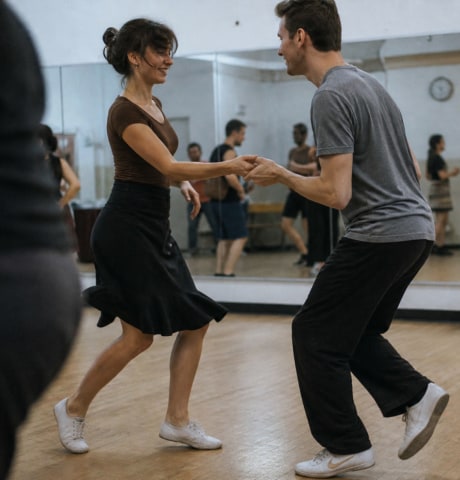
A focused look at the feet and an ear close to the beat: whoever reads the tempo masters the dance floor.

Determine the music tempo in four steps

  1. Finding the basic beat

    Focus entirely on the music and try to filter out the steady, heavy basic beat. Ignore fast drum rolls or the vocals and tap the main beat lightly with your foot.

  2. Count beats over 15 seconds

    Start your stopwatch and begin counting the beats out loud at the same time. Start at zero and count every main beat in the rhythm until exactly 15 seconds have passed on the clock.

  3. Calculate the result

    Take the number of beats you counted and multiply it by four. For example, if you counted 8 beats in 15 seconds, the tempo of the song is 32 BPM.

  4. Assign the dance style

    Compare your calculated value with the BPM table for Latin dances. If the value is around 26, you are dancing Rumba, if it is over 40, it indicates a fast Jive in four-four time.

How to measure the tempo without errors

Measuring correctly

  • Listen for the heavy downbeat on the counts
  • Use a stopwatch for exactly 15 seconds
  • Check several sections of the song
  • Compare the BPM values with the official table

Avoid mistakes

  • Getting distracted by fast intermediate steps
  • Guessing based on feeling instead of counting
  • Only using the intro of the song for the measurement
  • Confusing BPM with the time signature

The process of measuring tempo at a glance

Before measuring

Preparation

During the song

Measurement

After counting

Analysis

Frequently Asked Questions

  1. Rumba is the slowest Latin American dance in the world dance program. Its tempo is usually in a very steady range of 25 to 27 beats per minute, which gives couples plenty of room for slow, expressive movements.

Latin courses near you

Find the right course to test your sense of rhythm directly on the dance floor.

View all matching courses

Find your rhythm partner on udansa

At udansa connect, you will find like-minded people who have rhythm in their blood just like you. Exchange ideas, practice counting together, or make plans for the next dance night.

Find your rhythm partner on udansa