Rhythm training5 minutes

Master Latin dances at any tempo

By Bernhard De LucaUpdated

In a nutshell
  • Radically adjust your step size to the tempo of the Latin music.
  • Fully extend slow movements and use the gaps for fluid weight shifts.
  • Keep steps tiny during fast songs and stay springy on the balls of your feet.
  • Reduce the complexity of figures to a minimum at extreme BPM levels.

When the music suddenly drags extremely slowly or flies by at a breakneck pace, your usual basic step quickly starts to falter. With the right adjustments in your body, you will master every speed effortlessly.

DefinitionLatin dance tempo adjustment

Latin dance tempo adjustment refers to the ability of dance couples to flexibly adapt their step size, dynamics, and weight distribution to extremely slow or very fast music speeds, without losing the basic beat.

The art of slowness in Rumba and co.

An extremely slow tempo puts balance in partner dance to a tough test. When a Rumba trickles out of the speakers at a snail's pace, a perceived eternity arises between the individual steps. Many couples tend to rush the movements or fill the pauses with restless bobbing in these moments. To keep the beat with slow music, a mental trick helps: break down the space between the main beats into smaller, invisible subdivisions. Instead of just waiting for the heavy beats, you use the entire duration of the note for a fluid weight transfer. Every movement is stretched out extremely, so that the foot only fully bears weight in the very last fraction of a second.

This challenge becomes particularly clear when you have to count a slow Rumba. This is where it shows whether your body tension is sufficient to fill the proverbial air between the steps while standing. Use these stretched moments quite consciously for the typical hip movement of Latin American dances. The slower the tempo, the more time you have to let the movement flow cleanly from the hips to the tips of your toes. Slowness is not an obstacle, but an invitation to maximum elegance and conscious control.

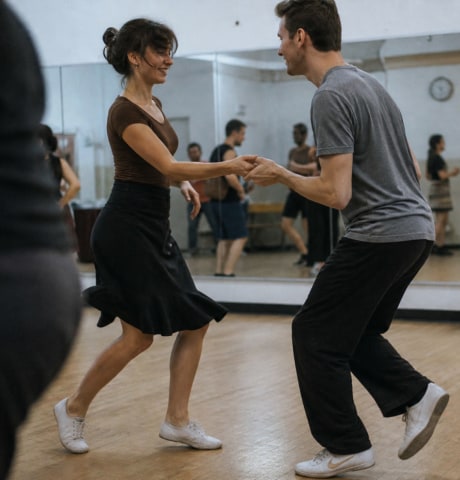
Feet and shoes of a male and female dance couple rehearsing ballroom and Latin dances
The right body tension determines whether an extremely slow rhythm looks elegant or leads to stumbling.

How to keep control during fast beats

At the other end of the spectrum, the challenge of high speed awaits. When the DJ pushes the faders up and a fast-paced Jive floods the dance floor, many couples start to panic. Anyone who tries to execute steps at their usual size now will inevitably lose the beat. The secret to extreme BPM counts lies in the radical reduction of step size. The feet stay extremely close to the floor, and the steps shrink to a minimum. This is the only way for the body to have enough time to precisely execute the rapid weight shifts.

To successfully adjust your Jive to the tempo, you must also keep your knees soft and shift your body weight slightly forward onto the balls of your feet. Anyone landing on their heel slows themselves down and immediately falls behind. With fast rhythms, it is not about demonstrating athletic peak performance, but about using your own energy economically. Short, springy impulses in the ankle replace expansive movements and ensure your rhythmic survival on the dance floor.

Rhythmic balance in the extreme range

Correct

  • Make steps extremely small when the tempo is fast
  • Fully utilize the slow beat with fluid movements
  • Return to the basic step immediately if you feel uncertain
  • Maintain active body tension at every tempo

Wrong

  • Take large steps during fast Jive
  • Bounce restlessly during pauses in slow music
  • Force difficult figures despite losing the beat
  • Lock your knees at high speeds

If you really want to embody the music, you cannot be afraid of the silence between the beats or the intensity of fast rhythms. The adjustment always begins in your own pelvis.

Latin dance instructor, Cologne

The mental shift to extreme BPM numbers

The biggest hurdle at extreme speeds is usually not the body, but the mind. As soon as the music deviates from the usual standard, many dancers tense up and lose their connection to their partner. Yet, rhythmic adaptation is a dynamic process that is controlled within the pair through constant micro-signals. The leader must adapt to the changed tempo immediately and pass it on through clear, precise impulses, while the following partner must maintain a constantly high level of body tension to be able to react without delay.

If you notice that you are getting out of sync, only one thing helps: reduce the complexity. Focus on the pure basic step or dance simple weight changes in place until you feel the common pulse of the music in your bodies again. Only when the foundation is absolutely stable at the new tempo should you start attempting more complex turns or figures again. A strong sense of rhythm in a pair grows primarily through experiencing and balancing these extreme musical moments together.

Two extremes on the Latin dance floor

Slow

The Rumba delay

Let it flow and stretch

Use the entire space between the beats for an extremely slow, fluid weight transfer. Keep your body tension high to dance through the pauses elegantly.

Fast

The Jive acceleration

Stay compact and bouncy

Minimize your steps and stay elastic on the balls of your feet. Use short, precise impulses from your ankles to follow the beat effortlessly.

Frequently Asked Questions

  1. With extremely slow music, it helps to subdivide the counts in your head. Focus on stretching out the weight transfer as much as possible, instead of finishing the step prematurely.

Latin courses near you

Find the right dance course now and learn to adapt perfectly to any tempo.

View all suitable courses

Find your rhythm together

On udansa you will find like-minded people who keep the beat with you. Discover suitable dance courses and dance partners in your area to deepen your sense of rhythm in partner dance together.

Find your rhythm together