Sense of rhythm5 minutes

Viennese Waltz vs. Slow Waltz: Comparing the rhythm

In a nutshell
  • The Slow Waltz is danced at about 28 to 30 bars per minute and is characterized by a strongly emphasized, flowing rise and fall movement.
  • The Viennese Waltz is twice as fast at around 58 to 60 bars per minute and focuses on a continuous rotational movement across the floor.
  • The essential differences in waltz rhythm lie in the tempo and the resulting change in the dynamics of the steps on counts two and three.
  • In the Slow Waltz, the time on two and three is used for rising, whereas in the Viennese Waltz, these beats are used flat for the rapid rotation.

Although both dances are in the classic three-quarter time, they are worlds apart. If you want to not only hear the rhythm but also feel it in your body, you have to understand the subtle differences in tempo and dynamics.

DefinitionThree-quarter time

Three-quarter time is a musical time signature where each measure consists of three quarter notes. When dancing, this rhythm is interpreted as a unit of three steps, with the emphasis usually on the first beat.

Two worlds in three-quarter time: gliding versus rotating

The three-quarter time is the common basis for both forms of Waltz, but their effect on the dance floor could hardly be more different. In the Slow Waltz, which is also known as the Boston or Waltz in English-speaking countries, the focus is on the flowing, almost floating glide. The music gives the dancer plenty of time to fully savor the movement. Each step is taken consciously, and the highs and lows of the movement are extremely emphasized.

The Viennese Waltz presents itself quite differently. Here, the rush of speed dominates. The couples spin across the floor at a breathtaking pace, which requires a completely different physical dynamic. Anyone who wants to master the Viennese Waltz natural turn without losing balance must learn to control the centrifugal forces through precise orientation in the room and an extremely compact posture. The rhythm drives the couple forward, while with its slow counterpart, the art lies in conscious deceleration.
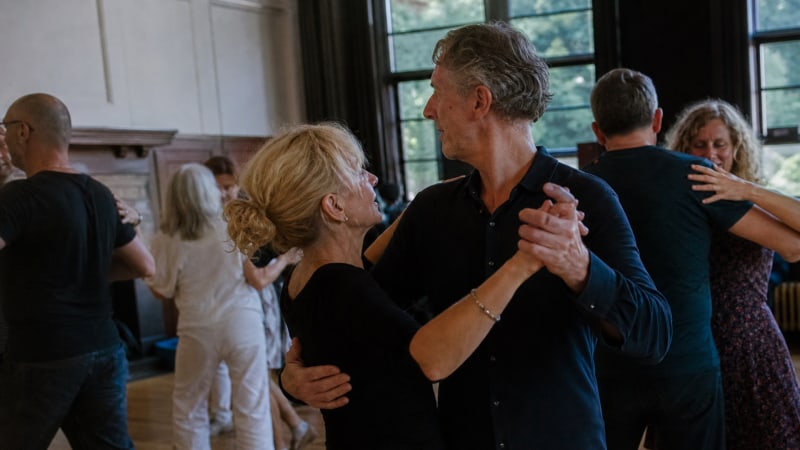
The right footwork is decisive: While the Waltz rolls extremely over the balls of the feet, the Viennese Waltz remains significantly flatter on the dance floor at high speeds.

Tempo in comparison: The raw numbers on the dance floor

The decisive factor for the completely different feeling while dancing is the tempo, measured in beats per minute (bpm). In Slow Waltz, the music moves in a very relaxed range of about 28 to 30 bpm. This means that only around 90 beats sound per minute. For the dance couple, this timing of the Slow Waltz means that they must execute every single step with extreme control. Every mistake in balance becomes immediately visible due to the slow tempo.

Viennese Waltz, on the other hand, runs at a speed of 58 to 60 bpm, which corresponds to a full 180 beats per minute. With this rapid rhythm of the Viennese Waltz with its high bpm numbers, there is no time for long hesitation or expansive rising and falling movements. The steps must be kept significantly smaller and flatter to be able to keep up with the music. While you celebrate the movement in Slow Waltz, Viennese Waltz is about pure efficiency and rhythmically merging with the rapid beat.

Rhythmic sensitivity on the dance floor

Training correctly

  • Use the one as a deep, powerful starting point
  • Keep the steps small and flat for the Viennese Waltz
  • Fully enjoy the rise and fall for the Slow Waltz

Common mistakes

  • Hastily skipping the counts of two and three
  • Taking steps that are too large during a fast Viennese Waltz
  • Dancing the Slow Waltz stiffly and without any rise and fall

If you really want to feel the difference between the two forms of Waltz in your body, you have to learn to stretch the time between the beats in the slow dance and to tame it in the fast dance.

Dance teacher, Dresden

How the emphasis shapes the character of the movement

Although both dances are based on the same mathematical beat structure, the emphasis on the individual beats differs fundamentally. In the Slow Waltz, experienced dancers use the principle of sway and rise and fall. The one is the powerful, deep step, on the two the rise begins, which reaches its highest point on the three before it goes softly down again on the next one. Each count has its own unmistakable face.

In the Viennese Waltz, this vertical movement is extremely reduced. Due to the high tempo, a strong rise and fall would take too much time and throw the couple out of rhythm. Instead, the energy is converted into continuous rotation. The one is danced deep and driving as the main emphasis, while the two and three are used flatter and purely for the rotational movement. Anyone who wants to try out the modern pop songs as ballroom dance trend at dance events or balls will quickly notice how important this adaptation of the movement to the respective tempo is.

Two interpretations of the same bar

Gliding

Floating elegance

Waltz: The art of deceleration

Deceleration dominates here. With only about 30 bars per minute, there is plenty of room to maintain balance and to dance the rise and fall in the knees and ankles in an extremely soft and musical way.

Rotating

Swirling dynamics

Waltz: The thrill of speed

Dynamics rule here. At 60 bars per minute, the centrifugal force of the fast turns creates a real rush. The steps must be placed flat and precisely to avoid losing balance.

Frequently Asked Questions

  1. The Viennese Waltz, at about 60 bars per minute (180 bpm), is exactly twice as fast as the Slow Waltz, which is played at about 30 bars per minute (90 bpm). This difference in tempo changes the entire dynamic of the dance.

Standard dance courses near you

Find the right course on udansa now and learn to master the Waltz beat perfectly.

View all matching courses

Find your dance partner for the Waltz

On udansa you will find dance enthusiasts in your area who will keep the beat with you, as well as the right ballroom dance courses for every level.

Find your dance partner for the Waltz