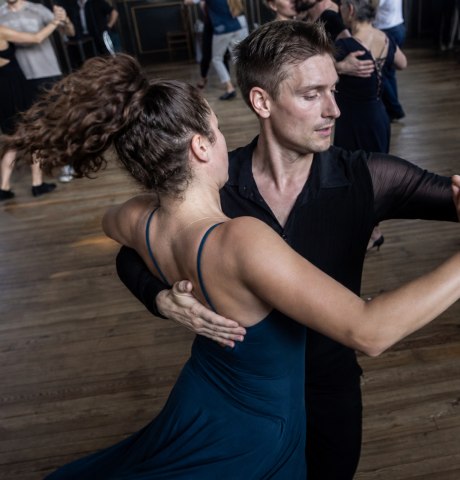
Rhythm training5 minutes

Counting the Slowfox rhythm: Understanding the timing in Slowfox

In a nutshell
  • The Foxtrot is based on a four-four time signature with a typical speed of around 28 to 30 bars per minute.
  • The basic movement pattern follows the rhythm slow-quick-quick over four beats.
  • The slow step (slow) extends over two beats, while the quick steps (quick) each last one beat.
  • The basic step in a pair is counted on the beats 1-2 (slow), 3 (quick), and 4 (quick).

Foxtrot fascinates with its flowing elegance, which is reminiscent of weightless gliding. With the right feel for the typical timing and the musical structure, this demanding ballroom dance will quickly become accessible to you too.

DefinitionSlow-Quick-Quick

Slow-Quick-Quick describes the basic rhythm structure in Slowfox. It combines one slow step over two beats with two quick steps on one beat each.

The magical structure of floating dance

Slowfox is considered by dancers to be the supreme discipline of ballroom dances. This is mainly due to its seemingly effortless, floating movement, which glides across the dance floor like a gentle stream. Yet behind this elegance lies a rhythmic structure that often poses challenges for beginners. To learn to count the Slowfox rhythm, you must first understand the musical structure. The dance is based on a classic four-four time, typically played by big bands or in a gentle jazz style. However, the special thing is not the beat itself, but how the steps are distributed across it. In contrast to the Quickstep, the tempo is significantly more sustained, which makes every single step more visible.

Anyone who develops a deep understanding of the music will also find it easier to dance. A solid foundation in recognizing the beat in ballroom dance helps you to hear the subtle nuances of the Slowfox. The music usually emphasizes the first and third beat in the measure. We use exactly this emphasis to structure our movement and build the characteristic dynamics of the dance.

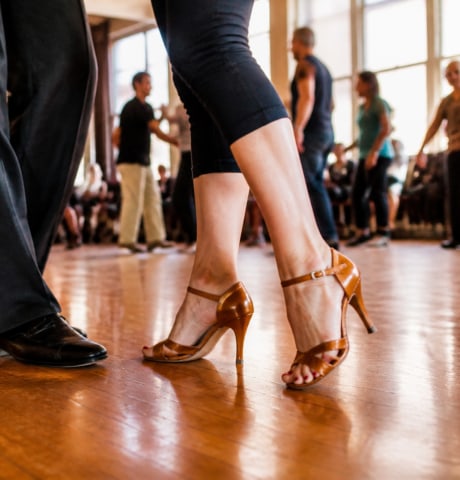
The formula for flow: internalizing Slow Quick Quick

The heart of the dance is the Slow-Quick-Quick step sequence. Translated, this simply means: one slow step, followed by two quick steps. But how does that fit into the four beats of the musical bar? This is where the secret to the correct Slowfox timing lies. The slow step (Slow) is elongated and takes up exactly two full beats of the music. The two quick steps (Quick, Quick) share the remaining two beats, meaning they each last for only one beat.

In practice, this means when counting: you take the first step on one and hold the movement through two. On three, the first quick step follows, and on four, the second quick step. The counting pattern is therefore: 1, 2 (Slow), 3 (Quick), 4 (Quick). This interplay of long gliding and precise, brisk steps creates that inimitable wave-like feeling. It is important not to simply stop the slow step, but to let the movement flow over the full two beats until the next step begins almost by itself.

The path to flawless Slowfox timing

Correct

  • Stretch the first step softly over two beats
  • Speak along out loud to solidify the rhythm
  • Keep the upper body stable and calm
  • Choose music with a clear percussion emphasis

Wrong

  • Stop abruptly after the first step
  • Rush through the fast steps in a hectic way
  • Lose your posture during fast transitions
  • Start with complex orchestral pieces

If you want to dance the Slowfox, you have to learn to enjoy the time between the steps and let your breath flow.

Dance teacher, Hamburg

From counting to gliding together on the dance floor

Once you have the beat in your ear, it is time to put it into practice as a couple. For stable timing, a good ballroom dance posture is essential, because only through a stable body frame can the delayed timing of the slow step be transmitted without errors. The leading partner must clearly signal the extension of the first step so that the following partner does not shift their weight too early.

It is best to start your first attempts without music. Count the rhythm out loud: "Slow, quick, quick" or "1-2, 3, 4". Only when the weight transfer works smoothly as a couple should you turn on a slow, classic Slowfox melody. Focus entirely on gliding together and resist the urge to become hectic. In Slowfox, calmness in movement is the key to perfection.

Two speeds in harmonious interplay

Slow

The sustained glide (slow)

Count 1 and 2 in the beat

The slow step requires conscious deceleration. You use the full two beats of the music to shift your weight softly and let your body glide through the room in a controlled manner.

Quick

The quick changes (Quick)

Count 3 and 4 in the beat

The quick steps bring dynamics to the dance. They share the remaining two beats and set a precise, rhythmic counterpoint to the previous gliding.

Frequently Asked Questions

  1. The Foxtrot is danced in a classic 4/4 time signature. The music usually emphasizes the first and third beat, which gives the couple orientation while dancing.

Standard dance courses near you

Discover courses where you can learn the Slowfox from scratch.

View all matching courses

Find your partner for the Slowfox

Here you can find like-minded people who want to decode the rhythm of the Slowfox with you and dare to take their first fluid steps on the dance floor.

Find your partner for the Slowfox