Ballroom dance technique5 minutes

Musicality in ballroom dance: More than just counting the beat

In a nutshell
  • Musicality in ballroom dancing differs from mere beat counting by actively shaping movement to match the melody.
  • Phrasing uses the natural arcs of the music to connect figures harmoniously with the tension of the piece.
  • Instead of focusing rigidly on every single beat, musical dancers react to the instrumentation, dynamics, and pauses in the music.
  • A deep understanding of the music allows for smoother leading and a more harmonious interaction within the couple.

Dancing is far more than just flawlessly executing sequences of steps. Only when you stop stubbornly counting the beats in your head does the music begin to guide your movements.

DefinitionPhrasing

Phrasing in dance refers to the conscious alignment of movements and step sequences with the musical phrases of a piece of music. A phrase is a self-contained musical unit of meaning, which in ballroom dance usually consists of eight bars.

Why counting is just the beginning

Anyone starting with ballroom dancing quickly learns to count. One, two, three for the Waltz or Slow, Quick, Quick for the Foxtrot. This mathematical approach is helpful at the beginning to roughly organize the steps. However, anyone who counts rigidly in their head often appears on the dance floor like a clockwork mechanism turning its rounds mechanically. True musicality in ballroom dancing begins exactly where pure counting ends. It is about using the music not just as a timekeeper, but actively interpreting it.

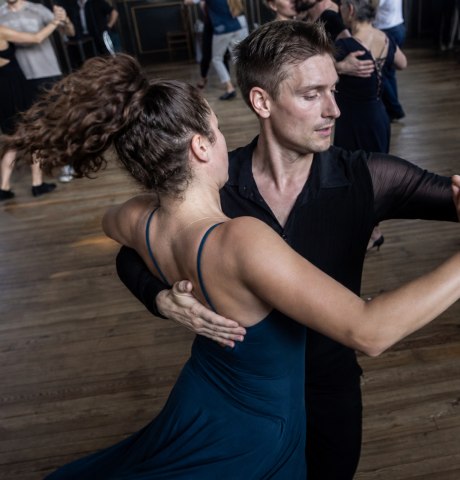
When you let go of pure beat counting, your entire presence changes. Your movements no longer appear choppy, but flow harmoniously with the melodic arcs. A gentle string entry in the Waltz then leads to a softer rise and fall, while a sudden accent in the Tango triggers a dynamic delay. This connection makes the difference between merely reeling off steps and real dancing. To reach this level, it helps to take a look at the correction of posture errors when dancing, as a stable body is the only way to sensitively transmit musical impulses.

Harnessing the power of phrasing

To truly interpret music in ballroom dancing, you have to understand its structure. Every classical dance orchestra builds its pieces in blocks, known as phrases. A phrase in ballroom dancing usually comprises eight bars. When you learn to hear these arcs, you recognize the breathing of the music. You feel when a melody gains tension, reaches its climax, and resolves again. Phrasing when dancing ballroom means adapting your figures to these musical pauses.

An experienced dancer initiates a sweeping promenade exactly when the music opens up, and finishes a turn in sync with the end of a phrase. This creates a visual unity of sound and movement. Anyone who stubbornly keeps dancing without paying attention to these arcs wastes the impact of their figures. Once you have the phrases in your ear, you no longer need to count every single step, you intuitively feel when the next change in the music is imminent.

The path from counting to dancing

Like this

  • Pay attention to the pauses and highlights of the melody
  • Adapt the dynamics of the steps to the instruments
  • Start figures at the beginning of a new phrase

Not like this

  • Stubbornly counting every single beat in your head
  • Always dancing at the same speed regardless of the music
  • Stopping abruptly in the middle of a musical phrase

Only when the body stops thinking about which number to step on, can the soul begin to translate the music.

Dance teacher, Hamburg

From hearing to feeling together

Musicality is not a purely theoretical matter, but a question of perception and fine-tuning as a couple. Instead of focusing on the drums or the bass, try directing your attention to the melodic instruments for a change. Which instrument is leading right now? Is it a soft violin or a rhythmic piano? Try to give these different characters space in your steps.

Especially as a couple, it becomes clear how important this shared listening is. The signals for a musical delay or acceleration must be transmitted without words. This only works if both dance partners perceive the music attentively and react flexibly. If you want to move safely on the dance floor and keep your orientation, knowing about the dance direction in the room will help you to focus entirely on the music without colliding with other couples.

Two ways to experience the music on the dance floor

Beat

The step on the beat

The mathematical framework in your ear

udansa uses music as a rigid framework. Every step falls exactly on the beat, regardless of the instrument's mood or the melody's dynamics.

Rhythm

Breathing with the melody

The emotional shaping of movement

You let yourself be carried by the melodic arcs. Your movements expand, slow down, or accelerate to match the character of the piece of music.

Frequently Asked Questions

  1. Musicality means translating the character, dynamics, and mood of the music into movement. Rhythm is merely the mathematical recognition of the regular beats in the background.

Standard courses near you

Find the right course to take your musicality to the next level.

View all matching courses

Find your rhythm together

On udansa you will find like-minded people who want to feel the music just as much as you do, as well as the right courses for your next step on the dance floor.

Find your rhythm together