Find your Salsa dance partner on udansa
On udansa, you will find like-minded people who keep the beat with you, as well as suitable dance courses to perfectly tune your steps to the rhythm.



By Bernhard De LucaUpdated
On udansa, you will find like-minded people who keep the beat with you, as well as suitable dance courses to perfectly tune your steps to the rhythm.
Salsa music thrives on its energy and its complex instruments. If you want to explore its true depth and feel absolutely confident while dancing, you cannot overlook one tiny, but powerful rhythm maker.
The Clave refers to both a traditional rhythm instrument made of two wooden sticks and the fundamental, two-bar rhythm pattern of Afro-Cuban music. It serves as the rhythmic skeleton that all musicians and dancers orient themselves by.
Anyone starting to learn Salsa often hears a mysterious, wooden clicking in the background of the music during their first dance classes. This rhythmic foundation is the Salsa Clave rhythm. The Clave is much more than just a simple accompaniment pattern: it is the rhythmic law to which all other instruments, the vocals, and ultimately your dance steps must submit. Without this rhythmic skeleton, complex Salsa music would break out into uncontrolled chaos.
The word "Clave" comes from Spanish and translates to "key". And that is exactly what this rhythm is: the key to understanding the entire musical genre. When you learn to consciously isolate the Clave in the music, you no longer have to laboriously orient yourself to individual instruments while dancing. You instinctively feel where the song is at and when the perfect moment for your steps has arrived.
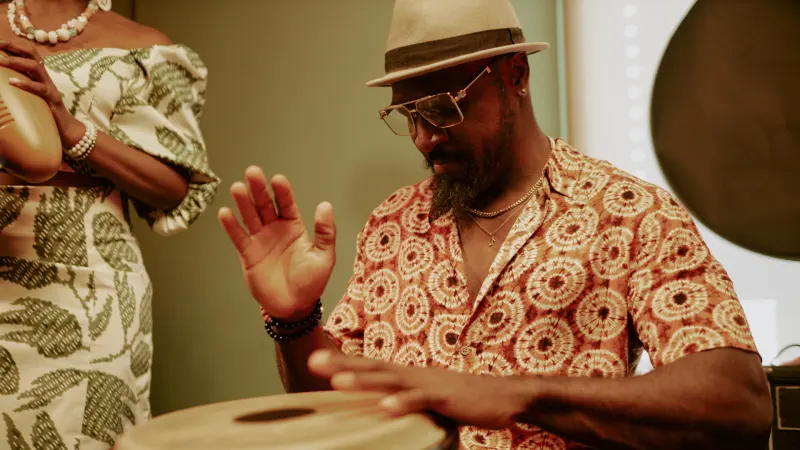
To understand the rhythm, it is worth taking a look at the Salsa clave instrument. It consists of two simple, solid wooden sticks, usually made from hardwood such as grenadilla or rosewood. One stick is placed loosely in the cupped hand, which serves as a natural resonator, while the other stick is used as a striker. Striking them together creates an extremely penetrating, bright, and dry sound that cuts through even dense big-band arrangements with ease.
Although the instrument is so minimalist, playing it requires the utmost precision. Every Salsa song is built on a two-bar phrase pattern that spans a total of eight beats. The clave rhythm explained is therefore an asymmetrical pattern that divides these eight beats into two distinct halves: one half is syncopated and tension-filled, while the other half acts as a stabilizing and resolving force. This constant interplay of tension and release creates the irresistible forward momentum of Salsa.
Listen carefully
Avoid hearing mistakes
If you don't feel the clave, you aren't dancing with the music, but only to the music. It is the invisible thread that connects us all.
In practice, you will encounter two variations of the pattern. The 3-2 clave in Salsa starts in the first measure with three beats, followed by two beats in the second measure. It feels driving, as the rhythmic tension is built up right at the beginning of the phrase. If the pattern is reversed, it is called the 2-3 clave in Salsa. Here, the phrase begins calmly with two beats, before the rhythmic intensification follows with three beats in the second measure.
For you as a dancer, it is crucial to know that a song never arbitrarily changes its clave direction throughout its entire course. A song that begins in the 3-2 structure maintains it. Once you have found your entry point, this rhythm will carry you safely through the entire piece. Conscious listening trains your ear and ensures that your movements merge organically with the music, instead of just appearing mechanically counted.
Three beats before two beats
In this variation, the song starts in the first measure with three beats and immediately builds a palpable rhythmic tension. In the second measure, the two resolving beats follow, which gives the dance a very dynamic, forward-driving character.
Two beats before three beats
This structure starts relaxed with two beats in the first measure and shifts the rhythmic density to the second measure with the three beats. For many dancers, it feels a bit more sustained and rhythmically balanced.
The clave is the rhythmic foundation of Salsa. It provides the structure that all other instruments and the dancers' steps follow to stay in time.
The clave consists of two solid wooden sticks that are struck together. They produce a very bright, piercing sound that remains clearly audible in a Salsa orchestra despite the presence of many other instruments.
The difference lies in the sequence of the beats within the two-bar pattern. The 3-2 clave begins with three beats in the first bar, while the 2-3 clave starts with two beats.
Bring your new sense of rhythm directly to the dance floor and learn Salsa in a friendly group.
Couple danceLimbach-Oberfrohna · Germany
PaartanzkreisFriday · 18:15 · Oct 23
Limbach-Oberfrohna
Couple danceLimbach-Oberfrohna · Germany
Silberkurs für PaareSunday · 16:15 · Oct 25 - Nov 15
Limbach-Oberfrohna
 Learn Salsa rhythm: Beat and music theory for dancersDo you want to learn Salsa rhythm and finally dance on beat with confidence? Our guide explains the music structure, the key instruments, and how to find the beat effortlessly.
 The 6 essential Salsa instruments and their rhythmsLearn how the six essential Salsa instruments work together and how they guide your steps on the dance floor. The ultimate guide for better musicality.
 Salsa Rhythm Test: Do you have the beat in your blood?Take the big salsa rhythm test and find out how well you can hear the Latin beat. Perfect for all beginners!
 Mastering Salsa rhythm: 5 practical solo exercisesMaster Salsa rhythm without a partner: With these five practical solo exercises, you can playfully improve your timing at home and in your daily life.
 Salsa Song Structure: Understanding the MusicWhen you understand Salsa song structure, you stop just doing steps and start merging with the music. Learn how verses, montunos, and mambo sections influence your dance.
 Dancing Latin Jazz: Focus on rhythmic nuancesLatin Jazz challenges dancers with complex syncopations and improvised solos. Learn how to understand these rhythmic nuances and bring them to the dance floor with elegance.
 Modern Salsa Music Trends: New Rhythms for the Dance FloorSalsa music is evolving rapidly and merging with electronic beats. We show you which new rhythms are taking over the dance floors in 2026 and how to dance to them.