
Experience the magic of connection
On udansa connect, you meet like-minded people in your area who share a passion for the non-verbal language of Salsa. Find your perfect dance partner for the next social dance now.



By Bernhard De LucaUpdated
On udansa connect, you meet like-minded people in your area who share a passion for the non-verbal language of Salsa. Find your perfect dance partner for the next social dance now.
Salsa is a conversation without words, where the body forms the sentences and the eyes set the accents. Learn how you can build a deep connection with your dance partner through conscious non-verbal signals.
Salsa non-verbal communication refers to the exchange of signals through body language, posture, weight distribution, and eye contact while dancing. It allows the dance couple to improvise harmoniously and coordinate their movements without spoken words.
Salsa is far more than just reeling off learned step sequences on the dance floor. The true magic happens in the moment of improvisation, carried by a subtle, non-verbal understanding between lead and follow. While technical signals via the hands and body contact indicate the direction, non-verbal Salsa communication forms the emotional foundation. It determines whether a dance feels mechanical or becomes a harmonious dialogue.
This silent language is based on mutual attention and fine nuances. A slight tilt of the upper body, the gentle increase of body tension, or a short pause in the rhythm transmit information in fractions of a second. Anyone who learns to pay attention to these signals experiences a completely new dimension of dancing. The movement becomes fluid because both partners no longer think about the next step, but feel it together in the flow of the music.
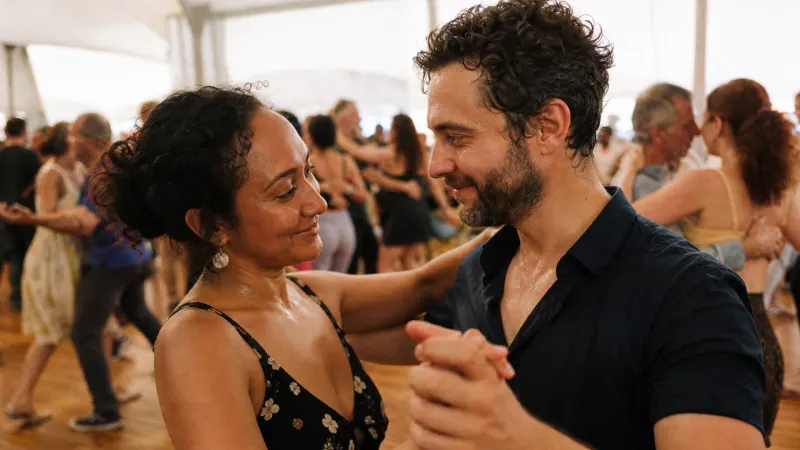
Intense Salsa eye contact is often misunderstood by beginners. Some fear that looking at their partner is automatically interpreted as romantic interest or an attempt to flirt. However, in social dancing, there is a clear distinction between flirting or dancing Salsa: The gaze is primarily a tool for orientation, safety, and respect. It signals to the other person: I am fully present with you and I acknowledge you.
Anyone who avoids eye contact completely and instead stares intensely at their feet or into space signals disinterest or extreme insecurity. This makes it difficult for the partner to build a real connection. A friendly, open gaze creates trust and eases tension. It is an invitation to play with the music together, without the need to derive personal intentions from it.
Correct
Wrong
The most beautiful connection in Salsa is not created by the most complex move, but by the intuitive understanding in the moment of eye contact.
To be able to dance a deep Salsa connection, you need a sensitive balance in the space. Non-verbal communication only works if both partners meet as equals. This also means respecting each other's boundaries. Too much closeness can feel intrusive, while too much distance causes the connection to break.
Body language sends continuous feedback. A slight withdrawal by your partner is a clear signal to widen the dance frame a little. A smile, on the other hand, signals joy and relaxation. Anyone who reads these subtle signs and adjusts their own dancing accordingly will quickly become a valued partner at any social. This is how communication during social dance becomes a harmonious interaction that works entirely without words and conveys pure joy of living.
Building connection and presence
Use eye contact to maintain the connection with your partner, signal security in the room, and share the mutual joy of the music.
Sending and receiving signals precisely
Pay attention to the subtle signals in your core and hands to transmit changes in direction and rhythm fluidly and without any effort.
Eye contact in Salsa signals attention, respect, and presence. It helps to anticipate the partner's movements, provides security during turns, and ensures harmonious coordination on the dance floor.
No, in social dance, eye contact is primarily a sporty and respectful tool for connection. It expresses the joy of dancing together and should not automatically be misunderstood as a romantic advance.
Look at your partner in a friendly and relaxed way, focusing on their eyes or the area of their forehead and face. Avoid staring fixedly, but also do not constantly look at the floor or past your partner, as this can seem insecure or disinterested.
A good dance connection is characterized by pleasant body tension, where both partners react to each other's weight shifts. The arms remain flexible but stable so that signals are transmitted directly.
Find the right course and learn the art of non-verbal connection from scratch.
 Salsa Party Guide: Your first social danceIs your first salsa party coming up? Don't worry: our compact guide explains the exact flow of a salsa social from the very first minute.
 Salsa parties and socials: Etiquette, scene, and your first nightsSalsa social dance is your key to the global community. With our guide to etiquette and parties, you will feel right at home on any dance floor.
 First lead signals in Salsa: Creating connectionDiscover the physical and anatomical foundations of tension and compression in Salsa leading. Learn how to build a perfect connection with your partner.Salsa parties and socials: Etiquette, scene, and your first nightsSalsa social dance is your key to the global community. With our guide to etiquette and parties, you will feel right at home on any dance floor.
 Salsa with mixed levels: Fun for both partnersHow do you dance Salsa when partners have different skill levels? Learn how beginners and advanced dancers can have fun together at socials.Salsa Party Guide: Your first social danceIs your first salsa party coming up? Don't worry: our compact guide explains the exact flow of a salsa social from the very first minute.
 Salsa Floor Etiquette: Navigating Social Dancing SafelyWith the right Salsa floor etiquette, you can master any social dance with confidence. Learn the unwritten rules that keep you and others safe from injury.
 Salsa Event Quiz: What kind of partygoer are you?Find out which salsa event type suits you best with our quick self-test. This way, you will always make the right choice for your level and preferences.
 Salsa Congress for beginners: How to master your first festivalIs your first Salsa festival coming up? Our guide shows you how a Salsa Congress works, how to choose the best workshops, and how to feel confident on the dance floor.
 Salsa Community Trends: How socials are changing globallyThe global salsa scene is evolving. Learn all about the latest salsa community trends and how modern socials are breaking down barriers.