Historical dance5 minutes

Historical dance partner wanted: Baroque to vintage

In a nutshell
  • A historical dance partner shares a passion for dances from the Baroque period to the 19th century, clearly distinguishing themselves from modern ballroom dancing.
  • The search requires a focus on specialized clubs, historical balls, and online platforms with precise filter options for niche styles.
  • Beyond the steps, an understanding of historical music, the etiquette of the respective era, and often the wearing of historical costumes play a central role.
  • If you are searching specifically, you should state the desired era, such as the Renaissance, Baroque, or the Victorian age, directly in your profile on udansa.

The fascination of past eras is best experienced as a couple. However, anyone looking for historical steps beyond Discofox and Viennese Waltz needs patience and the right compass for the niche.

Definition
Historical Dance

Historical dance encompasses the reconstruction and performance of social dances from past eras, ranging from the Middle Ages, the Renaissance, and the Baroque period to the early 20th century. These dances are mostly based on contemporary records and dance manuals.

What makes the search for a historical dance partner so special

If you are passionate about historical dances, you will often search in vain at conventional dance schools. Whether it is the magnificent Baroque dance of the 17th century, the courtly Renaissance, or the lively vintage dances of the 19th century like the quadrille and the early Waltz: these disciplines differ fundamentally from modern ballroom dancing. Being searched for as a historical dance partner or looking for one yourself therefore requires a completely different approach than searching for someone for standard or Latin dances. It is not about athletic peak performance in the modern sense, but about the shared experience of history, culture, and the aesthetics of the era.

The biggest hurdle is usually finding people with the same niche interest at all. While Salsa and Discofox courses are offered on every corner, historical dance circles are few and far between. If you want to find a dance partner by dance style who is enthusiastic about historical reconstructions, you have to search specifically in forums, at reenactment clubs, or on specialized platforms. Enthusiasts often travel across the country for a single historical weekend, which is why flexibility and a willingness to travel play a major role in this search.

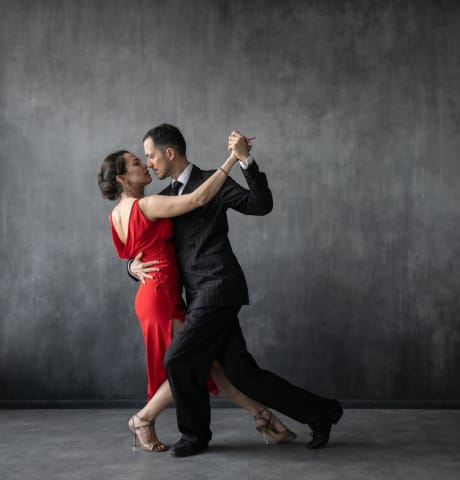
The magnificent backdrop of a historic ballroom calls for steps that are in harmony with the etiquette of that time.

Misunderstandings between modern and historical dance

In modern partner dance, clear, often standardized step sequences and very close physical leading dominate. Historical dances, on the other hand, are often based on group choreographies, line formations (contredanse), or fixed ceremonies where the partner changes constantly, even though you start as a pair. A typical mistake when looking for a vintage dance partner is to apply the requirements of modern competitive dance. In a historical context, it is much more about a deep understanding of the music of the respective era, a sense of rhythm, and the precise adherence to spatial paths.

In addition, historical attire plays a crucial role. The range of movement in a corset and hoop skirt from the Baroque period or in the heavy tailcoat of the 19th century is completely different from that in modern training clothes. Anyone who wants to find a dance partner in your city should therefore clarify early on whether the interest in historical clothing and its reconstruction is also shared. Often, the best dance partnerships arise directly in tailoring circles or at historical associations that offer dance rehearsals as part of their living history presentation.

The path to the right dance partner for historical eras

Searching correctly

  • Filter specifically for eras like Baroque or Rococo
  • Openly address your willingness to wear historical costumes
  • Use specialized historical balls and clubs
  • Get involved in complex group choreographies

Common mistakes

  • Searching for standard and Latin dance skills
  • Expecting modern dance schools to offer these styles
  • Focusing only on modern partner dance leading
  • Neglecting historical etiquette and floorcraft
udansa tip

Visit historical dance workshops even without a partner. Since many dances from these eras are performed in groups or with partner changes anyway, you will find it easiest to connect with others on site.

Historical dance is like a living time machine. You don't just share steps, you bring the culture and the spirit of a completely different era to life together.

Leader of a historical dance ensemble, Berlin

How to find the right partner for your era

The search for a baroque dance partner or a companion for 19th-century vintage balls also differs in terms of etiquette. Many historical dances thrive on a refined, distant elegance, where courtly ceremony takes center stage. Those who get involved here quickly realize that respect and the joint practice of complex figure dances require a high level of concentration. It is advisable to familiarize yourself with the basics of the respective era beforehand, so you can harmonize right away during your first joint rehearsal.

To successfully find a historical dance partner, you should specify exactly which eras fascinate you in your profile on udansa. Are you looking for the mathematical precision of the Baroque, the playful lightness of the Rococo, or the lively waltzes and polkas of the Victorian era? The more precisely you describe your preferences and your willingness to wear costumes, the greater the chance that you will meet someone who wants to bring exactly the same era to life.

Two eras in dance comparison

Baroque dance

Courtly elegance in the Baroque era

The era of symmetry and court ceremony

Here, the focus is on precise geometry, courtly etiquette, and dancing in harmony with live Baroque music. Perfect for lovers of symmetry, refined gestures, and historical costumes from the 17th and 18th centuries.

Vintage dance

Vibrant salon balls

The glamour of the 19th century and salon balls

The 19th-century era brings vibrant spinning dances, opulent quadrilles, and the fast-paced Waltz. Ideal for everyone who wants to experience lively group dynamics, grand ballrooms, and the romance of the imperial era.

Frequently Asked Questions

  1. A historical dance partner specifically looks for dances from past centuries, such as Baroque or Renaissance. Standard dancers, on the other hand, focus on the modern world dance program and competitive sports of the 20th and 21st centuries.

Historical dance events near you

Find the best balls, workshops, and historical dance circles for your next journey through time.

View all matching events
udansa community

The next journey through time begins together

On udansa you meet like-minded people who share your passion for historical dances and want to dive into past eras together with you. Simply create your profile and find the perfect companion for the next journey through time on the dance floor.

Sources

Empirical values from the German reenactment and vintage dance scene, as well as guidelines from historical dance associations, as of August 2026.