Dancing together without limits
On udansa you will meet an open community that celebrates diversity. Find the exact people who share your passion and want to explore new paths on the dance floor with you.


By Mary De LucaUpdated
On udansa you will meet an open community that celebrates diversity. Find the exact people who share your passion and want to explore new paths on the dance floor with you.
Dancing connects people across all perceived boundaries. If you want to dance outside of classic gender roles, you will find vibrant communities today that actively live diversity, inclusion, and creative freedom on the dance floor.
Equality dance partners refers to dance couples where the assignment of the leader and follower role is independent of biological gender. Often, the role of the leader and follower is switched dynamically while dancing.
Traditional dance schools still often divide couples strictly according to the binary principle: gentleman leads, lady follows. However, the reality on dance floors has long since become more colorful and diverse. Whether in equality dancing, in a queer context, or dancing together in a wheelchair: it is not about who has which gender or what physical requirements they bring, but about the shared experience of rhythm and movement. Anyone who wants to specifically find a queer dance partner or is looking for dance partners for students is consciously breaking down gender roles and creating space for new, creative dynamics.
Especially in the queer scene and in equality dance sports, the concept of Lead & Follow: partner dance as teamwork is being completely redefined. Here, the dancers decide for themselves who takes the lead or whether roles are switched flexibly during the dance. This openness attracts more and more people who want to free themselves from the rigid corset of traditional role distributions.

The search for the right partner differs greatly depending on your stage of life and individual needs. While the topic of equality dance partners is primarily about an open attitude towards gender-neutral leading roles, the search for a dance partner for students often focuses on flexible times and affordable courses. Students like to network directly on campus or through student initiatives to easily find like-minded people for university sports.
The search for a dance partner for children or for people in wheelchairs places completely different demands on the process. For children, the focus is on the playful aspect and coordination, often organized through schools or sports clubs. In wheelchair dance, also known as Wheelchair Dance, a high level of mutual understanding and technical coordination is required. Here, either two wheelchair users dance together (duo dance) or a standing person dances with a wheelchair user (combi dance), which enables completely new, fascinating forms of movement.
Correct
Wrong
On the dance floor, it is not about conventions, but about the connection between two people. Anyone who frees themselves from rigid roles experiences dancing in a completely new way.
If you are looking for like-minded people outside of the classic partner dance search, it is best to use udansa and targeted networks. Instead of asking around at random in a traditional dance school, it is worth taking a look at queer sports clubs, student forums, or community platforms like udansa. Here, you can specify directly in your profile which role you would like to dance and whether you are specifically looking for like-minded people for equality tournaments, inclusive dance, or student courses.
An important step is to communicate your own wishes clearly from the start. If you are a wheelchair user looking for a dance partner in a wheelchair, or if you are a student and only have time in the evenings, this openness saves a lot of time during your search. The modern dance scene is characterized by enormous helpfulness and openness, meaning that the right community exists for every need and every level.
Leading roles redefined
In equality dance, traditional gender roles play no part. Same-sex or mixed-gender couples share the leading role flexibly and set entirely new creative accents.
Breaking down barriers together
In wheelchair dancing, wheels and steps combine into a fluid unit. Whether as a duo or in a combi-pair with standing partners: movement in space is interpreted in a completely new and dynamic way.
The best way to find queer dance partners is through queer sports clubs, specialized dance schools with equality courses, or online platforms like udansa, where you can specify your preferences directly in your profile.
Equality dancing refers to partner dance where traditional gender roles are removed. Same-sex couples or couples who flexibly switch leading roles dance together on equal terms.
The best way is to use your university's bulletin boards, your student council's social media groups, or sign up directly for university sports lists to find other dance-enthusiastic students.
Yes, in so-called combi-dance, a person without a wheelchair dances together with a partner in a wheelchair. Specialized wheelchair dance groups offer the perfect environment and techniques for this.
For children, children's sports clubs, dance schools with creative dance programs for kids, or school clubs where the focus is on the fun of moving in a group are ideal.
Find the right course and start your new dance adventure with the perfect partner.
Dance for Kids and TeensLimbach-Oberfrohna · Germany
Kinderkurs 5-7 JahreThursday · 16:45 · Oct 8
Limbach-Oberfrohna
Creative Dance for Kids (from age 3)Berlin · Germany
Kreativer Kindertanz 3-5 J.Thursday · 17:20 · Oct 8
Famox
Creative Dance for Kids (from age 3)Berlin · Germany
Kreativer Kindertanz 3-5 J.Thursday · 17:30 · Oct 8
Park Studio
 Dance partners for students: Easy access to danceThe easy way to get into dancing during your studies: How students use university sports, campus groups, and apps to find the perfect dance partner their own age.
 Dancing for the blind and visually impaired: find a partnerDancing without barriers: learn how dancing works for the blind and visually impaired and how you can find the right partner for an intense dance experience.
 Find a wheelchair dance partner: step by step in combi danceAre you looking for a partner for combi dance in a wheelchair? This guide shows you how wheelchair users and standing dancers can successfully connect and train in harmony.
 Lead or Follow: Which dance partner role suits you?Find out whether you prefer to lead, follow, or use both roles flexibly in switch dancing. Our self-test helps you find your way.
 Neurodivergent dancing: Finding the right partnerNeurodivergent dancing requires understanding and the right environment. Learn how to find a suitable dance partner for ADHD or the autism spectrum.
 Gender-neutral dancing: find partners without clichésDiscover how gender-neutral dancing is revolutionizing the traditional search for partners and giving you new freedom on the dance floor.
 Find a dance partner for students: Ready for the promAre you still looking for a dance partner for your first student dance class or the big prom? This guide shows teenagers between 13 and 17 the safe way to dance success together.
 Dancing while deaf: 5 ways to find the perfect dance partnerDancing while deaf or hard of hearing requires a keen sense for visual cues and physical vibrations. Discover the best resources and platforms to find your perfect dance partner.
 Dance partners aged 18 to 30: How to conquer the young dance sceneAre you looking for a dance partner between 18 and 30? Our guide shows you how and where to find the young social dance scene beyond stiff dance classes.
 Dance partners for single parents: Dancing despite a busy scheduleThis guide shows single parents how to find the right dance partner and enjoy flexible dancing, despite time constraints and childcare responsibilities.
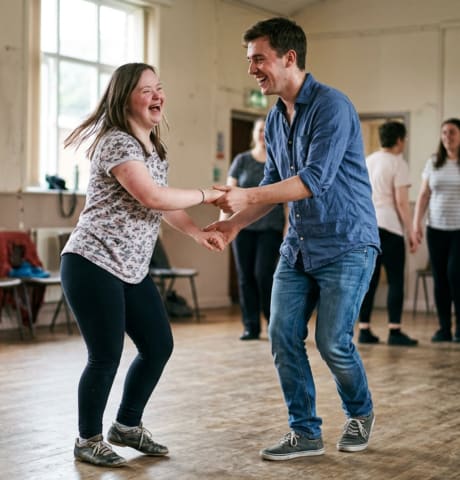 Inclusive dance: 5 real places to find a dance partnerDancing connects us without words. Discover recommended, real-world contact points and inclusive dance groups that warmly welcome people with intellectual disabilities.