
Find your dance partner on udansa
Create your free profile and find dance enthusiasts in your area who share your passion and with whom you can coordinate using visual signals or gestures.


By Bernhard De LucaUpdated
Dancing is a universal language that works entirely without sound. With the right networks, visual communication, and the right feel for vibrations, you will easily find the perfect partner for the dance floor.
Real and active networks
All presented platforms and associations offer verified, real opportunities for the deaf community.
Free accessibility
The presented methods are based on active participation and accessibility without commercial agency fees.
Focus on non-verbal communication
Options have been specifically chosen to focus on visual communication and sensing vibrations.

Active nationwide all year round, hundreds of members
The German Deaf Sports Association offers its own sections for deaf sports and dance groups through its regional clubs. Here you can specifically meet like-minded people who use sign language.
Regional in major cities, monthly events, changing dance styles
In large cities, deaf centers and cultural associations organize regular meetings, cultural evenings, and dance events. This is the ideal place to find a hard of hearing dance partner in a relaxed environment.
Online, available anytime, Europe-wide reach
Special Facebook groups and forums that focus on the topic of deafness and hobbies offer a quick way to post a search ad for a deaf dance partner on udansa.
Selected cities, temporary courses, for all levels
Inclusive dance schools and special workshops for the deaf offer trial courses. Here, the focus is on experiencing rhythm together through vibrations and visual cues.
Global, new registrations daily, individual profiles
On udansa, you can specifically state in your profile that you are looking for a dance partner who knows sign language or has experience with visual and physical leading in dance.
Create your free profile and find dance enthusiasts in your area who share your passion and with whom you can coordinate using visual signals or gestures.
When dancing as a couple without hearing, perception shifts completely from the ear to the body and the eyes. While hearing couples often rely blindly on acoustic signals, deaf dancers use precise eye contact, body tension, and the subtle vibrations of the floor. A strong sprung wooden floor transmits the low frequencies of the music directly to the feet, which works excellently, especially with rhythmic styles like Kizomba or Salsa. If you are a hearing dance partner dancing with a deaf person, you quickly learn that leading happens not through words, but through clear physical impulses and visual orientation. This intensive form of shared feeling creates a deep dance connection that is often far more precise than simply dancing by ear.
Deaf dancers perceive music primarily through the vibrations of the bass, which are transmitted to the body via the floor and the air. An elastic wooden sprung floor is particularly well-suited for this.
Communication takes place via German Sign Language (DGS), visual hand signals, facial expressions, and clear physical cues. Before dancing, the couple often agrees on simple signals for start, stop, or changes in direction.
In principle, every dance style is suitable. However, rhythmic dances with a strong bass such as Salsa, Bachata, or Kizomba are particularly popular, as the vibrations can be felt physically with ease.
Find the right course and try out new dance styles right away.
Couple danceLimbach-Oberfrohna · Germany
PaartanzkreisMonday · 19:30 · Oct 12
Limbach-Oberfrohna
Couple danceLimbach-Oberfrohna · Germany
PaartanzkreisFriday · 18:15 · Oct 23
Limbach-Oberfrohna
 Find a wheelchair dance partner: step by step in combi danceAre you looking for a partner for combi dance in a wheelchair? This guide shows you how wheelchair users and standing dancers can successfully connect and train in harmony.
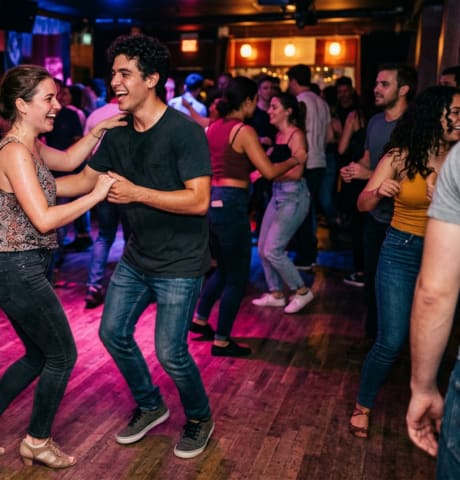 Dance partners for students: Easy access to danceThe easy way to get into dancing during your studies: How students use university sports, campus groups, and apps to find the perfect dance partner their own age.
 Find dance partners for any groupWhether for children, students, or those with special needs: find the perfect dance partner for your group and get started.
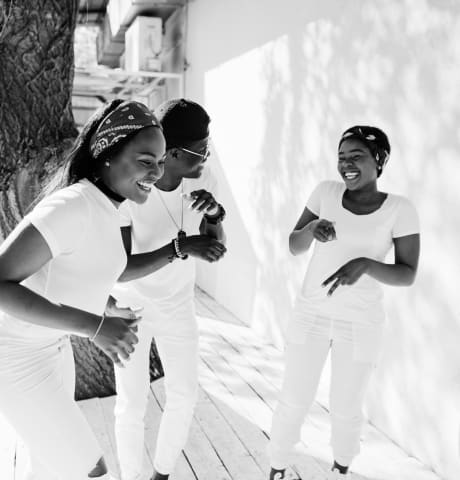 Dance partners aged 18 to 30: How to conquer the young dance sceneAre you looking for a dance partner between 18 and 30? Our guide shows you how and where to find the young social dance scene beyond stiff dance classes.
 Dance partners for single parents: Dancing despite a busy scheduleThis guide shows single parents how to find the right dance partner and enjoy flexible dancing, despite time constraints and childcare responsibilities.
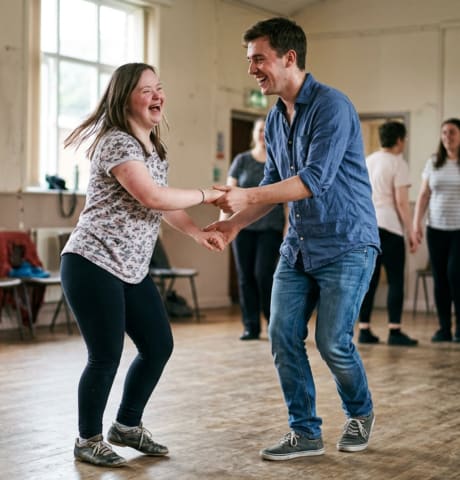 Inclusive dance: 5 real places to find a dance partnerDancing connects us without words. Discover recommended, real-world contact points and inclusive dance groups that warmly welcome people with intellectual disabilities.Dance partners for students: Easy access to danceThe easy way to get into dancing during your studies: How students use university sports, campus groups, and apps to find the perfect dance partner their own age.
 Dancing for the blind and visually impaired: find a partnerDancing without barriers: learn how dancing works for the blind and visually impaired and how you can find the right partner for an intense dance experience.Find a wheelchair dance partner: step by step in combi danceAre you looking for a partner for combi dance in a wheelchair? This guide shows you how wheelchair users and standing dancers can successfully connect and train in harmony.