
Find your dance community with udansa
On udansa you will find like-minded people who share your passion for rhythm and movement. Discover dance partners and courses near you to experience the magic of dance together.



By Bernhard De LucaUpdated
On udansa you will find like-minded people who share your passion for rhythm and movement. Discover dance partners and courses near you to experience the magic of dance together.
Behind the infectious energy of Mambo lies a centuries-old spiritual power. Its steps and rhythms are not mere show effects, but the legacy of sacred rituals and African cosmologies.
Afro-Cuban roots in Mambo describe the direct influence of West and Central African music and dance traditions on the development of this Cuban style. They encompass both spiritual chants and complex polyrhythmic drum patterns.
To understand the origins of Mambo, we must look far beyond the glittering stages of the New York big bands. The true cradle of this dance lies in the spiritual traditions of enslaved people from West and Central Africa, who preserved their culture in Cuba under extreme conditions. In particular, the Yoruba and the Bantu peoples brought a deep understanding of rhythm and movement that was inextricably linked to their religion and cosmology. At the center of these traditions is communication with the ancestors and the Orishas, the deities of Yoruba mythology.
This connection between faith and movement fundamentally distinguishes Mambo from purely secular social dances. Originally, every movement and every drumbeat had a sacred meaning. As these religious practices blended with Spanish influences over the centuries, a rich syncretic heritage emerged that forever shaped the musical DNA of Cuba. Anyone dancing Mambo today is moving to patterns that once served as a direct bridge to the spiritual world.
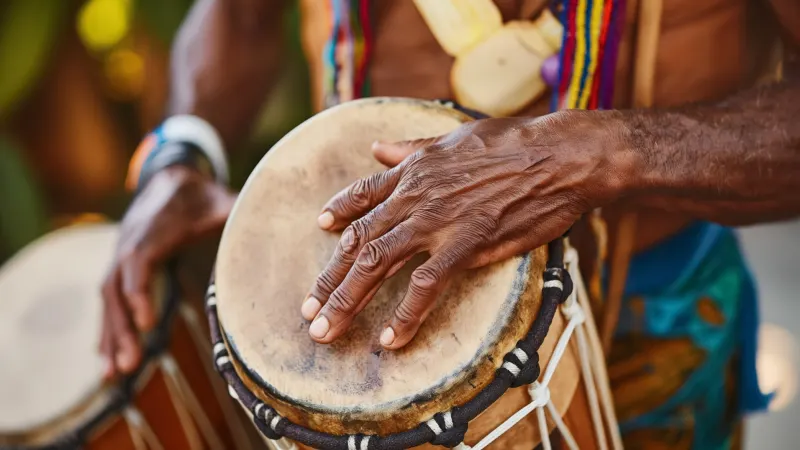
A crucial building block for the rhythmic complexity of Mambo are the ritual drums of Cuba, above all the sacred Batá drums of the Yoruba religion Santería. These hourglass-shaped, double-headed instruments are always played in a trio and speak their own complex language. The musicians imitate the tonal structure of the Yoruba language with the drums, so that the drum literally speaks to the deities. The rhythmic patterns that arise through this polyrhythmic layering challenge the entire body of the dancers.
The Bantu influence on dance, in turn, is particularly evident in the earth-bound movements of the Palo cult and the Yuka dance. While European dances often require an upright, rigid posture, the Afro-Cuban original forms are characterized by a deep bend in the knees, flexible hip work, and a direct connection to the ground. This physical grounding and the rhythmic independence of different body parts from one another flowed directly into the aesthetics of Mambo and gave it its unmistakable, pulsating dynamic.
Correct
Misconceptions and myths
Mambo is not a product of chance, but the loud echo of African gods who found a new language on Cuban soil.
The term Mambo itself is likely derived from the Congo-Bantu language, where it means something like conversation, word, or even sacred act. In ritual ceremonies, the Mambo designated the moment when priests or singers entered into a spiritual dialogue with the community and the forces of nature. When musicians in Havana in the 1930s and 1940s began to infuse traditional Cuban musical forms with these ritual rhythms, they were searching for this ecstatic energy.
They wanted to give dancers the opportunity to lose themselves completely in the rhythm. If you would like to learn more about the historical development of musical styles, it is worth taking a look at the Mambo history. Even though modern partner dance is taught in dance schools worldwide today, the core of Mambo remains deeply spiritual. It is the attempt to experience a collective trance and liberation through total surrender to the rhythm, which draws its power directly from its African roots.
The pantheon of Santería
The Yoruba tradition brings the highly complex, speaking Batá drums and the dialogue with the Orisha deities into Cuban music. Each rhythmic pattern is assigned to a specific spiritual force and demands precise, expressive movements.
The earthy power of the Congo
The Bantu traditions from the Congo Basin primarily shape the physical dynamics. With earth-bound steps, swirling hip work, and the ritual ecstasy of the Palo cult, they brought raw, vital energy into Mambo.
Yoruba rhythms brought polyrhythm and the structure of spiritual dialogue to Cuban music. Each drum voice has a fixed function, which established the rhythmic complexity of Mambo.
The Bantu influence is primarily visible in the deep, earth-bound posture, the flexibility of the pelvis, and the isolated movements of the upper body. This style of dance differs significantly from upright European standards.
The sacred Batá drums of Santería were traditionally used to communicate with the Orishas. Their complex, layered rhythms were later transferred to secular instruments like the congas and shaped the Mambo sound.
To understand Mambo as spiritual means to see the dance as a form of trance and collective liberation. The rhythmic repetition and physical exertion connect directly to the ecstasy of African rituals.
Find the right dance course on udansa now and feel the energy of Afro-Cuban rhythms for yourself.
Couple danceLimbach-Oberfrohna · Germany
PaartanzkreisFriday · 18:15 · Oct 23
Limbach-Oberfrohna
BallroomMeißen · Germany
Tanzkreis | PROFESSIONALTuesday · 20:15 · Oct 27, 2026 - Jan 5, 2027
“Ein Haus für Vieles” - Saal Tanzkurse
 Mambo history: The fiery rhythm and its rootsDive into the fascinating history of Mambo: Learn how Afro-Cuban rhythms and New York big bands created one of the most exciting dance styles of all time.
 Mambo in Mexican Cinema: The Golden Era of RumberasDive into the golden age of Mexican cinema, where Mambo became world-famous thanks to the Rumberas and Pérez Prado.
 Classic Mambo Albums: Milestones in Music HistoryDive into the golden era of Mambo. We present the historical classic albums that defined the sound of an entire generation.
 Voice and Rhythm: The Role of Vocals in MamboDiscover the fascinating evolution of vocals in Mambo, from short rhythmic calls to the high art of the sonero's improvisation.
 The origins of Mambo: How it all began in CubaThe origins of Mambo lie in 1930s Havana. Discover how the fusion of Danzón and Afro-Cuban rhythms changed the music world forever.
 The Palladium Ballroom: Heartbeat of the Mambo EraThe Palladium Ballroom in New York was the epicenter of the Mambo era. Learn how this legendary club revolutionized the dance world and broke down barriers.
 The Three Mambo Kings: Prado, Puente, and RodriguezGet to know the three Mambo Kings who sparked a global dance revolution in the fifties with their distinctive big band rhythms.