
Share your passion for Mambo
Find like-minded people who share your passion for historical and Latin rhythms. On udansa, you will meet dance enthusiasts in your area for shared courses and unforgettable socials.


By Mary De LucaUpdated
Find like-minded people who share your passion for historical and Latin rhythms. On udansa, you will meet dance enthusiasts in your area for shared courses and unforgettable socials.
Mambo is much more than just a fast dance: It is the explosive result of a fusion of Afro-Cuban drum rituals and American big band jazz, which took the world by storm in the 1950s.
The clave is the fundamental rhythmic pattern of Afro-Cuban music, which consists of two bars and serves as a temporal framework for all instruments and dance steps.
The Mambo history begins in Cuba in the late 1930s as a fascinating musical revolution. Its roots lie deep in the Danzón, the traditional social dance of the Cuban upper class. However, young, innovative musicians found the rigid structures of the Danzón too restrictive. They began to mix classic arrangements with elements of Son Cubano and to emphasize the rhythm section drastically. The actual driving force behind this new sound was powerful Afro-Cuban rhythms, which were inspired by ritual drumming and gave the dance a completely new, energetic dimension. This musical evolution broke with old conventions and laid the foundation for a global phenomenon.
A decisive turning point for the Mambo origin was the year 1938, when the brothers Orestes and Israel “Cachao” López composed the piece “Mambo”. They incorporated a syncopated, highly improvised final section into the Danzón, which they referred to as Mambo, which in the language of the Congo-Bantu means something like “conversation with the gods” or “sacred act”. This new rhythmic freedom spread rapidly. Anyone who wants to understand the roots of modern dances today sees Mambo as the direct precursor. Similar to the disco history of music, early Mambo also stood for social liberation and the breaking of musical boundaries on the dance floor.

Although the roots were in Cuba, it was one man who globalized the sound and made it danceable: Perez Prado. The brilliant musician and bandleader simplified complex Afro-Cuban polyrhythms, paired them with the powerful sound of North American big band brass sections, and invented the unmistakable Mambo shout. Through his catchy compositions like Mambo No. 5, Prado ignited a worldwide fever from Mexico in the late 1940s that soon reached the metropolises of the USA.
The absolute epicenter of this hype became New York, more precisely the legendary Palladium Ballroom on Broadway. Here, Puerto Rican, Cuban, Jewish, and African American dancers met. In the Palladium Ballroom, the Mambo was shaped from a pure musical style into a highly developed partner dance. Famous dancers created those rapid step combinations there that captivated the audience. This era left a lasting mark on music history and shows parallels to other epochs in which dance styles developed from pure social dance into complex forms, as the history of ballroom dances impressively documents.
Understanding correctly
Misconceptions
Mambo is not just a beat, it is a state of ecstatic musical feeling where the drums speak directly to the dancer's body.
What makes Mambo music so unique and captivating is its highly complex, multi-layered structure. At the heart of the action is the clave, a fundamental rhythmic pattern that serves as an invisible metronome for all musicians and dancers. Without the clave, the entire rhythmic fabric collapses. Above this foundation, a dense web of polyrhythms unfolds, created by very specific Mambo instruments.
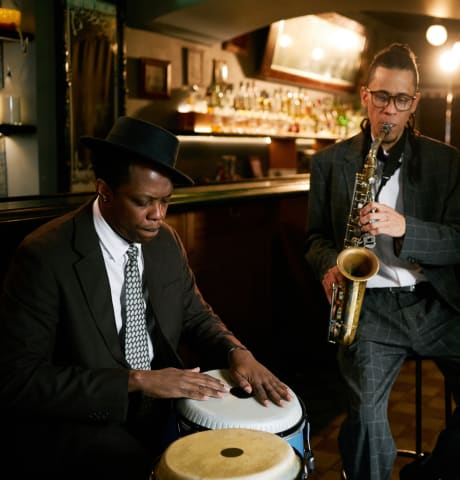
Among the most important percussion instruments are the congas, which generate deep pressure, the bongos for bright accents, and the timbales, which are played with cascading strokes. The campana, a heavy cowbell, further drives the rhythm in the chorus section. Added to this are driving bass lines and the typical, almost aggressive brass sections of the trumpets and trombones. This interplay requires an excellent rhythmic ear. Those who understand these structures learn to feel the music in a whole new way. The principle is similar to other rhythmically demanding dances: only those who have the basic beat in their blood can move freely, which also proves to be the key to success when listening to the Cha-Cha-Cha beat, for example.
The rhythmic cradle of Mambo
The original form emerged in Cuba through the breaking up of rigid structures. It is characterized by earthy, complex polyrhythms and a deep rooting in Afro-Cuban traditions, where the drums take on the spiritual lead.
The birthplace of the global hype
In the clubs of Manhattan, the music merged with jazzy big band brass. Here, Mambo developed into a fast-paced show dance, which was shaped by urban influences and the mixing of different cultures at the Palladium Ballroom.
The term Mambo comes from the Kongo-Bantu language and translates roughly to conversation with the gods or sacred act. In Cuba, it eventually became the name for a new, wild style of music.
Perez Prado is considered the king of Mambo because he crossed the traditional Cuban sound with elements of American jazz. With his catchy big-band arrangements, he made the dance world-famous starting in 1949.
The most important difference lies in the rhythm and the tempo. While Mambo is extremely fast, heavily syncopated, and jazzy, Cha-Cha-Cha developed shortly thereafter as a slower, rhythmically simplified variation for a broader audience.
Discover the captivating rhythm and learn the steps at a dance school in your region.
Couple danceLimbach-Oberfrohna · Germany
PaartanzkreisFriday · 18:15 · Oct 23
Limbach-Oberfrohna
BallroomMeißen · Germany
Tanzkreis | PROFESSIONALTuesday · 20:15 · Oct 27, 2026 - Jan 5, 2027
“Ein Haus für Vieles” - Saal Tanzkurse
 The Disco History of Music: Liberation on the Dance FloorThe disco era of the 1970s was much more than just glitter: it was a musical and social revolution that began on the dance floors of the New York underground.
 History of Ballroom Dance: From Salon to SportEmbark on a fascinating journey through time and discover how classic ballroom dances found their elegant form during industrialization and through English pioneers.
 Hearing the Cha-Cha-Cha beat: How to master the chasse timingIf you can hear the Cha-Cha-Cha beat correctly, you will dance the chasse on 4-and-1 with absolute ease. This guide shows you how to recognize the syncopated rhythm instantly.
 The origins of Mambo: How it all began in CubaThe origins of Mambo lie in 1930s Havana. Discover how the fusion of Danzón and Afro-Cuban rhythms changed the music world forever.
 The Palladium Ballroom: Heartbeat of the Mambo EraThe Palladium Ballroom in New York was the epicenter of the Mambo era. Learn how this legendary club revolutionized the dance world and broke down barriers.
 The Three Mambo Kings: Prado, Puente, and RodriguezGet to know the three Mambo Kings who sparked a global dance revolution in the fifties with their distinctive big band rhythms.
 Mambo rhythm explained: Understanding the musical structureUnderstand the fascinating musical structure of Mambo. We explain the beat, the secret of the clave, and the power of syncopation to you.
 Mambo Instruments: The Big Band SoundBehind the infectious groove of Mambo lies a perfectly tuned interplay of Afro-Cuban percussion and powerful brass. We introduce the key instruments.
 Learn to listen to Mambo music: Master the rhythmMambo music captivates with its infectious energy, but it can be rhythmically challenging for beginners. With our practical guide, you will learn step by step how to confidently identify the clave and Mambo rhythm in complex big band pieces.
 What kind of Mambo dancer are you? Take our music taste testFind out which historical era of Mambo best suits your musical preferences with our interactive quiz.
 Eddie Torres: How Mambo On 2 was inventedDiscover the fascinating story of Eddie Torres and how he forever shaped the modern New York Style with Mambo On 2.
 Mambo Boom in Europe: The Dance Wave of the 50sThe Mambo boom of the 1950s brought an unprecedented dance wave to Europe. Discover how the fiery rhythm revolutionized traditional dance schools and the hurdles it had to overcome.
 Afro-Cuban roots: The spiritual soul of MamboDive into the spiritual world of Mambo and discover how African drum rituals and the traditions of the Yoruba and Bantu shaped this dance.
 Mambo in Mexican Cinema: The Golden Era of RumberasDive into the golden age of Mexican cinema, where Mambo became world-famous thanks to the Rumberas and Pérez Prado.
 Classic Mambo Albums: Milestones in Music HistoryDive into the golden era of Mambo. We present the historical classic albums that defined the sound of an entire generation.
 Voice and Rhythm: The Role of Vocals in MamboDiscover the fascinating evolution of vocals in Mambo, from short rhythmic calls to the high art of the sonero's improvisation.