Rhythm training4 minutes

Learning to hear mambo music: The rhythm in your ear

In a nutshell
  • Consciously listening to Mambo requires you to deliberately tune out the loud brass instruments and focus entirely on the percussion section.
  • The two-bar clave pattern forms the rhythmic foundation, which usually spans eight beats in a 2:3 or 3:2 ratio.
  • By gradually isolating individual instruments like congas, campana, and timbales, you can decode the complex big band structure.
  • Regularly clapping along and counting out loud will train your ear for the rhythmic syncopations of Mambo in the long term.

Complex big band arrangements can be overwhelming to the ear at first. With targeted rhythm training, you will learn to decode the hidden patterns of the percussion and effortlessly hear the clave in every Mambo piece.

What you need for your ear training

  • Quiet room without distracting background noise
  • Headphones with clear sound resolution
  • A selection of classic Mambo music tracks
  • Basic understanding of counting in 8-count rhythm

Recognizing the structure in the dense big band sound

Anyone listening to a classic big band piece from the golden era for the first time is often overwhelmed by the sheer number of instruments. Trumpets, trombones, and saxophones duel at a rapid pace, while the rhythm section weaves a dense web of beats. However, within this apparent chaos lies a fascinating, mathematically precise order. To truly penetrate the Mambo rhythm, you have to learn to steer your hearing away from the loud melody instruments. Instead, focus specifically on the percussion. As soon as you understand the structure behind the drum rolls, the dense big band sound transforms into a clear map on which you can orient yourself effortlessly. This deeper musical understanding helps you enormously to improve your sense of rhythm.

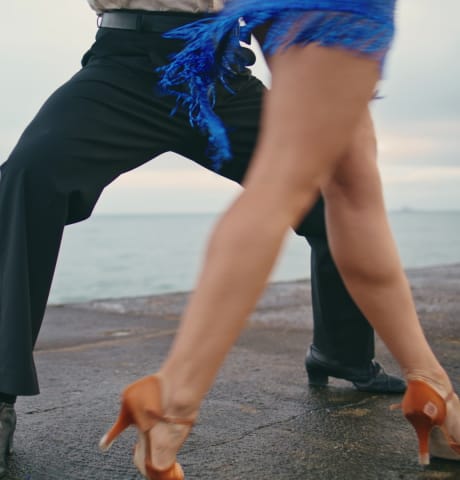
A couple dancing in front of a white background
The percussionists of a big band lay the rhythmic foundation upon which the entire piece is built.
udansa tip

For your first attempts, use historical recordings where the instruments are strongly separated in the stereo image to the left and right. This makes it easier for you to focus on a single track.

Five steps to the perfect sense of rhythm

  1. Mentally tune out the melodic layer

    Choose a classic Mambo track and mentally tune out the melodies of the trumpets and saxophones. Focus exclusively on the rhythmic rustling and clattering in the background to open your ears to the percussion instruments.

  2. Isolate the clave pattern and clap along

    Listen for the distinctive, wooden click of the claves or the bright metallic sound of the cowbell. As soon as you have this guide in your ear, clap the typical five-beat pattern precisely in time with the music.

  3. Count the eight-beat basic rhythm out loud

    Count the eight beats of the basic rhythm out loud while the music is playing. Pay attention to how the beats of the clave fall exactly on specific counts to internalize the structure of 2:3 or 3:2 patterns.

  4. Listening for the deep conga beat

    Now, direct your attention to the deep tones of the congas. Try to hear the open double stroke that, in Mambo, usually lies just before the heavy downbeat and gives the rhythm its typical forward drive.

  5. Accompany two rhythm tracks at the same time

    Connect what you have learned by alternating between clapping the clave and tapping the conga rhythm with your foot. Once you feel both rhythms in your body simultaneously, you have successfully decoded the complex structure of the big band.

The best strategies for effective ear training

Listening correctly

  • Focus your concentration specifically on a single instrument
  • Count the basic beat out loud and clap along
  • Start with slower Mambo tracks
  • Use the Clave as a rhythmic foundation

Avoiding listening errors

  • Getting distracted by loud melody lines
  • Only listening to music passively in the background
  • Starting directly with highly complex live recordings
  • Determining the beat solely through the melody

Your checklist for daily ear training

Before listening

Preparation

During the first run-through

Meanwhile

After the exercise

Progress check

Frequently Asked Questions

  1. The clave is a two-bar rhythmic pattern consisting of five beats. In Mambo, it serves as the connecting foundation to which all other instruments and musicians orient themselves in time.

udansa community

Find like-minded people for your rhythm training

On udansa you will find like-minded people who share your passion for complex rhythms, as well as first-class music and dance courses in your area. Join our community and take your sense of rhythm to the next level together with others.

Sources

Insights are based on the music theory foundations of Afro-Cuban percussion and common ear training methods, as of August 2026.