
Find your dance community
On udansa connect you will find like-minded people who share your passion for Latin rhythms. Make connections and bring your enthusiasm to the dance floor together with new dance partners.



By Bernhard De LucaUpdated
On udansa connect you will find like-minded people who share your passion for Latin rhythms. Make connections and bring your enthusiasm to the dance floor together with new dance partners.
Only the interplay of Afro-Cuban percussion and powerful brass sections creates the unbridled energy of Mambo. We will show you which instruments carry the world-famous big band sound.
Historical relevance
udansa only lists instruments that are an integral part of a classic Mambo ensemble.
Sonic function
Every instrument is evaluated based on its specific function within the overall structure.
Independent selection
No payments or sponsorship deals were agreed upon for the creation of this overview.

Deep hand drums, Afro-Cuban origin
Congas are the rhythmic heart. Their warm, deep sound provides the continuous pulse, while the typical conga rhythm (Tumbao) serves as a guide for the entire band.
Small hand drums, high pitch
These two small, connected drums are held between the knees. They provide fast, bright accents and artfully play around the rhythmic structure of the congas.
Paired metal drums with cowbells
The Timbales are the dynamic control center. With their sharp strikes on the drumhead or the metal shells (cascara), they drive the band and signal changes in the song.
High brass, usually in a three-part section
With their sharp, piercing riffs, the trumpets cut through the dense carpet of rhythm. They often carry the main melody and provide the brilliant highlights.
Low brass, warm and rough sound
The trombones provide the powerful, deep foundation in the brass section. Their rough, jazzy interjections form the perfect counterweight to the high trumpet lines.
Alto saxophone and tenor saxophone
Although they are woodwind instruments, saxophones perfectly round off the sound of a Mambo big band. They harmoniously connect the rhythm section with the sharp brass instruments.
A classic Mambo Big Band differs fundamentally from European dance orchestras due to its three-part rhythm section, which lays the rhythmic foundation. While a single drummer often keeps the beat in jazz, three specialized percussionists share this task in Mambo. Each percussion instrument serves its own frequency band and a specific rhythmic layer. The timbales cut through the dense brass section with their metallic overtones, the congas provide the warm, earthy foundation in the bass range, and the bongos fill the gaps with nimble, accented strokes in the high-frequency range. Together, these three pillars form the rhythmic grid over which the melodic lines can unfold.
It is only through the precise interlocking of these percussion instruments that the driving pull that made Mambo world-famous is created. The brass instruments react directly to the accents of the drums, creating a constant call-and-response pattern. Anyone who wants to dive deeper into the fascinating development of this genre will find valuable historical background on this musical evolution in the article about the Mambo history and its roots.
The three most important Mambo percussion instruments are congas, bongos, and timbales. Together, they form the rhythmic trio that carries the typical, multi-layered groove of Mambo.
Timbales are shallow, single-headed metal drums played with wooden sticks. In Mambo, they take on the role of the timekeeper, set sharp accents on the shells, and signal transitions to the orchestra.
The brass section, consisting of trumpets, trombones, and saxophones, provides the melodic power. They set explosive, syncopated riffs against the percussion foundation and drive the dynamics of the piece forward.
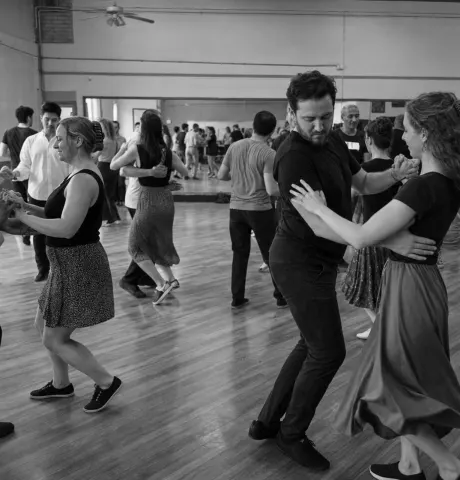
Experience the fascination of Latin American rhythms yourself on the dance floor.
BallroomMeißen · Germany
Tanzkreis | PROFESSIONALTuesday · 20:15 · Oct 27, 2026 - Jan 5, 2027
“Ein Haus für Vieles” - Saal Tanzkurse
 Mambo history: The fiery rhythm and its rootsDive into the fascinating history of Mambo: Learn how Afro-Cuban rhythms and New York big bands created one of the most exciting dance styles of all time.
 Learn to listen to Mambo music: Master the rhythmMambo music captivates with its infectious energy, but it can be rhythmically challenging for beginners. With our practical guide, you will learn step by step how to confidently identify the clave and Mambo rhythm in complex big band pieces.
 What kind of Mambo dancer are you? Take our music taste testFind out which historical era of Mambo best suits your musical preferences with our interactive quiz.
 Eddie Torres: How Mambo On 2 was inventedDiscover the fascinating story of Eddie Torres and how he forever shaped the modern New York Style with Mambo On 2.
 Mambo Boom in Europe: The Dance Wave of the 50sThe Mambo boom of the 1950s brought an unprecedented dance wave to Europe. Discover how the fiery rhythm revolutionized traditional dance schools and the hurdles it had to overcome.
 Afro-Cuban roots: The spiritual soul of MamboDive into the spiritual world of Mambo and discover how African drum rituals and the traditions of the Yoruba and Bantu shaped this dance.
 Mambo in Mexican Cinema: The Golden Era of RumberasDive into the golden age of Mexican cinema, where Mambo became world-famous thanks to the Rumberas and Pérez Prado.