
Experience the magic of dance history
On udansa connect, you meet like-minded people who share the fascination for historical rhythms. Find your dance partner for the next session and bring the golden era to life together!


By Bernhard De LucaUpdated
On udansa connect, you meet like-minded people who share the fascination for historical rhythms. Find your dance partner for the next session and bring the golden era to life together!
In the late 1940s and throughout the 1950s, the Palladium Ballroom in New York at the corner of 53rd Street and Broadway was the undisputed temple of the dance world. This is where the Mambo era unfolded in its purest and most intense form. While strict racial segregation and social barriers still defined everyday life out on the streets of the metropolis, a revolutionary equality reigned inside the club. On the dance floor of the Palladium of Mambo, skin color, origin, or social status played no role: only talent, a sense of rhythm, and a passion for the music determined the reputation of the dancers.
What made the Palladium special was its integrative power in the midst of a politically charged era. African Americans, Puerto Rican immigrants, Jewish New Yorkers, and the white upper class danced shoulder to shoulder. This unique social mix left a lasting mark on new york dance history. The legendary big bands drove the audience to peak performance with their complex arrangements. Anyone who wanted to hold their own here had to have rhythm in their blood. The Palladium Ballroom was not an elitist salon, but a vibrant melting pot that turned Mambo from a niche movement into a global phenomenon.

Listen specifically to recordings of the great big bands from the fifties. Pay attention to the interplay between powerful brass sections and typical rhythm instruments like congas and timbales.
Focus on the rhythmic emphasis and learn to execute the quick changes in direction and syncopations precisely on the beat to experience the authentic Palladium feeling.
Use the history of the Palladium as inspiration for your own style. Let the energy and openness of the dance pioneers of that time guide you on the dance floor.
The Palladium Ballroom was located in New York City at the corner of 53rd Street and Broadway. In the 1950s, this intersection was the absolute center of the global Mambo movement.
The Palladium Ballroom was historically significant because it abolished racial segregation. On the dance floor, only dancing ability mattered, which united people of the most diverse origins peacefully and creatively.
The music at the Palladium was shaped by gigantic big bands that combined driving horn sections with Afro-Cuban percussion. This high-energy mix defined the typical big band Mambo sound.
Find the right dance school and learn the classic steps of the golden era.
Couple danceLimbach-Oberfrohna · Germany
PaartanzkreisFriday · 18:15 · Oct 23
Limbach-Oberfrohna
Couple danceLimbach-Oberfrohna · Germany
Silberkurs für PaareSunday · 16:15 · Oct 25 - Nov 15
Limbach-Oberfrohna
Couple danceLimbach-Oberfrohna · Germany
PaartanzkreisSunday · 16:30 · Oct 25
Limbach-Oberfrohna
 Mambo history: The fiery rhythm and its rootsDive into the fascinating history of Mambo: Learn how Afro-Cuban rhythms and New York big bands created one of the most exciting dance styles of all time.
 The Three Mambo Kings: Prado, Puente, and RodriguezGet to know the three Mambo Kings who sparked a global dance revolution in the fifties with their distinctive big band rhythms.
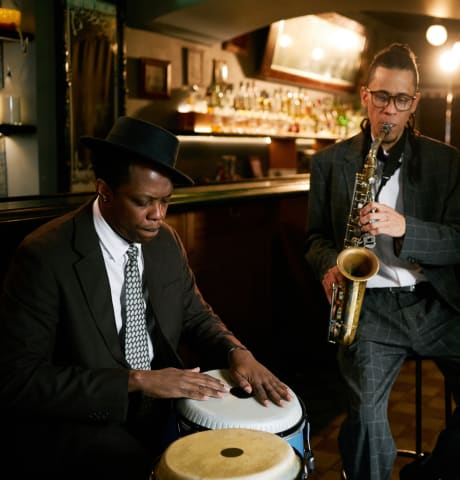 Mambo rhythm explained: Understanding the musical structureUnderstand the fascinating musical structure of Mambo. We explain the beat, the secret of the clave, and the power of syncopation to you.
 Mambo Instruments: The Big Band SoundBehind the infectious groove of Mambo lies a perfectly tuned interplay of Afro-Cuban percussion and powerful brass. We introduce the key instruments.
 Learn to listen to Mambo music: Master the rhythmMambo music captivates with its infectious energy, but it can be rhythmically challenging for beginners. With our practical guide, you will learn step by step how to confidently identify the clave and Mambo rhythm in complex big band pieces.
 What kind of Mambo dancer are you? Take our music taste testFind out which historical era of Mambo best suits your musical preferences with our interactive quiz.
 Eddie Torres: How Mambo On 2 was inventedDiscover the fascinating story of Eddie Torres and how he forever shaped the modern New York Style with Mambo On 2.