
Find your dance partner for Latin
Whether you are looking for the sensual calm of Rumba or want to get swept away by the fast-paced Mambo fever: on udansa you will find like-minded people for every Latin dance style.


By Mary De LucaUpdated
Whether you are looking for the sensual calm of Rumba or want to get swept away by the fast-paced Mambo fever: on udansa you will find like-minded people for every Latin dance style.
Latin American dances fascinate with their variety. However, while the Rumba focuses on sensual deceleration, the Mambo demands pure energy and fast feet on the dance floor.
Cuban Motion refers to the typical hip movement in Latin American dances. It is created by consciously bending and straightening the knees during weight transfer.
Anyone hearing Latin American music for the first time often only perceives an infectious interplay of drums, rattles, and brass instruments. But behind the scenes, two completely different worlds are hidden. The comparison of Rumba and Mambo reveals that these two dances, despite their common roots, bring completely opposite energy to the dance floor. While Rumba is considered the epitome of romance and enchants with extremely slow, flowing movements, Mambo sets off a rhythmic firework display that thrives on rapid, linear steps and a palpable dynamic.
A fundamental rumba mambo difference lies in the spatial arrangement and the direction of movement. In Rumba, the dancers move very stationarily. The steps are placed compactly, while the entire body interprets the music through wave-like hip movements, the so-called Cuban Motion. Mambo, on the other hand, demands a clear direction. The steps shoot forward and backward in a straight line. This creates a pulsating back-and-forth movement that gives the dance its typical, almost athletic aggressiveness.
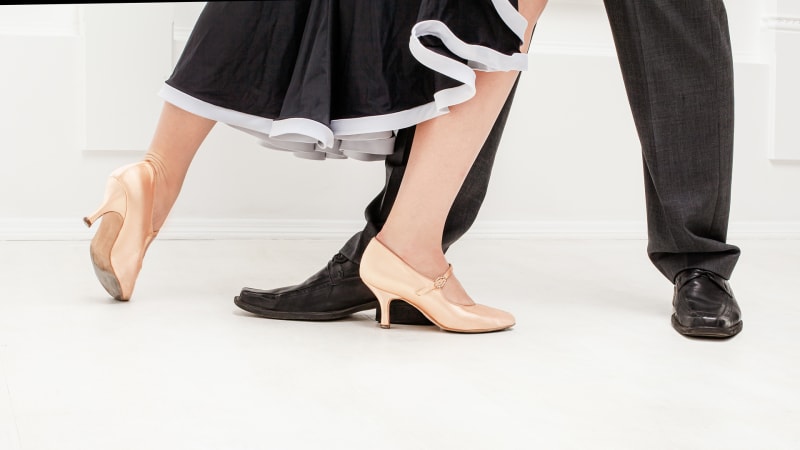
Rumba draws its power from deliberate delay. In the classic four-four time, the first beat of the bar is not actively stepped on, but used for an expressive weight shift. The actual step only occurs on count two. This artificial pause requires enormous body control and creates the typical floating, fluid character. The partners dance around each other, maintain eye contact, and use the space between steps for an intense, almost silent dialogue.
Mambo, on the other hand, breaks with this stillness. Here, the drive of the brass sections and dense percussion dominate. The dance style demands constant presence and quick reactions. Anyone who wants to learn to dance Mambo will quickly realize that the feet must be used like precise instruments here. The steps are direct, the weight shifts occur without delay, and the hip movement is not soft and pulling like in Rumba, but crisp and accentuated.
Dancing Rumba correctly
Better avoid this
In Rumba, you dance the silence between the beats, while in Mambo, you have to capture every single accent of the drums with your body.
This comparison of Cuban dances clearly shows that the choice of dance style depends strongly on your own personality and your current mood. Rumba is perfect for those who are looking for a deep connection with their partner and want to savor the music down to their fingertips. It does not forgive any rush and instead rewards balance and elegance. Those who want to burn off physical energy and feel pure joy, on the other hand, will find their home in Mambo.
In dance schools, Rumba is usually taught very early because it is firmly anchored in the world dance program. It trains the sense of rhythm and body control like almost no other dance. Mambo is often a wonderful next step for advanced dancers who want to expand their repertoire with a rhythmic highlight. Both styles complement each other perfectly: the hip technique learned in Rumba helps to keep the hips elastic and active even in fast Mambo, without appearing stiff.
Fluid and stationary
Rumba remains largely on the spot. Dancers use soft weight shifts and pronounced hip movements to interpret the music without covering much space.
Dynamic and straightforward
Mambo shoots straight through the room. With quick forward-and-back steps and crisp accents, the energy of the music is translated directly into movement.
Rumba is significantly slower and is usually danced at about 25 to 27 bars per minute. Mambo, on the other hand, is a fast, energetic dance with usually 45 to 50 bars per minute.
Yes, the basic hip technique, the so-called Cuban Motion, is very similar in both dances. If you have mastered Rumba, you can use this smooth hip movement in Mambo as well, although you have to execute it much faster and with more emphasis.
For absolute beginners, Rumba is usually easier to learn because the slow tempo leaves more time for coordination. Due to its speed, Mambo requires very quick footwork and a good sense of rhythm from the start.
Discover the variety of Latin rhythms and find the right course for you.
Couple danceLimbach-Oberfrohna · Germany
PaartanzkreisFriday · 18:15 · Oct 23
Limbach-Oberfrohna
BallroomMeißen · Germany
Tanzkreis | PROFESSIONALTuesday · 20:15 · Oct 27, 2026 - Jan 5, 2027
“Ein Haus für Vieles” - Saal Tanzkurse
Couple danceLimbach-Oberfrohna · Germany
Silberkurs für PaareSunday · 16:15 · Oct 25 - Nov 15
Limbach-Oberfrohna
 Mambo vs. Salsa: Which rhythm suits you?Mambo and Salsa may look similar at first glance, but their rhythm and dynamics are fundamentally different. We show you how to distinguish these styles in your ears and your feet.
 Latin Dances: Comparison Guide and TableMambo, Salsa, Bachata, or Merengue? Our structured comparison shows you the differences in rhythm, tempo, and movement at a glance.
 Mambo Classic vs. New York Style: Comparing Dance PostureMambo Classic or New York Style? We compare the differences in dance posture and leading dynamics of these two fascinating Mambo styles.
 Switching from Salsa to Mambo: How to make the changeSwitching from Salsa On 1 to Mambo On 2 is difficult for many experienced dancers. With this systematic guide, you can successfully reprogram your muscle memory.
 Mambo in competitive dance vs. social dance: The differencesMambo fascinates in competitive dance through athletic precision and in the club through free improvisation. Learn how both worlds differ in posture and dynamics.
 Mambo vs. Salsa music: The subtle rhythmic differencesMambo music is considered the wild, complex sister of Salsa. We show you how the rhythmic structures differ and what that means for your steps.
 Mambo Jazz vs. Partner Dance: Solo Steps and Partner DynamicsMambo Jazz or classic partner dance? Learn how the solo groove differs from traditional partner dancing and which style suits you best.