Belly dance technique4 minutes

Belly Dance Chest Isolation: Technique for the upper body

By Bernhard De LucaUpdated

In a nutshell
  • Chest isolation completely separates upper body movements from the hips and pelvis.
  • A stable basic posture with slightly bent knees forms the foundation for precise muscle control.
  • The four basic directions, front, back, right, and left, are fluidly connected to create clean circles.
  • When walking, the knees cushion the step so that the isolated chest can appear calm and independent.

The art of oriental dance thrives on the fascinating interplay of contrasts. When your upper body moves fluidly while your pelvis remains completely still, it captivates every observer.

DefinitionChest isolation

Chest isolation refers to the ability to move the entire rib cage in all directions independently of the pelvis, shoulders, and head. This technique forms the foundation for all elegant upper body movements in oriental dance.

The basis of isolation while standing

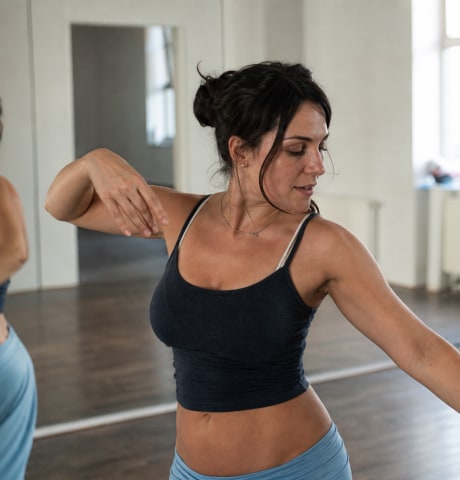
The foundation for every movement in oriental dance is the isolation of different body parts. If you want to master the technique of ribcage isolation in belly dance, everything starts with the correct posture. Place your feet hip-width apart, keep your knees slightly bent, and tilt your pelvis. Your lower back should be long and relaxed. The crucial trick is to treat the pelvic area as if it were frozen. While your hips remain firmly anchored to the ground, the deep muscles in your upper body are at work. This conscious separation requires a lot of concentration at first, but it protects your joints in the long run and ensures the typical, effortless look of Raqs Sharqi.

To target the ribcage, we use the four cardinal directions: front, back, right, and left. When shifting to the right and left, the shoulder line remains absolutely horizontal. Avoid leaning to the side at the waist or tilting your shoulders. It helps to imagine that the ribcage is sliding along a flat rail. Once you can target these four points precisely, you connect them fluidly. This creates a harmonious pain-free movement sequence that forms the basis for complex combinations.

From point to circle in the upper body

As soon as the straight shifts while standing work, you can take the next step: learning the fluid chest circle in belly dance. A clean circle is not a chaotic flailing movement, but the precise connection of the isolated extreme points. You push your chest forward, glide smoothly over to the right, pull it in a controlled manner back into the curve, and switch back to the front via the left. The magic is created by the continuous flow. Your intercostal muscles and deep back muscles are working at full capacity here, while your breath should continue to flow evenly.

It is particularly important to cleanly separate the movement from the pelvis. If your hips move along with the circle, the movement loses its oriental character. Use a mirror to check your hip bones, they should remain absolutely still. This precise work in the upper body can be excellently combined with other elements, such as a fluid arm wave movement, to refine the overall expression of your dance and increase the dynamics in the room.

The direct path to clean technique

Correct

  • Keep your knees slightly bent
  • Keep your shoulder line horizontal
  • Guide the movement through your intercostal muscles
  • Always keep breathing evenly

Mistakes

  • Locking your knees completely
  • Tilting your shoulders to the side
  • Using momentum from your arms
  • Holding your breath due to tension

Anyone who learns to move their upper body completely independently from their pelvis gains a whole new dimension of elegance and expressiveness in oriental dance.

Dance instructor for oriental dance, Hamburg

Mastering isolation in movement

The true art of upper body isolation in oriental dance reveals itself when you move away from static positions. Isolating the ribcage while moving requires excellent coordination. Start with simple steps forward and backward while keeping the ribcage isolated and lifted. Each step is gently cushioned by the balls of your feet so that the impact of walking is not transferred to your upper body. As soon as that works, synchronize the movements: shift the ribcage to the right or left with every step.

A wonderful tool to emphasize the vertical axis is the rhythmic lifting and lowering of the ribcage in belly dance while walking. When lifting, the sternum pulls diagonally upwards while the shoulders remain relaxed and down. When lowering, use your abdominal muscles to bring the ribcage back to the starting position in a controlled manner. These vertical accents give your steps a proud, almost floating presence on the dance floor, without blocking the movement in the pelvis.

Two dimensions of upper body work

Sliding

Horizontal sliding movement

The lateral isolation

Focus entirely on the horizontal displacement of your rib cage. Your shoulders remain level, while the rib muscles take the lead.

Lift

Vertical accent

The vertical isolation

Actively lift your sternum diagonally upwards and lower it again in a controlled manner. The movement comes deep from the muscles below the chest.

Frequently Asked Questions

  1. A mirror helps you to immediately identify unwanted compensatory movements in your hips or shoulders. Additionally, you can place your hands on your hip bones to feel whether your pelvis really remains stable.

Find your dance match for the course

On udansa, you will find like-minded people to work on the perfect isolation with, as well as experienced instructors for your next dance course.

Find your dance match for the course