Prop technique4 minutes

Veil dance in belly dance: Guide to elegant throws and handling

By Bernhard De LucaUpdated

In a nutshell
  • The veil is held loosely between the index and middle finger to allow for a quick release.
  • The power for elegant throws comes from the entire body and the shoulders, not from the wrists.
  • Utilizing air resistance ensures maximum flight duration of the fabric over the dancer.
  • A stable stance and fluid transitions prevent the veil from getting tangled around the body.

The veil dance fascinates with fluid movements and apparent weightlessness. With the right technique, you tame the delicate fabric and let it glide breathtakingly through the air.

What you need for training

  • A rectangular veil made of silk or chiffon
  • Sufficient space to the ceiling and to the sides
  • Basic knowledge of oriental arm positioning
  • Non-slip surface for safe turns

The physics of floating in oriental dance

The veil is one of the most fascinating props in oriental dance, as it makes air movements visible and gives the performance a mysterious, almost floating dimension. To unfold this magic, a precise belly dance technique is essential. Many beginners make the mistake of tearing the veil through the room with too much force, which makes the fabric look heavy and tires the arms quickly. The key lies in the combination of gentle guidance, the targeted use of air resistance, and perfect timing when releasing.

Before you dare to try dynamic throws, you should develop a feel for how the fabric reacts to your movements. The arms never act in isolation, but initiate the movement from the center of the body and the shoulders. An elegant veil dance lives from the illusion that the fabric flies weightlessly while you move completely effortlessly underneath it. If you want to familiarize yourself more intensively with the musical structures of Raqs Sharqi, our guide on belly dance music & rhythms will help you to coordinate your throws exactly with the accents of the music.

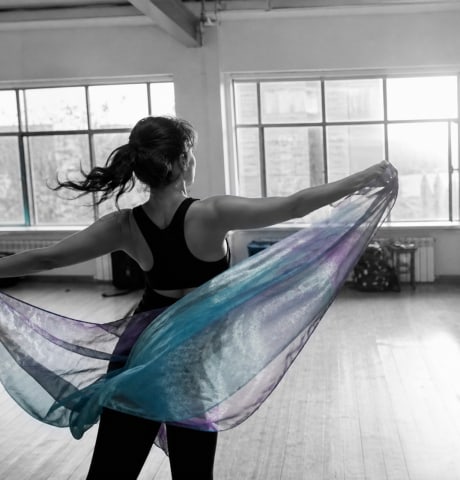
The correct arm position creates a stable cushion of air under the fine silk fabric.

Step by step to the perfect move

  1. Take the starting position

    Spread your arms wide to the side and grab the veil at the top corners. Your elbows are slightly bent, your wrists relaxed, so that the fabric forms a gentle curve behind your back.

  2. Generate momentum from your shoulders

    Move your arms in a large, circular motion upwards and slightly forward. Use the momentum of your entire upper body to build a cushion of air under the fabric, which carries it upwards.

  3. Release the veil in a controlled manner

    Open your fingers exactly at the moment your hands reach the highest point in front of your face. Let go of the veil and pull your hands flat downwards so that it can fly undisturbed.

  4. Dancing under the veil

    Use the moment the veil is in the air for an elegant turn or a soft hip movement directly under the descending fabric. Catch the veil by the edges again before it touches the floor.

The most important do's and don'ts for the veil toss

Correct

  • Move your arms fluidly from the shoulder
  • Spread the veil with a wide curve
  • Release the fabric at the apex of the throw

Error

  • Press your elbows rigidly against your body
  • Jerk the veil upwards
  • Keep your grip tensely closed

Your checklist for the perfect veil dance

Before the dance

Preparation

On the dance floor

Meanwhile

Frequently Asked Questions

  1. Chiffon is very suitable for beginners, as it is slightly heavier and flies more stably. Advanced dancers usually opt for lighter silk, which looks particularly elegant but requires more precise handling.

Feel the lightness together

On udansa you will find the right dance school and like-minded people to refine your technique in oriental dance. Make connections and take your movements to the next level.

Feel the lightness together