Dance technique5 minutes

Saidi stick dance: Technique and balance with the assaya

By Bernhard De LucaUpdated

In short
  • The assaya is held loosely between the thumb and index finger to guarantee maximum flexibility in the wrist.
  • Continuous spinning is based on gentle impulses from the wrist, utilizing the natural center of gravity of the stick.
  • For secure balance, the exact center point of the stick must be determined and stabilized through soft movements from the knees.
  • An upright posture and active core engagement prevent cramping in the shoulder and arm muscles.

Dancing with the Saidi cane requires a fine interplay of strength, rhythm, and physical intuition. Learn how to guide the assaya precisely, spin it elegantly, and balance it safely on your body with udansa.

DefinitionAssaya

The assaya is the traditional cane, usually made of bamboo, which is used in oriental dance as a central prop for the Saidi style. It is characterized by its lightness and flexibility.

The correct handling and hand position of the assaya

Dancing with the assaya, the traditional bamboo stick, is fascinating due to the powerful dynamics and the playful ease with which the prop is moved through the air. To achieve this effect, precise handling is crucial. The stick is not gripped tightly, but balanced loosely between the thumb and index finger. This loose guidance makes it possible to implement the Saidi stick dance technique fluidly, without the muscles in the forearm cramping up. The remaining fingers serve only as a guide and gently catch the stick during quick changes of direction.

The correct hand position forms the foundation for every movement. If you grip the stick too tightly, you lose the flexibility in the wrist that is essential for the continuous spinning in oriental stick dance. Make sure that your shoulders remain low and relaxed while your arms guide the stick. Stable core tension ensures that the movements of the stick come organically from your center and do not appear isolated from the arms. If you would like to check your general posture, our guide on core tension when dancing will help you.

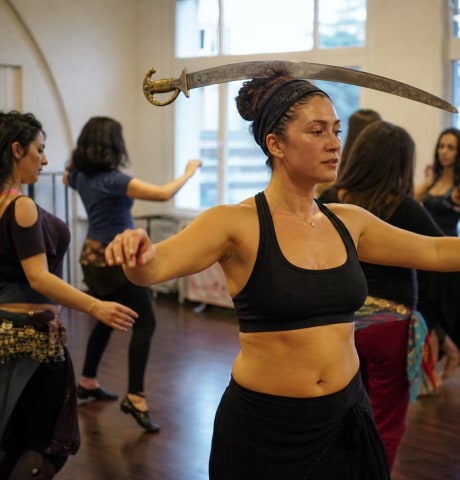
The perfect balance requires an upright posture and soft, springy steps from the knees.

Mastering momentum and control while spinning

The dynamic spinning and circling of the assaya is one of the most spectacular elements in Saidi. The key to effortless spinning lies in the physical pivot point of the cane. To rotate the cane in a controlled manner, you need to precisely sense its center of gravity. When spinning forwards and backwards, the tip of the cane traces a horizontal figure eight in the air. This movement requires a continuous, gentle impulse from the wrist, while the forearm remains largely stable.

A common mistake when practicing is trying to force the movement with too much strength. This easily causes the cane to deviate from its vertical or horizontal path and blocks the flow of the dance. Start your training slowly and focus on using the momentum of the assaya instead of working against it. Once the rhythm is internalized, you can combine the spinning with simple steps around the room. If you want to put your technical precision in oriental dance to the test in general, take a look at our belly dance level test.

The most important do's and don'ts when dancing with the Assaya

Correct

  • Guide the stick loosely between your thumb and index finger
  • Give impulses for spinning purely from the wrist
  • Determine the exact center point before balancing
  • Cushion steps softly through your knees

Incorrect

  • Grip the assaya firmly with your whole fist
  • Use your entire arm for the rotation movement
  • Place the stick on your head without preparation
  • Make hectic or jerky steps

The assaya is not a foreign object, but the extended line of your own arms. Only when you let the stick flow, does the Saidi unfold its true power.

Instructor for oriental dance, Hamburg

The art of weightless cane balancing

The crowning achievement of cane dance is the free balance on the head, shoulder, or hip. A perfect Saidi cane balance requires absolute stillness in the upper body and fine adjustment through the knees and pelvis. Before you place the cane on your head, you should determine the exact center point of the assaya. To do this, lay the cane flat on your index finger until it remains horizontally balanced. This exact point is what will later go on the crown of your head.

During the balancing phase, keep your gaze directed straight ahead, your neck long, and your cervical spine stretched. To move with the balanced cane, use soft, cushioned steps from your knees. Any abrupt jolt would cause the assaya to fall. By consciously compensating for movements, you strengthen your deep muscles and improve your overall body coordination on the dance floor. For an even better sense of your center of gravity in dance, we also recommend taking a look at the topic Activate contemporary dance center.

Two facets of the Saidi stick dance: Dynamics meet balance

Leading

Focus on active cane leading

Control and targeted impulses in space

Active leading emphasizes the dynamics of the cane. Here, you control the assaya through targeted impulses from the wrist and guide it powerfully through the space to visually accentuate the music.

Balancing

The passive art of carrying

Weightless balance through body tension

When balancing, you let the stick rest on your body as if it were weightless. The movement now comes primarily from your pelvis and your knees, in order to gently maintain the balance of the assaya.

Frequently Asked Questions

  1. For beginners, a light, medium-thick bamboo stick that reaches about to your hip or belly button is ideal. A stick that is too heavy tires out your wrists too quickly, while a stick that is too short limits the leverage when spinning.

Find your rhythm with udansa

Whether you want to refine the basics of leading or try out new dance styles: on udansa you will find the right courses and like-minded people in your area.

Find your rhythm with udansa