

Find your community on udansa
On udansa, you connect with dance enthusiasts in your area and discover dance courses for every style. Find your community now and play an active part in the history of social dance.

By Bernhard De LucaUpdated

On udansa, you connect with dance enthusiasts in your area and discover dance courses for every style. Find your community now and play an active part in the history of social dance.
Social dance connects people across borders. But how did the ritual folk dances of the past evolve into the vibrant, improvised dance scenes that we celebrate all over the world today with udansa?
Social dance refers to dance styles that are primarily danced for social interaction, conviviality, and entertainment, rather than for performances or competitions. The focus is on improvisation as a couple and the sense of community on the dance floor.
The history of social dance is inextricably linked to the migration movements and cultural exchange of the 19th and 20th centuries. Originally, people in rural communities danced traditional folk dances to celebrate harvests, weddings, or seasonal rituals. These dances were often highly ritualized, followed fixed patterns, and served to strengthen the cohesion of the village community. With the advancing industrialization starting in the 1840s, millions of people moved to rapidly growing metropolises. In the cramped working-class districts of cities like New York, Paris, or Buenos Aires, the most diverse cultures met. From the fusion of European polkas, African rhythms, and Creole influences, completely new, freer forms of movement emerged that emancipated themselves from the rigid rules of courtly dance.
A milestone in this development was the emergence of the Waltz in the early 19th century, which established the closed partner dance position among the bourgeoisie for the first time. However, the true revolution of social dance took place on the streets and in working-class clubs. Here, it was no longer about representation, but about immediate communication and the expression of a zest for life. The dance floor became a social melting pot where societal barriers fell for the duration of a song.
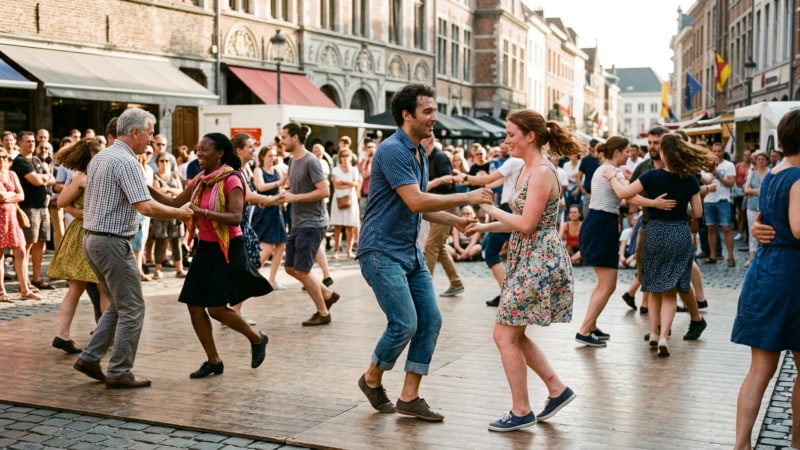
The birth of modern social dance in the 20th century took place in the late 1920s in the Harlem district of New York. Lindy Hop emerged in the legendary Savoy Ballroom, which opened its doors in 1926. As one of the first ballrooms in racially segregated America, the Savoy allowed for a mixed dance floor. Here, jazz, tap dance, and European partner dances merged into a high-energy, improvised form. Dancers broke away from the closed position, incorporated acrobatic elements, and reinvented swing. The history of the dance scene shows that these clubs were safe spaces for marginalized groups, where social identity and resistance were expressed through movement.
At the same time, Argentine Tango developed in the impoverished port districts of Buenos Aires and Montevideo at the end of the 19th century. It, too, was the product of a multicultural immigrant society and was initially danced in the brothels and taverns of the suburbs. It was only when the dance conquered European salons via Paris that it lost its disreputable image. This historical development of these dance styles illustrates that almost every popular social dance has its roots in subculture and only found its way into the mainstream through detours.
That's it
Not like this
At the Savoy Ballroom, there were no prejudices. All that mattered there was how well you could feel the rhythm and connect with your partner.
Today, the way the global community interacts has fundamentally changed due to digitalization. While local dance halls and word-of-mouth used to define the scene, dancers now connect digitally, for example via udansa. A worldwide network of festivals, congresses, and local dance evenings ensures that you can find a connection almost anywhere on earth. Those who master the codes of social dance can step onto the dance floor in Tokyo, Berlin, or Rio de Janeiro without words and interact with others immediately. Modern technology makes it immensely easier to find a suitable dance partner and to organize yourself in local groups.
At the same time, the core of social dancing remains unchanged: it is about the real, analog connection between two people in the here and now. In an increasingly digital world, dancing together offers a tangible balance to everyday life in front of screens. The global community is constantly growing because the need for community, touch, and non-verbal communication is universal. Social dance is more than just a leisure activity today, it is a global language of understanding.
Fixed patterns and village rituals
Traditional folk dances followed fixed choreographies passed down through generations. The community usually danced in set patterns like circles or lines, with the ritualistic and celebratory character taking center stage.
Improvisation and free movement
Modern social dance is based on free improvisation and non-verbal communication within the couple. Movement is created in the moment, reacts flexibly to the music, and allows for individual interpretation without rigid step sequences.
The history of social dance began in the late 19th and early 20th centuries in the urban melting pots of the world. Due to migration and industrialization, African rhythms blended with European dance forms, resulting in styles like Tango, Swing, and Salsa.
The social component is the focus of social dance, as the dance does not require fixed choreographies. It is about the spontaneous connection between partners, the joy of the music, and making contacts in an open, global community.
Lindy Hop is considered the forefather of modern Swing dances and became popular in the late 1920s at the New York Savoy Ballroom. It broke with rigid conventions and established wild, improvised acrobatics in partner dancing.
Discover the variety of dance styles and find the perfect way to join your local community.
 Salsa, Bachata & Kizomba: Comparing the stylesSalsa, Bachata or Kizomba? Our comprehensive comparison shows you the differences in music, dynamics and atmosphere so you can find the perfect style for you.
 Social dance styles: Find your dance communityDive into the fascinating world of social dance styles. Learn what sets the Salsa, Bachata, and Swing scenes apart and how to find your place in the community.Social dance styles: Find your dance communityDive into the fascinating world of social dance styles. Learn what sets the Salsa, Bachata, and Swing scenes apart and how to find your place in the community.Salsa, Bachata & Kizomba: Comparing the stylesSalsa, Bachata or Kizomba? Our comprehensive comparison shows you the differences in music, dynamics and atmosphere so you can find the perfect style for you.
 West Coast Swing vs. Discofox: The ultimate comparisonThe ultimate comparison between West Coast Swing and Discofox shows you which modern partner dance best matches your rhythm and preferences.
 The 5 most important swing dance styles at a glanceFrom Lindy Hop to Balboa: This guide gives you a quick overview of the five most important swing dance styles and shows what defines the global vintage subculture.
 Sensual dance styles: Bachata Sensual, Kizomba & ZoukDive into the world of sensual dance styles. Our guide shows you the unique features of Bachata Sensual, Kizomba and Zouk, as well as the fascinating dynamics of their global communities.
 What is Forró? A portrait of the Brazilian social danceForró is more than just a dance: it is pure joy and community. Learn everything about the Brazilian roots and the special vibe of this fascinating social dance.
 Finding the dance scene: A guide for your local communityAre you looking to connect with the local dance scene? This structured guide shows you how to analyze the communities in your city and discover the perfect genre for you.