

Find your Forró community on udansa
Whether you are taking your first steps or looking for like-minded people for the next festival: on udansa you will meet dance enthusiasts who share your passion for the Brazilian rhythm.

By Mary De LucaUpdated

Whether you are taking your first steps or looking for like-minded people for the next festival: on udansa you will meet dance enthusiasts who share your passion for the Brazilian rhythm.
Forró is taking dance floors by storm worldwide. Find out why this traditional Brazilian partner dance has created such an exceptionally warm and close-knit community.
Forró refers to both a style of music and the corresponding Brazilian partner dance, which is characterized by syncopated rhythms and a close, warm connection between the dancers.
Anyone entering a Forró party for the first time immediately feels a special energy. The music, carried by accordion, triangle, and the zabumba drum, radiates an infectious joy while couples move across the dance floor in remarkable closeness. Forró is much more than just a dance: it is a way of life that is deeply rooted in the culture of the Brazilian Northeast and connects people worldwide today.
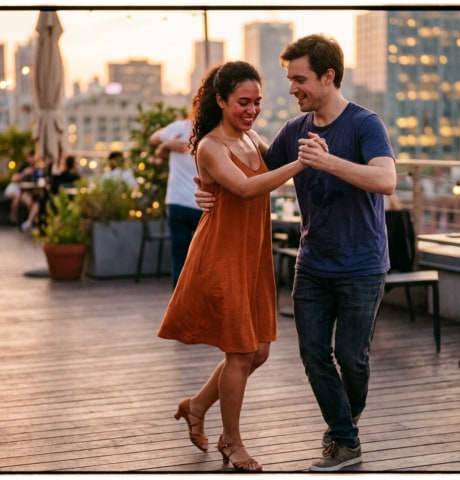
The significance of dancing Forró goes far beyond simply learning steps. It is about community, warmth, and celebrating the moment together. Compared to other partner dances, where perfection and show are often in the foreground, Forró is characterized by its approachability. The dance posture is close and intimate, carried by a deep mutual trust that has created a completely new form of togetherness in the European social dance community.

The roots of Forró lie in the dry hinterland of the Brazilian northeast, the Sertão. There, the music was the soundtrack to the hard everyday life of the rural population and their festive gatherings. The name itself is likely derived from the term "forrobodó", which in Brazilian Portuguese means something like "big party" or "whirlwind". It was the legendary musician Luiz Gonzaga who made Forró popular throughout Brazil in the 1940s.
In Europe, a vibrant, rapidly growing scene has established itself in recent years. This Brazilian partner dance attracts people of all ages who are looking for an alternative to the often performance-oriented classical dance schools. Those who dance Forró appreciate the relaxed atmosphere. There are no strict dress codes or rigid hierarchies. Instead, a familiar culture of welcome characterizes the parties, where experienced dancers and newcomers dance together as a matter of course.
Like this
Not like this
Forró is like a big hug to the music. It is not about who dances the most spectacular moves, but who builds the most beautiful connection with their partner.
The fascination of Forró in music and dance lies in the balance of simplicity and emotional depth. While the basic step is learned quickly, the true art lies in the subtle interaction of the couple. The music dictates the tempo: sometimes it is melancholic and slow, sometimes extremely fast and full of syncopation. This dynamic requires a sensitive interaction, where the concept of Lead & Follow is lived in a very intuitive, almost playful way.
The European Forró community organizes itself in numerous local associations and international festivals. These events are often multi-day gatherings where people not only dance, but also cook, laugh, and live together. Anyone who gets involved in this world quickly finds a connection and experiences a community that is carried by openness and mutual respect.
The roots of the dance in the Sertão
The traditional style from the northeast of Brazil. It is usually danced very closely, with a focus on the subtle connection in the upper body, gentle swaying steps, and an earthy, calm dynamic.
Influences from the global dance scene
The modern, urban evolution of the dance. It integrates elements from Salsa, Samba de Gafieira, and West Coast Swing, which leads to dynamic turns and more complex step patterns.
Forró is a traditional partner dance and music style from the northeast of Brazil. It is characterized by syncopated rhythms and a very close, emotional connection between the partners.
A traditional Forró band consists of three instruments: the accordion (sanfona), the triangle, and a large frame drum called zabumba. This combination creates the typical, driving sound.
No, Forró is known for its extremely open and welcoming community. At parties and festivals, people constantly switch partners, so you will find connections immediately even without a fixed partner.
Forró is usually danced flat and grounded. Comfortable, flat shoes with a slightly sliding sole or even clean sneakers are ideal for the quick turns and rocking steps.
Find the right course and become part of the warm Forró community.
 Social dance styles: Find your dance communityDive into the fascinating world of social dance styles. Learn what sets the Salsa, Bachata, and Swing scenes apart and how to find your place in the community.
 Lead & Follow: Partner dance as teamworkLeading and following is more than just telling and trailing. Learn how to harmonize perfectly as a leader and follower on the dance floor with udansa!Social dance styles: Find your dance communityDive into the fascinating world of social dance styles. Learn what sets the Salsa, Bachata, and Swing scenes apart and how to find your place in the community.
 Finding the dance scene: A guide for your local communityAre you looking to connect with the local dance scene? This structured guide shows you how to analyze the communities in your city and discover the perfect genre for you.
 Dance Scene Etiquette Checklist: Understanding Culture & CodesEvery dance scene has its own unwritten laws. With our etiquette checklist, you can easily decode the customs of Salsa, Tango, and more during your first visit.
 Switching from Ballroom to Social DanceThe switch from ballroom to free social dance is difficult for many. This guide shows you how to leave fixed choreographies behind and learn improvisation.
 Argentine Tango vs. Ballroom Tango: A ComparisonArgentine Tango or Ballroom Tango? Our comparison shows the differences between the improvised world of milongas and the structured elegance of ballroom dance.
 Neotango: The modern twist on Tango ArgentinoNeotango brings a breath of fresh air to traditional Tango Argentino. Learn all about the modern music, the open culture, and the creative dance style.
 Kizomba vs. Urban Kiz: Comparing origins, music, and the sceneKizomba and Urban Kiz are captivating dancers worldwide. Our guide compares traditional African roots with the modern European club scene.