The right community is already waiting for you
On udansa, you will meet like-minded people from all dance scenes who share your passion. Find the right dance partners and get to know the codes of your new favorite community together.

By Mary De LucaUpdated

On udansa, you will meet like-minded people from all dance scenes who share your passion. Find the right dance partners and get to know the codes of your new favorite community together.
The first step into a new dance scene often feels like a journey to a foreign country. With the right compass, you will decode the unwritten rules in no time.
Every dance community has developed its own unique, unwritten rules over the years. While the Caribbean Salsa scene often features a loud, exuberant party atmosphere where people approach each other directly, communication at a traditional Tango milonga takes place almost silently through subtle eye contact. If you are not familiar with these subtle cultural differences, you can easily put your foot in it during your first visit, even if you are actually following the general social dance etiquette.
It is not about dancing ability, but about understanding the social fabric. The way the dance floor is divided, how couples find each other, and how intensely closeness is experienced differs fundamentally between genres. If you familiarize yourself with the typical codes in advance, you take the pressure off yourself. You learn to read the mood in the room correctly and show the new community the necessary respect for their established culture from the very first second.

After you arrive, sit on the edge for a while and watch. Pay attention to how the couples move, where the breaks take place, and how loud the conversations are away from the dance floor.
Find out how dancers find each other. Do people seek intentional eye contact across the room, or do they walk straight up to each other to ask verbally?
Pay attention to whether the couples are moving in a circle or dancing in a stationary position on small spots. Adjust your own movement to this flow to avoid collisions.
Observe how much physical closeness is common in this community. Respect your partner's boundaries and adapt your dance posture to the scene's average.
Correct
Wrong
Preparation
Arrival
During
In Argentine Tango, you traditionally ask for a dance using the cabeceo, a silent agreement through eye contact and a nod from a distance. If you walk directly to the table and ask, you break this subtle code and risk an uncomfortable situation for both sides.
The Salsa scene is usually very open, informal, and festive, which is why a direct, verbal invitation right at the dance floor is the standard. Hierarchies are flat, and the shared experience of the music and the party atmosphere is the priority.
Yes, for dances that cover a lot of space like Tango or Ballroom dances, all couples move counter-clockwise along the line of dance on the outside. Faster couples dance on the outer lane, while slower couples or learners tend to stay in the middle of the floor.
Discover suitable courses in your area and get to know the world of social dance.
 Social dance styles: Find your dance communityDive into the fascinating world of social dance styles. Learn what sets the Salsa, Bachata, and Swing scenes apart and how to find your place in the community.
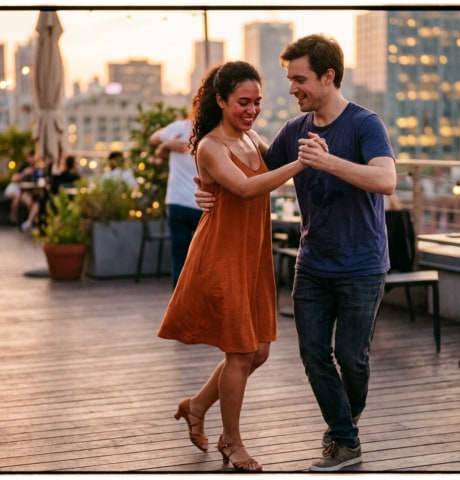 Switching from Ballroom to Social DanceThe switch from ballroom to free social dance is difficult for many. This guide shows you how to leave fixed choreographies behind and learn improvisation.
 Argentine Tango vs. Ballroom Tango: A ComparisonArgentine Tango or Ballroom Tango? Our comparison shows the differences between the improvised world of milongas and the structured elegance of ballroom dance.
 Neotango: The modern twist on Tango ArgentinoNeotango brings a breath of fresh air to traditional Tango Argentino. Learn all about the modern music, the open culture, and the creative dance style.
 Kizomba vs. Urban Kiz: Comparing origins, music, and the sceneKizomba and Urban Kiz are captivating dancers worldwide. Our guide compares traditional African roots with the modern European club scene.
 The history of social dance: From its roots to todayEmbark on a fascinating journey through time and discover how the history of social dance transformed traditional folk dances into a worldwide movement.
 Salsa, Bachata & Kizomba: Comparing the stylesSalsa, Bachata or Kizomba? Our comprehensive comparison shows you the differences in music, dynamics and atmosphere so you can find the perfect style for you.