

Find your dance community on udansa
Here you can meet like-minded people who are ready to take the step onto the dance floor. Connect with others and find the perfect partner for your next night of dancing.

By Mary De LucaUpdated

Here you can meet like-minded people who are ready to take the step onto the dance floor. Connect with others and find the perfect partner for your next night of dancing.
Moving from rigid choreography to free improvisation on the dance floor requires courage. With the right steps, you break free from fixed patterns and discover the pure joy of spontaneous partner dancing.
Anyone who has trained for years in classic competitive dance or a traditional dance school often moves within fixed grids. Every figure follows an exact count, the posture is strictly prescribed, and the couple moves along an invisible, but strictly defined circular path through the room. In social dance, however, this rigid construct breaks open. Here, there are no judges and no fixed choreographies that must be reeled off without error. Instead, the focus is on the spontaneous connection to the music and to the other person.
The switch from ballroom dance to social dance primarily means a mental adjustment. You have to learn to let go of control a little bit and trust the impulses of the moment. While the focus in a classic dance school is often on the flawless performance of a learned sequence, free dancing is about constant, wordless communication between partners. These principles of lead and follow are the key to breaking away from fixed patterns and discovering your own creativity on the dance floor.
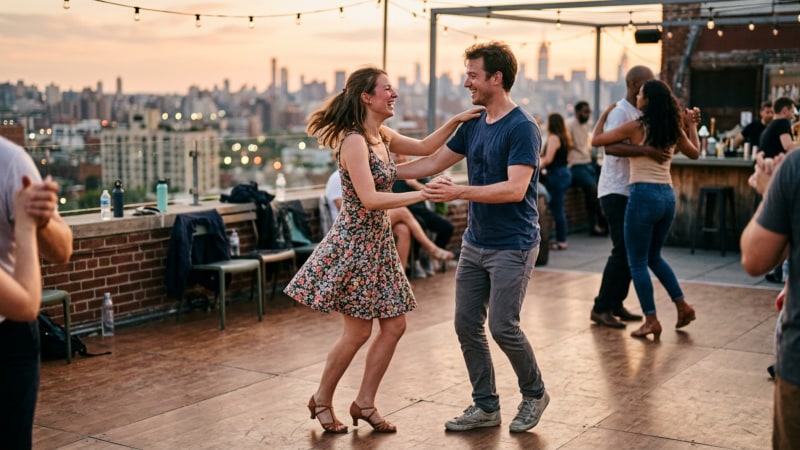
Say goodbye to the wide, extreme body tension of ballroom dancing. Let your shoulders drop, take some pressure out of your arms, and allow your center of gravity to sink more naturally and deeply.
When dancing, focus exclusively on the principle of weight and release. Feel which foot your partner is standing on, and follow these weight shifts without thinking about the next move.
Take a standard figure you know and mentally break it down into its individual parts. After half of the movement, start a different step or spontaneously change direction to train your improvisation in partner dance.
Specifically attend open practice nights or social dance parties. Take the opportunity to practice with dancers you don't know, as this forces you to truly lead or follow, instead of relying on habits.
Correct
Wrong
Preparation
Arrival
During
The main difference lies in the structure. While classical dance schools usually teach fixed sequences and choreographies for the dance floor, social dance is based on pure improvisation and direct communication within the couple.
You learn to dance freely by letting go of the fear of making mistakes and fully immersing yourself in the music. Start with simple weight shifts and react spontaneously to the rhythms instead of planning the next steps in your head.
Yes, absolutely. Your solid basic technique, your sense of rhythm, and your body awareness from ballroom dancing are an excellent foundation that you can quickly build upon in social dancing.
Discover courses in your area and learn the art of improvisation in partner dance.
 Social dance styles: Find your dance communityDive into the fascinating world of social dance styles. Learn what sets the Salsa, Bachata, and Swing scenes apart and how to find your place in the community.
 Argentine Tango vs. Ballroom Tango: A ComparisonArgentine Tango or Ballroom Tango? Our comparison shows the differences between the improvised world of milongas and the structured elegance of ballroom dance.
 Neotango: The modern twist on Tango ArgentinoNeotango brings a breath of fresh air to traditional Tango Argentino. Learn all about the modern music, the open culture, and the creative dance style.
 Kizomba vs. Urban Kiz: Comparing origins, music, and the sceneKizomba and Urban Kiz are captivating dancers worldwide. Our guide compares traditional African roots with the modern European club scene.
 The history of social dance: From its roots to todayEmbark on a fascinating journey through time and discover how the history of social dance transformed traditional folk dances into a worldwide movement.
 Salsa, Bachata & Kizomba: Comparing the stylesSalsa, Bachata or Kizomba? Our comprehensive comparison shows you the differences in music, dynamics and atmosphere so you can find the perfect style for you.
 West Coast Swing vs. Discofox: The ultimate comparisonThe ultimate comparison between West Coast Swing and Discofox shows you which modern partner dance best matches your rhythm and preferences.