Swing Competitions5 minutes

West Coast Swing Strictly Swing: What your couple score reveals

By Bernhard De LucaUpdated

In short
  • In Strictly Swing, you compete with a partner of your choice to music selected by the competition.
  • You improvise together instead of performing a set choreography to your own music.
  • The judges assess your performance as a couple, including timing, technique and musical connection.
  • The competition rules specify eligibility, judging procedures and movement restrictions, especially for lifts, drops and dancing apart.

Stepping onto the dance floor with someone you know takes away one uncertainty. It also shows how flexible you can be together when a song doesn’t suit your favorite combinations.

DefinitionCouple Scoring

Couple scoring means that the combined performance of two dancers receives a score or placement, rather than ranking each dancer independently.

A chosen couple keeps things spontaneous

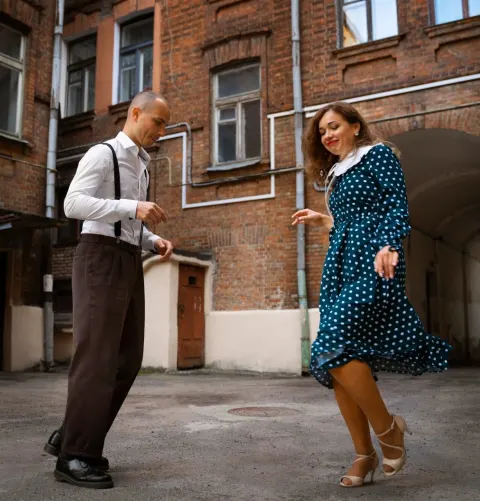
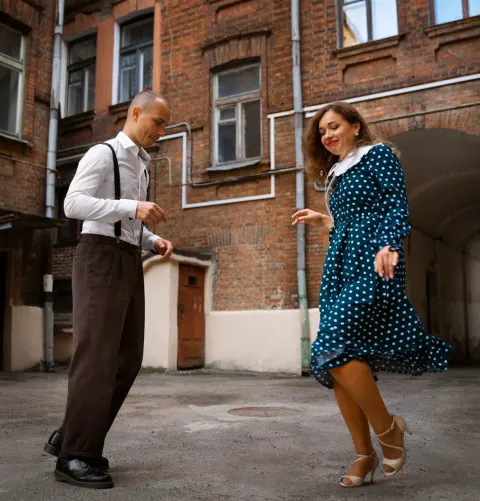
In West Coast Swing, Strictly Swing is a competition format where you choose your own partner. You register together and dance to music provided by the competition. Unlike Jack and Jill, your partner isn’t assigned to you. And unlike a choreographed performance, you don’t bring a fixed routine to your own song.

That doesn’t mean every move has to be invented on the spot. Familiar patterns, well-known transitions, and practiced reactions are all part of your repertoire. Improvisation comes from deciding which move fits the music and your partner right now. A combination might become shorter, a turn might be left out, or a quiet passage might get more space.

The leader offers pathways and transitions. The follower contributes rhythm and expression without losing the sense of connection. You both hear the same song, but you may notice different details in it. That coordination is what makes this format interesting: you know each other, but the dance remains open-ended.

That’s why it helps in training to use familiar building blocks with different music. A practice rhythm between two classes creates regular opportunities to do this without locking you into a competition routine.

Even familiar shoes can't replace your own balance, especially when the song prompts an unexpected decision.

The judges see the result of your collaboration

Judging in Strictly Swing focuses on the couple. A strong individual can support your shared result, but cannot replace clear transitions. If one person shapes the music while the other only keeps up, the dance lacks coordination. Conversely, a simple repertoire can be convincing when you both dance with precision and connection.

Typical judging areas are timing, technique and musical interpretation. Timing concerns how your weight changes and actions relate to the musical pulse. Technique can be seen, for example, in individual balance, controlled movements and clear transitions. Musicality is evident when the quality and expression of your movement match the song being played, not just a rehearsed effect.

These areas do not make up a universally identical scoring table. For example, judges may award placements instead of adding up fixed scores for individual technical elements. The criteria that are named and how they determine the result depend on the specific judging process. A difficult figure does not automatically earn a higher score.

A stable finish keeps further options open. For the technical foundation, see the guide to the Anchor Step without drifting away. In competition, what counts is not the move in isolation, but how securely you incorporate it into your dance together.

How to Recognize Genuine Improvisation

Do this

  • Use a practiced move that fits the current music
  • Take up a suggestion and adapt it together
  • When in doubt, choose a simple connection
  • Dance a dip only within the permitted limits

Not like this

  • Run through a practiced sequence regardless of the song
  • Lead your partner through a fixed sequence of moves
  • Force a difficult show move when you're unsure
  • Assume a dip is allowed because of its effect

A spectacular idea only helps the couple if both can carry it at the same moment.

Editorial team for dance guides

Movement restrictions are part of the competition format

Strictly Swing is not a free pass to perform every move you know together. The competition rules set limits on what you’re allowed to dance. These often apply to lifts or acrobatic moves, deep dips, and periods without partner contact. Some rulebooks also require a recognizable amount of Swing content. There is no universal percentage that applies to every Strictly competition.

When it comes to a lift, it’s especially important to understand how the rulebook defines a partner assisting you in leaving the floor. A small jump you do on your own is not automatically the same as a figure where your partner carries you. A dip may also be restricted even if you remain in contact with the floor. Terms like lift, aerial, drop, or dip therefore need to be understood in the context of the specific rules.

A brief moment of dancing apart and a longer solo section are not necessarily treated the same way. Being allowed to let go doesn’t mean you can improvise alongside each other for as long as you like. Depending on the rules, violations can result in point deductions or other consequences.

Before you start, read the competition rules on eligibility, judging, and these movement restrictions. There’s still plenty of room for creativity within those limits, even without acrobatics. A Swing course with a suitable learning goal can help you develop your musical expression on a solid foundation together.

Familiarity and surprise go hand in hand

Familiarity

You know your shared language

Habits make decisions readable

You know how a directional cue or a delay feels to your partner. This understanding creates room for small, precise responses, without having to agree on every movement in advance.

Surprise

The song changes your decision

Unexpected music keeps the dance open

A different timbre or an unexpected accent can make your familiar solution feel out of place. You can respond with a new decision while keeping your shared language.

Frequently Asked Questions

  1. Yes, you can practice figures and transitions in advance. An available repertoire is not a fixed choreography. What matters is that you develop your choices, sequence, and musical interpretation together while dancing, rather than performing a complete routine regardless of the song provided.

Partner dance classes for a shared foundation

You can develop timing, balance, and clear leading with your dance partner in class.

View all matching classes

Find a sense of partnership with room to play

On udansa, you can find dance partners to regularly practice West Coast Swing with and explore musical choices together.

Find a sense of partnership with room to play