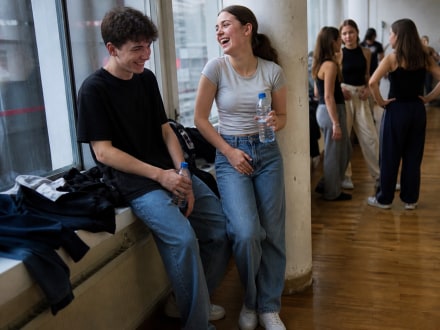
Find the right dance course
On udansa you can easily find the right dance school in your area and connect directly with other young people for your first dance course.


For many young people, their first dance class is an exciting step toward adulthood. To ensure that the anticipation is not dampened by unexpected expenses, a transparent look at all incurred costs helps.
The student dance course refers to a special course program offered by dance schools, which is aimed at teenagers aged mostly 14 to 18 and teaches the basics of the world dance program. In addition to the steps, the focus here is also on the joy of movement and the shared social experience.
Anyone interested in dance school prices will quickly realize that the course fee itself is only the foundation of the total costs. A classic beginner's course for teenagers usually spans a period of two to three months with weekly lessons of 60 to 90 minutes each. The course fees cover the instruction, the use of the dance studios, and the dance instructors' salaries. Often, this package also includes a small practice party where what has been learned can be tried out in a protected environment.
The price range varies depending on the region and the facilities of the dance school. In rural areas or for courses organized directly through school partnerships, the rates are often at the lower end of the scale. In metropolitan areas and at large, traditional dance schools in the city center, you usually pay a bit more. When comparing prices, parents and teenagers should pay close attention to how many lessons are actually included in the price and whether there are special discounts for group registrations.

Besides the course fee, there are expenses in everyday dance school life that hardly anyone thinks about at first. The largest item in weekly operations is usually drinks. Since dancing is a physical activity, young people quickly work up a sweat. For understandable reasons, many dance schools prohibit bringing your own drinks, which means costs for water, soda, or spritzers are incurred on-site every hour. Over the entire duration of the course, this adds up to a noticeable amount.
Another cost factor is the appropriate wardrobe. Although an expensive suit is not necessary for normal classes, as the guide on dance courses for teenagers shows, neat casual clothing is still required. Clean sneakers that are worn exclusively in the dance school, or special dance shoes with a smooth sole, may need to be purchased. Anyone who plans ahead here and uses existing, well-preserved clothing will save their budget significantly.
Ask for a free trial class or an information evening before signing up. This way, you can take a look at the premises and clarify directly whether you are allowed to bring your own drinks during the breaks.
A transparent price comparison protects you from surprises. If you include the additional costs for drinks and the right clothing from the start, you can enjoy the course in a completely relaxed way.
To plan the budget for a student dance course optimally, it is worth taking a systematic look at the payment terms. Most dance schools require a one-time payment before the course starts or offer monthly installments for longer durations. It is important to keep an eye on the cancellation policy: What happens if the teenager misses several weeks due to illness or school commitments? Some schools offer credits or the option to make up for missed lessons in parallel courses.
Those who compare cleverly can save real money. There are often early-bird discounts for quick decision-makers or special rates if half a school class signs up together. Family rates, in case older siblings were already active at the same dance school, are also not uncommon. With a realistic overview that includes not only the course fee but also a fixed weekly allowance for drinks and potential travel costs to the dance school, the anticipation for the new hobby remains untarnished.
The predictable basis of the dance course
The pure course price covers professional instruction by the dance teachers, the provision of the premises, and the basic organization. This amount is fixed in advance and can be planned for reliably.
Variable everyday expenses
Expenses for drinks during breaks, travel to the dance school, and the purchase of clean everyday clothing are flexible costs. You should factor these in as a fixed weekly budget for udansa.
A typical dance course for students costs between 80 and 150 euros for a duration of about two to three months. Prices vary depending on the region, group size, and the facilities of the respective dance school.
Find the right beginner course now and compare offers directly in your region.
Wednesday · 13:15-14:45 · Nov 11, 2026 - Feb 24, 2027
Leukersdorf
Friday · 13:20-14:50 · Nov 13, 2026 - Feb 26, 2027
Waldenburg