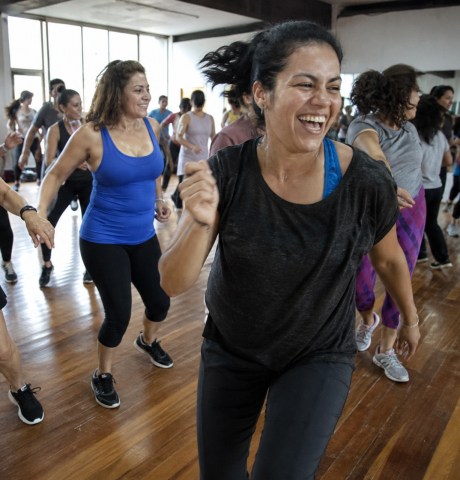
Find your Zumba rhythm together
On udansa connect, you will find like-minded people who share your enthusiasm. Search specifically for dance partners or discover the best Zumba courses right in your area.


On udansa connect, you will find like-minded people who share your enthusiasm. Search specifically for dance partners or discover the best Zumba courses right in your area.
Cumbia brings the warm, earthy heartbeat of Colombia directly into your workout. Learn how the asymmetrical rhythm guides your movements and why this dance style is so wonderfully grounding.
Cumbia is a traditional music and dance style from Colombia, which combines African, indigenous, and Spanish influences. It is characterized by a swaying rhythm and a distinctive, asymmetrical step pattern.
Anyone attending a course based on the Zumba concept for the first time will quickly notice the variety of Latin American sounds. Among the four core rhythms, Colombian Cumbia plays a very special role. While Salsa impresses with fast turns and Merengue with an incessant, march-like tempo, Cumbia brings an earthy, almost hypnotic calm to the workout. The Zumba Cumbia rhythm is characterized by a distinctive, dragging meter that historically traces back to the African and indigenous roots of Colombia.
To truly enjoy this style in class, it helps to take a look at the instrumentation. The music is traditionally carried by drums, rattles, and flutes, often supplemented in modern Zumba mixes by accordion sounds and electronic bass. The tempo is moderate and gives you time to focus on your hip work and the conscious lifting and lowering of your feet. Cumbia is the ideal rhythm to regain your strength after intense phases of exertion without losing your dance tension.
To execute the movements fluidly, understanding the Cumbia beat in Zumba is crucial. Cumbia is in a classic 2/4 or 4/4 time signature, but it is emphasized in a very asymmetrical way. The defining element is the so-called off-beat shaker sound or the characteristic scraping of the guacharaca (a traditional scraper). This sound creates a rhythmic "chack-a-chack" that lies between the main beats. It feels like a gentle trailing motion that sets your entire body into a swaying movement.
In contrast to European dances, where weight is usually shifted precisely and symmetrically from one foot to the other, the weight in Cumbia often remains slightly shifted to one side. The music invites you to literally feel the floor beneath your feet. When you learn to let this driving, yet never hectic, off-beat flow into your body, the initial stiffness dissolves almost by itself. You no longer dance against the beat, but let yourself be carried by it.
How it works
Avoid this
Cumbia brings a wonderful sense of grounding to every Zumba class. The music does not force us to rush, but invites us to feel the movement proudly and deep in the ground.
The typical Zumba Cumbia steps and their music are based on a historical peculiarity: the slave step (Paso de la Cumbia). Historically, the dancers had to drag a heavy chain on one foot, which led to the asymmetrical step sequence where one leg is stabilized and the other is dragged along. In a modern Zumba class, this translates into the so-called "Sleepy Leg" step or the "Cumbia Basic Step". One foot remains firmly on the ground and only makes small weight shifts in place, while the other foot taps in a semicircle to the front and back.
Another popular step is the "Sugar Cane" step, where you move sideways as if you were plowing the ground, combined with a soft, circular hip movement. The arms usually remain angled in front of the upper body or mimic the holding of a traditional skirt. Once you internalize this coordination, Cumbia becomes one of the most expressive parts of your Zumba class. It is less about athletic jumps here, but rather about the proud, upright posture and the rhythmic interplay of hips and feet.
The asymmetrical Cumbia basic step
The basic step is characterized by the fact that one foot remains firmly on the ground and carries the body weight, while the other foot taps rhythmically. This asymmetry requires soft hip movement and creates the typical dragging character of the dance.
Proud posture and flowing arms
The arms often move as if you were holding a long robe or skirt and swinging it rhythmically in the wind. The upper body remains proud and upright, which gives the dance an elegant and at the same time powerful aura.
The Cumbia beat is significantly slower and more earthy than Salsa or Merengue. It is based on a swaying off-beat, while Salsa is characterized by syncopated, fast steps and Merengue by a fast, march-like one-two pattern.
The most important step is the Cumbia basic step, often called the Sleepy Leg. One foot remains almost in the same spot as a pivot point, while the other leg rhythmically taps forward and backward, accompanied by a soft hip movement.
Yes, Cumbia is excellent for beginners. The moderate tempo gives you enough time to execute the steps precisely, train your coordination, and develop a feel for the hip movement without running out of breath.
Experience the Colombian rhythms live and find the perfect workout for you.
ZumbaLimbach-Oberfrohna
ZUMBA® Fitness Clubrunning since Aug 18
Limbach-Oberfrohna
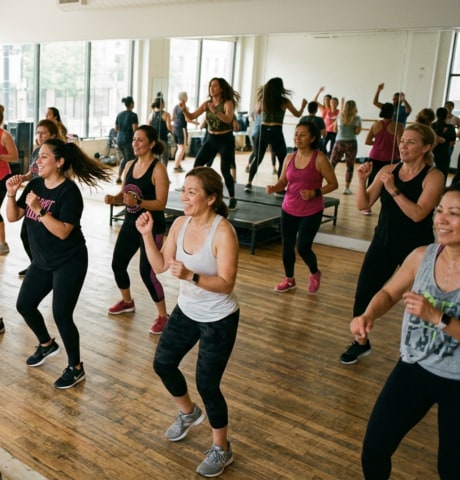 Zumba Music: The rhythms behind the workoutZumba music is much more than just a fast beat. Learn how different Latin American rhythms drive your workout and boost your fat burning.
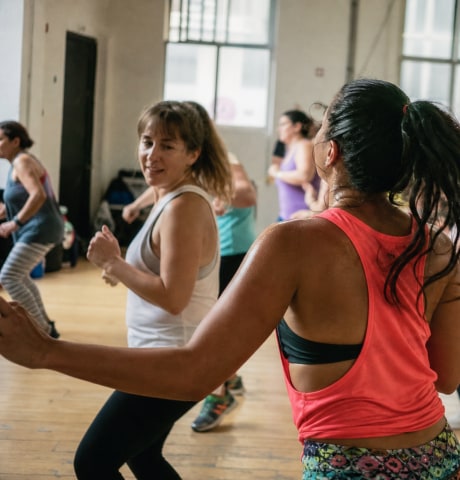 Zumba Reggaeton: Urban beats for maximum energyDiscover the untamed power of Reggaeton beats in Zumba. Learn how the distinctive dembow rhythm takes your fitness to a new level.
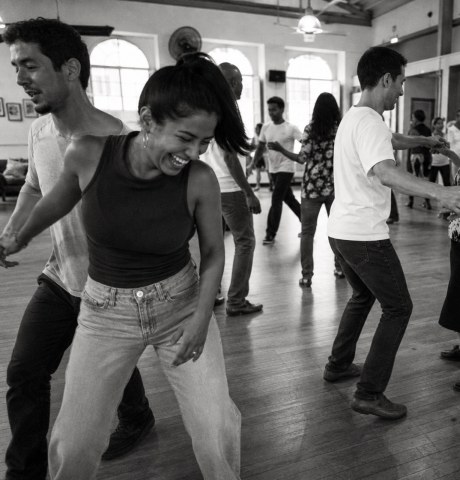 Zumba Merengue: Master the fast beat with easeLearn how to instantly identify the fast Merengue beat in your Zumba class and perfectly synchronize your steps with the music.
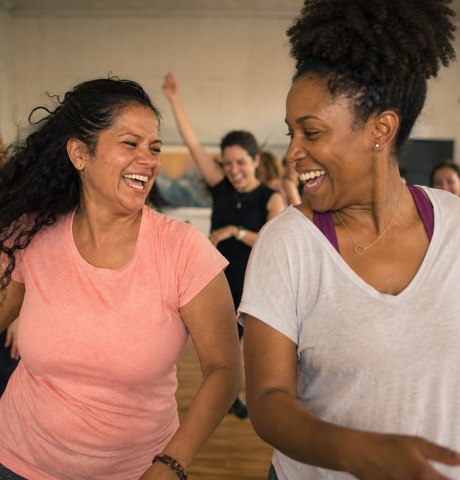 Zumba Soca: Caribbean rhythms for an explosive vibeDiscover the explosive power of Soca in your Zumba training. This guide shows you how fast Caribbean beats challenge your stamina and bring pure joy to your workout.
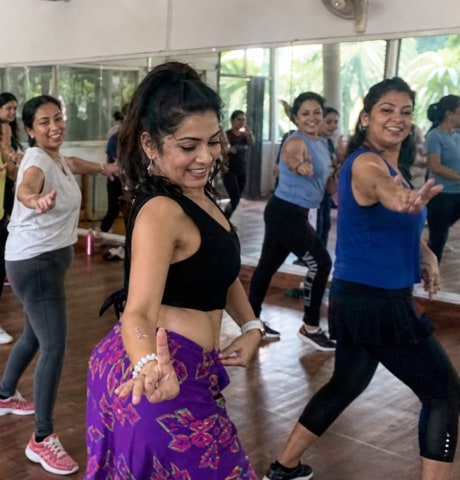 Zumba international rhythms: The world in your workoutDiscover how Zumba uses international rhythms like Bollywood and Flamenco to make your workout more varied and effective.
 Find free Zumba music: The best legal sourcesAre you looking for the perfect beats for your Zumba workout at home without spending money? We show you the best legal and free sources for danceable rhythms.
 Zumba music structure: The 32-count formula explainedThe 32-count formula is the key to every Zumba workout. Learn how the music is structured and dance perfectly on beat from the very first second.