Dance goals6 minutes

Dance styles in Karlsruhe: What suits your occasion

By Mary De LucaUpdated

In short
  • For your search in Karlsruhe, dance styles differ in movement technique, music, and whether you dance solo or with a partner.
  • Ballet trains precise positions, while contemporary dance uses weight, floor work, and improvisation, depending on the approach.
  • Salsa, Discofox, ballroom and Latin dances offer different rhythms and partner movements for social dancing or special occasions.
  • For a wedding, graduation ball, ball preparation, your own choreography, or fitness training, your learning goal determines the right choice.

A favourite song can inspire you to dance, but it doesn’t yet tell you which moves would go with it. If you have a particular occasion in mind, course names that sound similar can suddenly seem very different in appeal.

DefinitionChoreography

Choreography refers to the deliberate arrangement of a sequence of movements in space and time. It can include set steps, as well as agreed-upon room for improvisation.

Dance styles differ in their movement logic

When looking for dance styles in Karlsruhe, it helps to start by asking what kind of movement you want to learn. In ballet, you work with clearly named positions, alignment, balance and precise transitions. Turnout comes from the hips, not from twisting your feet. Even simple exercises combine posture with controlled weight shifts.

Contemporary dance can organize the body differently: releasing weight, rolling across the floor, falling and getting back up. That does not mean every movement is arbitrary. Here too, momentum, supporting yourself and changing direction require learned technique. Modern Dance and Dance Improvisation may appeal to similar interests, but they do not automatically describe the same kind of class.

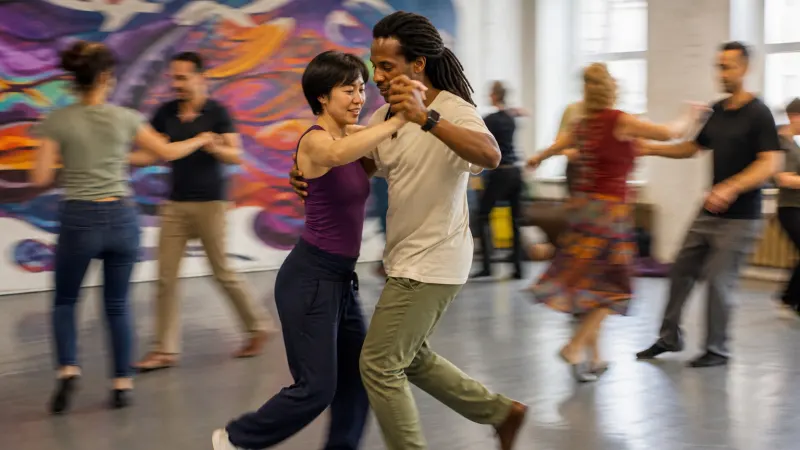
Hip Hop, among other things, focuses on groove, rhythmic accents and different movement qualities. A groove is the recurring physical organization of rhythm, not just a sequence of arm movements. With Salsa and Discofox, coordinating with a partner is also part of the picture: both of you need to support your own weight and respond clearly to signals.

Karlsruhe also has a documented connection to ballet: the ensemble at the Badisches Staatstheater was renamed Staatsballett Karlsruhe in 2013. For your own classes, however, the movement work is what matters, not the stage image in your mind. You can find more about the city context under Dancing in Karlsruhe.
Shoes reveal your approach to movement, but they don't replace the choice between precise form and free exploration.

An Occasion Is Not a Dance Style of Its Own

Wedding dance describes a learning goal, not a fixed technique. A Waltz may suit the song you have chosen, but it doesn't have to. The musical pulse, the tempo and the effect you want determine whether you create, for example, a calm sequence as a couple or a livelier dance. A short, confidently connected sequence is usually more convincing than figures that leave you having to start again each time.

For prom and prom preparation, the task is broader: you also want to be able to dance to music you haven't chosen yourself. Ballroom dances such as Waltz, Foxtrot and Quickstep use different rhythms and often travel around the floor. Latin American competitive dances include Cha-Cha, Rumba and Jive. Despite its Latin American origins, Salsa isn't part of this competitive dance group.

Discofox, in turn, offers compact partner movement to many songs with a steady pulse. But it doesn't replace every other dance form. Terms like ballroom and Latin encompass several dances, while prom and wedding dance describe the occasion. For a deeper look at dance preparation for a specific occasion, check out Getting ready to dance at prom. The key distinction here is: Do you want to perform a specific sequence, or respond to changing music?

Recognize the learning goal in dance

Just like that

  • Match your wedding dance to your chosen song
  • Learn floor patterns and partner hold for the ball
  • Create transitions and musical arcs in choreographies
  • Combine exertion and movement control in fitness dance

Not this way

  • Automatically choose a waltz for every wedding song
  • Reduce ball preparation to a single performance routine
  • Build a choreography using only difficult figures
  • Measure training quality only by how much you sweat

A clear beginning and a calm ending often give a short dance sequence more impact than an additional difficult figure.

udansa editorial team for dance guides

Choreography and fitness training focus on different things

You don't need to start with a particularly difficult style to create your own choreography. You need movement ideas that work well together. Ballet can provide clear lines, Hip Hop rhythmic accents, and contemporary dance shifts between upright movement and floor work. Transitions, repetitions, changes of direction, and deliberate pauses create a cohesive sequence. Even a few steps can show a clear progression.

A dance from a music video often shows only the finished result. Camera cuts, perspective, and elaborate staging can obscure how challenging a transition actually is. If examples like these inspire you, the guide to dances from film and television you can learn puts the journey from watching to moving for yourself into perspective.

With dance fitness training, the goal shifts: repeated sequences are meant to keep you moving and challenge your endurance. Zumba is one format, while a technique class breaks down individual movements in greater detail. Both can be physically demanding. However, working up a sweat proves neither clean technique nor an appropriate level of exertion.

For choosing a class in Karlsruhe, this means you should first decide whether you want to develop a choreographed sequence, dance freely, or train continuously. These goals can complement one another. But they are no reason to consider every class involving music and movement an equivalent substitute.

Two ways to express music through dance

Set

Deliberately develop a sequence

For a specific musical progression

A set choreography lets you deliberately shape accents, directions of gaze and transitions. Repetition builds confidence for a performance. You learn not only to execute movements correctly, but also to connect them into a coherent progression.

Open

Make decisions in the moment

For changing music and spontaneous movement

Freestyle dancing lets you respond to new music, space and impulses. In partner dancing, clear signals help, while in solo dancing, you draw on your movement vocabulary. You learn to connect familiar elements flexibly without recalling an entire sequence.

Frequently asked questions

  1. You don’t need to be particularly flexible to start ballet. Flexibility develops along with strength and coordination. What matters is performing positions with control within your available range of motion, rather than forcing your feet or hips into a greater turnout.

Dance classes for your learning goal in Karlsruhe

On udansa, you can find classes and dates in Karlsruhe and filter by dance style to suit your occasion.

Your occasion sets the beat

On udansa, you'll find dance classes in Karlsruhe for your specific learning goal. Whether you want to learn a wedding dance routine or create your own choreography, you can find the right lessons.

Your occasion sets the beat