Course level6 minutes

Advanced dance class in Karlsruhe: Is the level right?

By Mary De LucaUpdated

In short
  • A suitable advanced course in Karlsruhe requires skills you can draw on without constantly watching demonstrations.
  • Four qualities matter: rhythmic confidence, movement control, adaptability, and how you handle technical corrections.
  • Regular attendance and familiarity with many routines alone do not prove that the placement is right for you.
  • The level is right when new tasks challenge you without continually overwhelming your existing foundations.

In a familiar routine, everything can feel secure. Only a small change shows how much attention is still tied up in the basics and how much is free for new tasks.

DefinitionAutomation

Automation refers to performing practiced movements without having to consciously control every part. This leaves you free to focus on the music, the space, and new technical tasks.

Course levels describe the expected independence

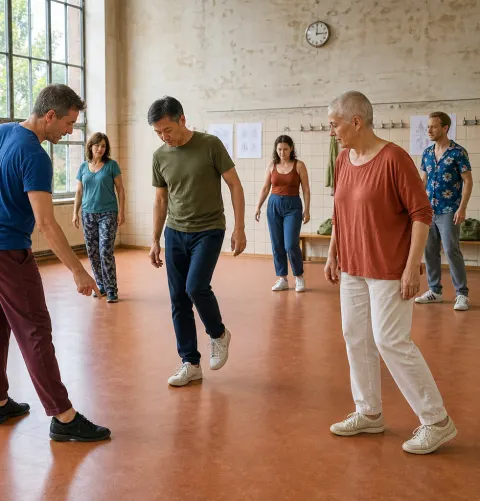
If you dance regularly in Karlsruhe, you probably know the reassuring feeling of a familiar routine. You know what comes next and can perform the movement without much thought. For an advanced course, however, it also matters what happens when a new task is added. Does your rhythm stay steady while you change a technical detail? Or do you have to consciously piece every step together again?

Course names such as advanced, intermediate or improver are not a standardized scale. They can describe different teaching goals. One class expands movement sequences, while another refines familiar movements. The key requirement is the independence the class can build on. This includes working through familiar tasks without constant demonstration and translating a brief correction into your own movement.

Regular attendance initially tells you only how often you have taken classes. It does not reveal which skills you have consolidated. Your experience is therefore more meaningful when you describe it in terms of what you can do: for example, starting independently, finishing a sequence with control or staying oriented when something changes. The guide to choosing a suitable Swing course also explains why a learning goal is more helpful than a level name.
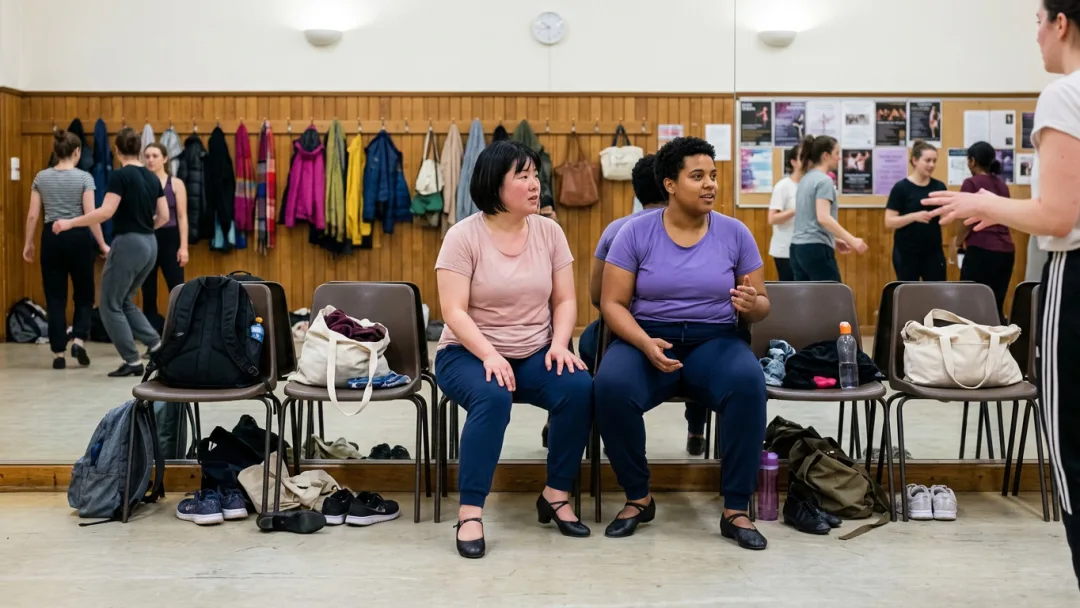
Taking a short break from practicing is also part of learning, if you try out a specific change afterward.

Four traits distinguish routine from accessible technique

Rhythmic confidence means you can coordinate your movement with the music, even when nobody is counting. You may briefly lose the beat. What matters is whether you can find your way back to the rhythm yourself, rather than simply copying another person's feet.

Movement control is especially evident in transitions: you shift your weight deliberately, finish a movement without an unintended extra step, and can change its size. Adaptability comes into play when a familiar condition changes, such as the direction or the available space. In partner dancing, this also means responding to your partner's movement without using extra force to insist on a familiar path.

The fourth trait is how you handle corrections. A note like “shift your weight later” does not have to work right away. But you should be able to recognize which part of your movement it concerns and keep working on it without giving up everything else.

These traits do not add up to a score or a universally applicable admission judgment. They explain why someone can know many sequences and still need support with a technical task. Likewise, someone with a smaller repertoire can learn challenging material because their fundamentals are reliably accessible. Neither can be determined by the number of classes attended.

How to recognize solid foundations

Like this

  • Dance a familiar sequence without constantly looking at the instructor
  • Resume on your own after an interruption
  • Make your steps smaller in a controlled way when there is less space
  • Try out a technical correction in a familiar sequence

Not like this

  • Copy every step at the same time as the instructor
  • Only be able to join in again after an interruption with someone else's help
  • Force the movement when there's less space
  • Have to relearn the entire sequence for every correction

A higher course level is a good fit when you don't constantly lose the basics you're already comfortable with while learning new steps.

udansa-Redaktion

The right challenge leaves room to learn

A suitable higher level may feel unfamiliar at first. You may need to understand new connections, distinguish movements more precisely, or meet several demands at once. This effort is productive as long as you recognize the core of the task and can draw on the foundations you already have. Feeling unsure about a new detail is different from constantly losing your bearings.

By contrast, you’re overwhelmed when almost all your attention is taken up by prerequisites that are already assumed in class. The group might be working on movement quality, for example, while you’re still trying to piece together the basic sequence. Being underchallenged looks different: You complete the tasks reliably, but encounter hardly any new technical demands. A familiar movement alone doesn’t prove that you’re underchallenged, since performing it more precisely can require a lot of concentration.

A higher level also doesn’t automatically mean dancing faster or with more physical intensity. Technical complexity and physical exertion are different things. For the physical side, the guide explains how you can increase the intensity of dancing.

For your search in Karlsruhe, you can turn this into a concrete learning goal, such as controlling familiar movements even when the direction changes. If it’s unclear which skills are assumed, it’s more helpful to ask the provider a specific question about them than to ask whether you’re generally “advanced enough.”

Two worthwhile goals for experienced dancers

In-depth practice

Refining the familiar with greater precision

Paying attention to small differences

A technically focused course can use familiar movements and still be challenging. You work on weight distribution, timing, or movement quality, for example. The challenge lies in noticing differences and changing them deliberately.

Extension

Combine more tasks

Awareness of new connections

An extension course combines familiar fundamentals with additional demands. For example, you keep the rhythm while the direction or your spatial orientation changes. The challenge is to manage several tasks at the same time.

Frequently Asked Questions

  1. No, an advanced course does not require flawless execution. What matters is that mistakes do not prevent you from moving on to every subsequent task. If you can pinpoint an area of uncertainty and work on it with a pointer, it is a worthwhile learning focus, not an automatic reason to move down a level.

Dance classes in Karlsruhe for your skill level

On udansa, you can find classes and dates in Karlsruhe that match your learning goal.

Keep moving forward with a suitable learning goal

On udansa, you can find dance classes in Karlsruhe and dance partners to practice with. This way, you can develop the skill that hasn’t received enough attention in your regular dancing so far.

Keep moving forward with a suitable learning goal