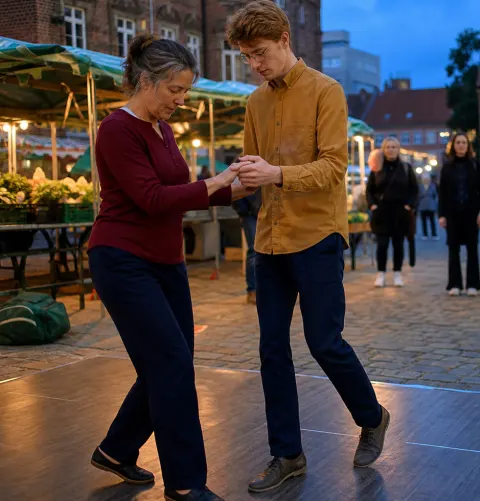
Dancing outdoors5 minutes

Open-Air Dancing in Bremen: Public or Private?

By Bernhard De LucaUpdated

In short
  • For open-air dancing in Bremen, it is the group of participants addressed, not the freely accessible location, that determines whether the event is open to the public.
  • A public invitation may still require registration, charge an admission fee, or have limited spots.
  • For dancing, a level surface and secure footing matter; a step-free route alone is not enough.
  • A useful weather policy specifies whether the event will be canceled or moved to an alternative venue, and how this will be communicated reliably.

You hear music, see people dancing and would like to join in. Especially outdoors, the line between watching and taking part can seem invisible, even though it may be quite clear to the people involved.

DefinitionRotational resistance

Rotational resistance describes how much the contact between the sole of a shoe and the floor slows a turn. If the foot sticks while the body continues to turn, this can put strain on the knee.

The place does not say who can join in

If you’ve found an occasion for open-air dancing in Bremen, it helps to distinguish between two things: whether the space is accessible and whether people are invited to dance. People can practise together privately on a publicly accessible lawn. A speaker playing audible music or passersby watching do not automatically make that group open to others.

The wording Anyone interested can join, on the other hand, is aimed at people outside an existing circle of acquaintances. We’re meeting with our previous course participants describes a limited group. Forwarding a message does not make it any less private. Being publicly visible is not the same as being publicly invited.

Registration and admission alone do not determine the distinction. An event advertised publicly can limit the number of places, while a private gathering can be free. Likewise, the word open tells you little without context: it can refer to who can take part, but it can also mean there is no set programme. The classification of a Swing party to suit your dance also shows how important such details about the format can be.

This is a practical guide to deciding whether to take part, not a legal assessment of permits or organizers’ obligations. An invitation also does not automatically give you permission to film the other dancers or publish footage of them.
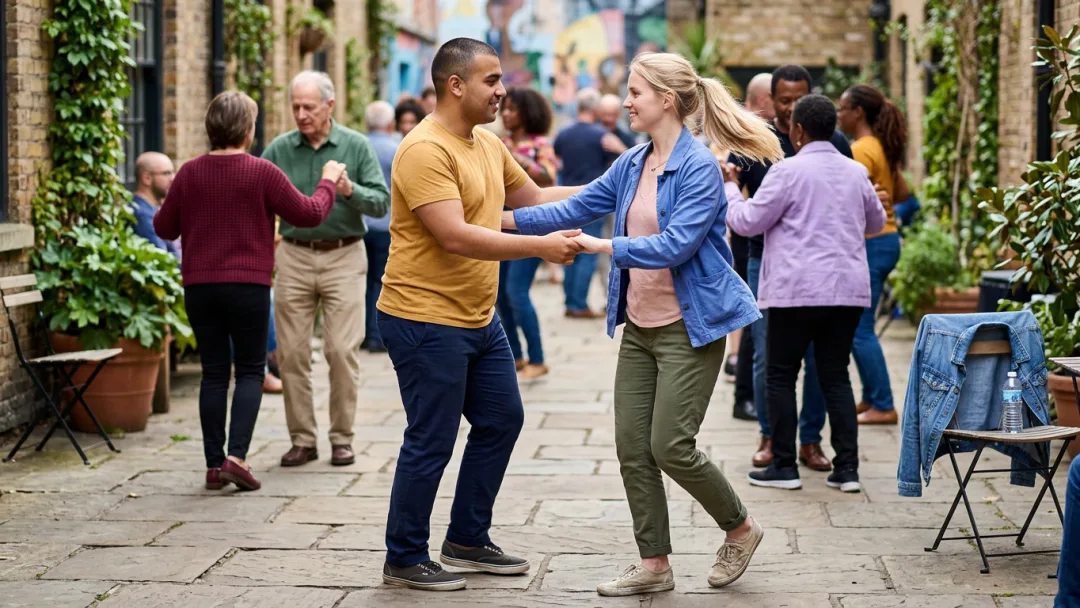
Even the transition from the firm path to the meadow can limit the usable dance floor.

An accessible space is not necessarily a suitable dance floor

When dancing outdoors, terms such as paved, level and step-free access describe different features. A paved path may be easy to access, while wide gaps can interrupt small steps. A meadow may look level, but give way under a weighted foot. A firm surface, in turn, may be so rough that turns become difficult.

The contact with the sole matters too. Smooth soles can slip on damp stone; grippy soles can greatly slow a turn on rough ground. Outdoor shoes with flat, sturdy soles are often more practical on varying paths than delicate dance shoes. However, they do not guarantee a safe turn. On a surface that grips, you can change direction with several small steps instead of turning on a planted foot. Greater mobility through dancing is no substitute for suitable contact with the ground.

Accessibility also applies to the entire route: from the entrance to the dance floor, to seating and, where applicable, to the restroom. A step-free entrance says nothing about gravel on the final stretch. That is why specific descriptions of these sections provide more guidance than the standalone word accessible. Different needs cannot be inferred from a single label.

Keep these details separate

Like this

  • Use the explicitly invited group of participants as your starting point
  • Consider step-free access and the dance floor surface separately
  • Relate the weather update to the event you found

Not like this

  • Take passers-by watching as an invitation to join in
  • Assume that a step-free entrance means there is a suitable dance floor
  • Treat an older fair-weather announcement as a confirmation

An announcement is helpful when its details give you a clear idea of what taking part will involve.

udansa editorial team

A weather policy describes the actual alternative

Only in good weather describes an intention, but not yet a reliable plan. A helpful announcement, by contrast, distinguishes between cancellation, a break and a specified alternative venue. It also states where any changes will be announced. An old post with no connection to the event you found is not reliable evidence.

The conditions also affect the dancing itself. After a shower, a solid surface may still be damp even though it has stopped raining. Wet leaves reduce traction. Wind can blow loose objects onto the dance floor and make clothing get in the way when turning. As daylight fades, small uneven spots become harder to see. Whether music is playing therefore says nothing about the condition of the floor.

A roof only solves part of the problem: rain can blow in from the side, and the route to the covered area may still be exposed. An alternative indoor venue, in turn, may have different entry requirements or less space. The word alternative alone does not clarify these differences.

If the announcement leaves out important details, one concise inquiry about who can attend, the floor, the route in and weather updates is enough. Without a reply, these points remain unclear. A photo of people happily dancing is no substitute for an invitation or a weather policy for your event.

Two different invitation formats

Public

No need to know anyone personally

The invitation is open to a broad group of people

You don't need to know the others personally to be part of the group being invited. Registration may still be required, for example to limit the number of places. The announced format sets the shared framework.

Private

Attendance by personal invitation

The invitation is for a limited group of people

You are part of the gathering through a personal invitation or existing affiliation. This setting can also exist in a publicly accessible area. Watching does not automatically make you part of the gathering.

Frequently Asked Questions

  1. Yes, a public dance event can charge an admission fee. Public describes who the event is open to, not whether it is free of charge. A binding registration requirement or a limited number of places does not automatically make a public invitation any less public.

Dance outdoors with the right setting

On udansa, you can find dance events in Bremen with details about each occasion. That way, you can tell an open invitation apart from a personal get-together, without assuming you're invited just based on the setting.

Dance outdoors with the right setting