Share your theatre night
On udansa connect, you can find people in Rome to watch a dance performance with and talk about what you saw afterwards.

By Mary De LucaUpdated
On udansa connect, you can find people in Rome to watch a dance performance with and talk about what you saw afterwards.
An evening can move you through a figure, a falling body, or an image that resists resolution. You don't need dance experience or specialist vocabulary to be drawn to one of these.
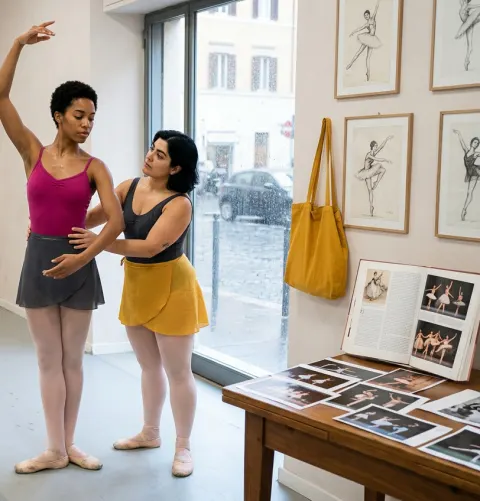
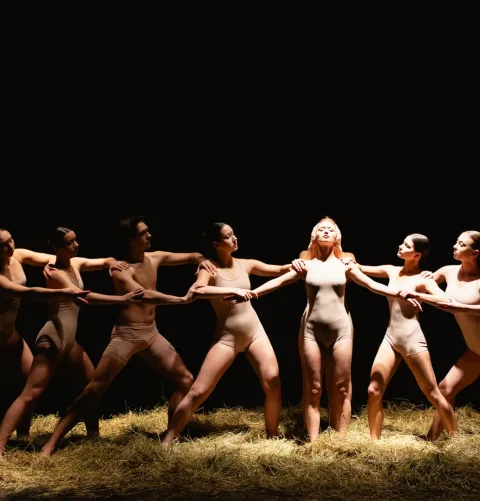
At a dance performance, you can follow a story or observe how bodies transform space. Classical ballet often works with turned-out legs, precise lines, jumps, and turns. But that doesn’t mean a plot is required. Contemporary dance can visibly transfer weight, move close to the floor, or interrupt movements. It can also tell stories and be very precisely choreographed. The style name alone doesn’t tell you what kind of evening you’ll experience.
Two historically documented reference points offer some orientation in Rome: in the 1950s, classical repertory ballets were among the premieres presented by the opera ballet. The Romäuropa Festival, founded in 1986, brought together contemporary dance, performance, theatre, music, and film. These describe different artistic contexts, not the current program. For a broader overview, take a look at the perspectives on dance performances in Rome.
Answer the five questions based on your spontaneous preference, choosing one answer each time. Then count your A, B, and C answers separately: the most frequent letter gives you a starting point. If there’s a tie, several approaches may suit you. There are no right answers and no higher level.
You find your way in through characters, clear developments and carefully shaped movement. Narrative ballet is therefore a good starting point, especially when the music carries a dramatic arc. Use plot, characters and classical movement vocabulary as criteria for your choice, without automatically classifying every ballet as a story.
Your attention is drawn to physical processes: impulses, balance, and the shift between tension and release. Contemporary dance can offer you a fitting way in, even without a narrative told through figures. When making your choice, look for descriptions of movement quality, physical contact, and space, not just the word modern.
You like evenings whose meaning isn't immediately set, and where different forms of expression come together. Experimental dance theatre or performance with a strong dance element are possible starting points. Use terms such as voice, everyday gestures, media, and open dramaturgy to describe more precisely what you're looking for.
| Criterion | A: Plot and Form | B: Movement and Body | C: Images and Experiment |
|---|---|---|---|
| Possible starting point | Narrative ballet | Contemporary dance | Dance theatre and performance |
| Your eye follows | Characters and relationships | Weight, impulses, and space | Gestures and ambiguous images |
| Musical approach | Melodies and dramatic arcs | Rhythm, sound, and contrasts | Voices, sounds, and silence |
| Possible point of friction | Abstract passages offer little plot | A clear throughline may be missing | Breaks can create distance |
| What you can allow | Even classical forms don't always tell a story | Even physically focused pieces can tell a story | Not every image needs a resolution |
The three results describe viewing preferences, not fixed boundaries between stage forms.
Use your result as an observation prompt, not as a lasting label. With A, you can follow how relationships change over the course of an evening: Who moves closer to whom, who steps back, when does a solo become a group? With B, observe where a movement impulse begins and how it travels through the body. A fall might slow to a controlled stop, a jump might land heavily or fade almost silently. With C, pay attention to what changes through repetition: An everyday gesture can seem funny and later become unsettling.
These perspectives also work beyond the letter you chose most often. A classically trained body can be used experimentally; a contemporary piece can tell a story about a relationship very clearly. Dance theater can use language, but it doesn't have to. So being open-minded isn't a test of your knowledge or patience.
Two personal preferences can help you choose a performance more than any blanket judgment: for example, a character-driven story plus melodic music, or floorwork plus contrasting sounds. When you sort through event listings on udansa, it also helps to distinguish between a stage performance and a dance floor. After attending, you can note which of the aspects you chose actually held your attention.
No, you don't need prior dance experience to understand contemporary dance. You can notice movement through tempo, weight, proximity and repetition. Technical terms can help you describe what you see, but they're not a ticket to understanding. Start with what you actually see instead of looking for a supposedly correct interpretation.
No, ballet can tell a story or be created without a plot or characters. In abstract choreography, for example, musical structure, pathways through space and relationships between bodies can carry the evening. If you chose mostly A in the quiz, narrative ballet is therefore a more precise starting point than the label ballet alone.
Contemporary dance and dance theatre overlap, with dance theatre often incorporating gestures, language and stage situations. Contemporary dance refers to a broad field of movement approaches, not a single technique for every stage. A piece can belong to both areas; when making your choice, its specific means of expression are more helpful than a rigid distinction.
A tie means that several approaches appeal to you to a similar degree. You don't have to settle on one fixed type of audience member. Use both results as a guide and choose the aspect you're more curious about right now for an evening out, such as a story with characters or unusual body movements.