Watch dance in Rome together watch
On udansa connect, you can find people in Rome to attend dance performances with and talk about what you saw afterwards.

By Bernhard De LucaUpdated
On udansa connect, you can find people in Rome to attend dance performances with and talk about what you saw afterwards.
If you live in Rome, familiar ruins can suddenly look different when you watch. A movement draws your attention to a gap, a passageway, or the size of a space you had previously just walked through.
A guided dance tour combines a guided route through a place with dance performances. This lets the audience experience movement at different locations rather than exclusively from a fixed seat.
From June 26 to July 5, 2026, Caracalla Danza took over the Baths of Caracalla in Rome. The festival was organized by the Soprintendenza Speciale di Roma and the CCN/Aterballetto company. The format included dance tours through the site and pieces performed on a stage above the water. This brought together an archaeological site and two different ways of presenting dance.
The difference lay not only in the piece itself, but also in where the audience was positioned. A stage focuses attention on a defined performance area. A tour combines watching with moving through the site: walking between the dance moments is also part of experiencing the place.
Caracalla Danza therefore cannot simply be read as another name for the Rome Opera's summer season. It was a festival of its own, with its own organizers and this combination of stage pieces and dance tours. This is about the completed 2026 edition, not a program you can book. The guide to the stage and dance floor in Rome explains the basic differences between a performance, a dance evening, and dancing together.
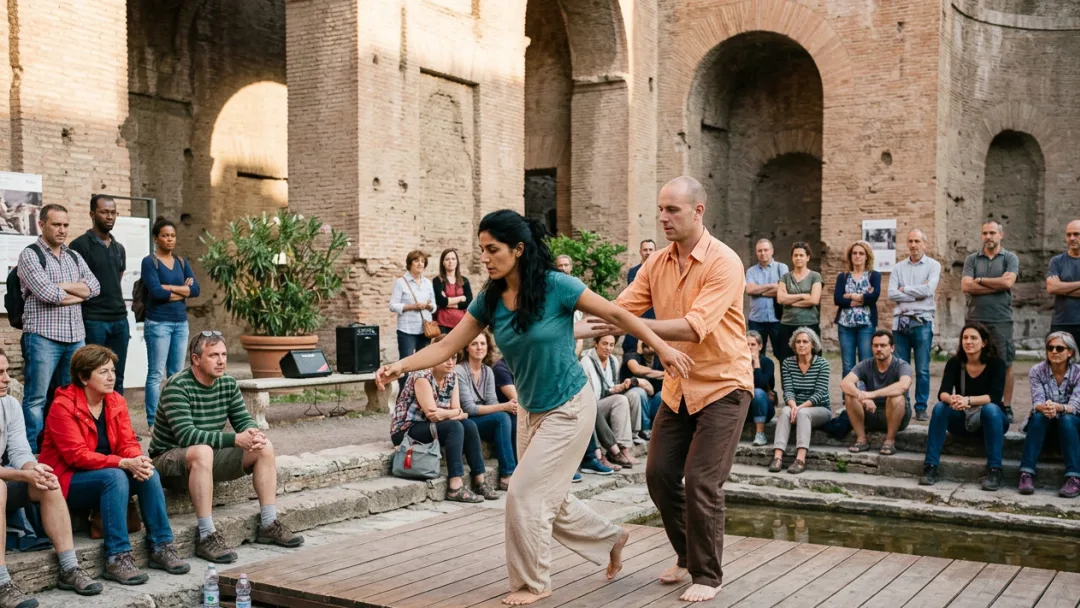
Pieces by Caracalla Danza were presented on the stage beside the reflecting pool. The stage area gave the movements a shared frame, while the archaeological surroundings remained visibly part of the performance venue. You could focus on the dancers without the setting disappearing from view.
This distinction is important for understanding stage dance: A striking setting is not the same as a story. A ruin does not automatically tell you what an outstretched hand or a falling movement means. Choreography emerges from the arrangement of movements: who begins, who responds, which gesture returns, and when a flow of movement comes to a halt.
A simple example anyone can understand is one person standing still while another passes by. At first, you see a contrast between stillness and movement. Only what happens next may turn it into an approach, a retreat, or a repetition. The architecture can reinforce this impression, but it does not replace the relationship between the dancers. This is a helpful way to look at stage performances in a large venue: you can enjoy the spatial effect while also following what the dancers are doing with one another.
So, yes
Not this way
A grand backdrop can shape the first impression, but the relationships between the bodies carry our understanding of movement.
On Caracalla Danza's dance tours, encounters with dance unfolded across the grounds of the Baths. Unlike a stage performance, the setting was not simply the backdrop to a fixed performance area. The audience explored the site along the way. Moving between walking and watching connected spatial orientation with artistic attention.
This also changes how you remember a performance. On a fixed stage, you might remember a sequence of movements or a shared entrance. On a tour, a dance moment can also stay connected to the route you took just before it. The audience's own movement becomes part of the context for what they see.
A dance tour is therefore neither automatically a dance class nor an invitation to join in. You can take part as a spectator without dancing the steps. For people who live in Rome, this format offers a different way to experience a familiar place: not as a collection of separate views, but as a connected experience of route and performance. If you'd like to try moving yourself afterwards, the explanation of Contemporary Dance Classes in Rome clearly distinguishes between watching and learning.
A performance space holds your attention
From a fixed seat in the audience, you can watch several dancers at once. Repetitions, shared cues and differences become visible within the same spatial frame. This makes it easier to follow the structure of a piece over time.
Moving from place to place connects the impressions
As you move through the grounds, your relationship to the performance venue changes. Paths and pauses become part of your memory of the dance. This makes it easier to connect individual performances with their surroundings.
The edition described here took place from June 26 to July 5, 2026. It was supported by the Soprintendenza Speciale di Roma and CCN/Aterballetto. These dates refer to a past festival and are not an announcement of another edition.
A list of the pieces is not provided here. What is documented historically is dance tours through the site, as well as pieces on the stage by the water mirror. This explains the event format without inferring a specific repertoire from the name of the company involved.
A dance tour does not automatically mean that you have to dance yourself. Its basic principle combines a route through the site with experiencing performances. The audience moving through the site is different from guided step practice or taking part in a choreography.
No, dance among ruins does not have to tell a story. Rhythm, repetition, proximity and distance can also structure a piece. The archaeological setting influences your perception, but does not determine what a movement means or whether it represents a character.