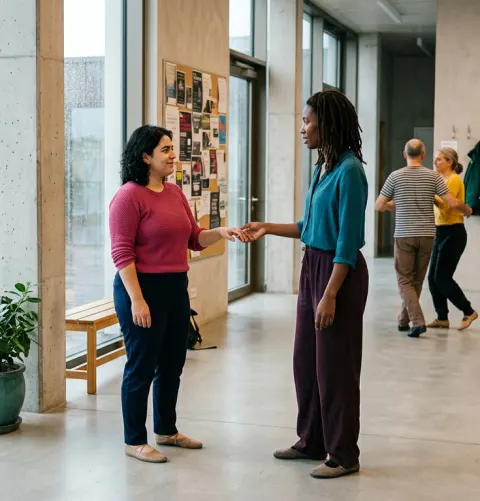
Party planning5 minutes

How to plan dance sets for your wedding party in Münster

By Mary De LucaUpdated

In short
  • For your wedding party in Münster, plan the opening, open dancing, and seating breaks as separate sections.
  • Confirm the permitted music hours, volume, and available dance space with the venue and the person in charge of music.
  • After the opening, a brief announcement invites all guests to join in for the next song if they wish.
  • Schedule speeches and games between dance sections so the music is not constantly interrupted.

You can’t order a full dance floor. But you can prevent guests from waiting for the right moment between cake, speeches and music, while nobody knows whether everyone is supposed to start dancing yet.

What you need for the process

  • A designated person for music and announcements
  • A floor plan with a dance floor, seating and walkways
  • The wedding day schedule
  • Your opening song and familiar songs for your guests
  • An agreed plan for when the music ends and how loud it should be

The transition determines whether guests join in

At a wedding celebration in Münster, people with different ideas about dancing come together. Some expect partner dances, while others prefer to dance alone to pop music. Still others would rather take part from their seats. When you, as the couple, open the dance floor, the moment can initially feel like a performance. Without a clear invitation, that divide remains, even when the next song is already playing.

So plan not just an opening song, but also a way to bring your guests in. A familiar song with a clear beat makes it easier to join in, because no one has to learn a sequence of steps first. A long instrumental intro or an abrupt change of style can stall the transition. If you have a band, agree on a signal for the end of the opening dance. The guide to waltzing to live music explains why live music does not always keep an even tempo.

An open invitation is all it takes to get your guests involved: they can dance alone, in pairs or in a small group. Assigning partners creates unnecessary barriers. The principle of voluntary pairing at celebrations applies here too. Seating within sight of the dance floor lets guests take part without any pressure to dance. Your planning has worked if a guest can tell where and when to join in without needing an explanation.

A conveniently located place to sit keeps guests closer to the action than retreating to another room.

Seven steps to the dance routine

  1. Agree on the venue-use arrangements

    Agree on the music end time, volume, technical setup, and any possible room changes together with the venue and the person handling the music. Put these limits in writing so that no part of the dancing later falls outside the agreed scope.

  2. Marking Out the Dance Area

    Mark out a dry, clear dance area near seating. Keep service and guest walkways outside this area, and don't run cables across it. When it rains, keep wet coats and umbrellas outside the dance area.

  3. Plan the opening into the schedule

    Schedule the opening after a program item has finished, not while tables are being cleared or food is being served. Name the person who will announce the wedding couple and then invite the guests. The couple can open the dance floor together, but this isn't a requirement for the party.

  4. Decide on the first guest song

    Choose a familiar song with a clear rhythm and a short intro. Agree on an announcement such as: “The dance floor is open to everyone, alone or together.” Two volunteers can join in right away, without getting others out of their chairs.

  5. Create Cohesive Music Blocks

    Arrange several songs with similar energy back to back before making a clear change in tempo or style. Mix familiar songs from different guest groups. Plan quieter sections too, rather than turning up the volume as a substitute for musical variety.

  6. Plan breaks at the end of each block

    Schedule speeches, games and cake activities between the music blocks. A coordinator gathers spontaneous contributions and gives the person in charge of the music the next cue. During the meal, the music can deliberately fade into the background instead of leaving the dance floor half open.

  7. Handing Over and Carrying Out the Plan

    Give the person in charge of the music and the event coordinator the same concise rundown, with the order, cues, and responsibilities. On the wedding day, a well-attended set can run longer within the agreed timeframe. Announce the end with one last song, rather than suddenly switching off the music.

Invite without specifying guests

Do this

  • Ask a willing guest to get things started
  • Pass music requests on to the person in charge of music
  • Allow solo, partner and group dancing side by side
  • Switch styles at the end of a piece of music

Not like this

  • Pulling a reluctant guest onto the dance floor
  • Interrupting the song in progress for every request
  • Pairing all guests up into fixed couples
  • Suddenly changing styles in the middle of the chorus

You can check off these points

Before the Party

Preparation

Before opening

Start

After the Last Song

Closing

Frequently asked questions

  1. No, you can also open the dance floor together with your guests to a song of your choice. A brief announcement makes it clear that the dancing is beginning. If you don't want to perform a dance of your own, starting together is an alternative, so the celebration doesn't have to miss a program item.

Make the most of your dance time together

On udansa, you can find dance events in Münster for an evening together before your wedding. There, you can discover which music gets you onto the dance floor and which transitions tempt you to stay seated.

Make the most of your dance time together