Dance Culture5 minutes

Folk Dancing in Dortmund: Dances as Cultural Exchange

By Mary De LucaUpdated

In brief
  • Folk dancing in Dortmund brings together traditional steps, music, and community from different regions.
  • Traditional dances differ in rhythm, movement, occasion, and how groups pass them on.
  • At the TanzFolk festival in Dietrich-Keuning-Haus, associations present dances from Africa, Asia, Europe, and South America.
  • If you want to dance yourself, check a course’s origins, teaching approach, and participation format instead of focusing only on the style name.

A dance can be a social gathering, a memory, and a living tradition all at once. If you recognize folklore only by its stage costumes, you often overlook how varied its forms and meanings are.

DefinitionFolk Dance

Folk dance is a traditional form of dance passed down within a community and performed at social or cultural occasions. Depending on the region and tradition, it includes different rhythms, steps, and ways of dancing together.

Dortmund showcases folklore as lived diversity

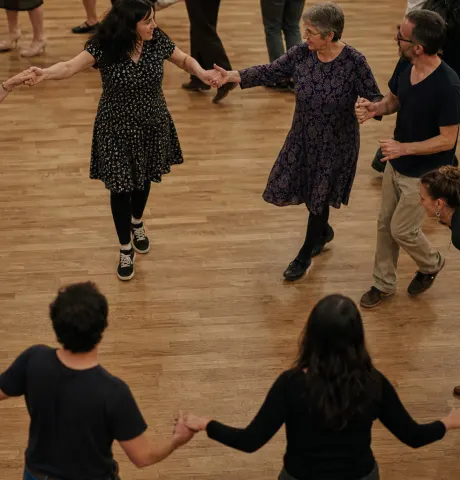
Folklore is not a single dance style with a fixed sequence of steps. The term includes dances passed down through communities, which look different depending on the region, music and occasion. In Dortmund, this diversity is on display at the TanzFolk festival at the Dietrich-Keuning-Haus: numerous associations showcase traditional dances from Africa, Asia, Europe and South America. The cultural center in Nordstadt is therefore a specific place where different traditions meet.

If you're interested in the subject, you can start by observing what the dancers focus on: a shared circle formation, changing partners, specific footwork or coordination with the music. These are points of reference, not boxes to put things in. For a broader overview of different dance styles in the city, see the overview of dance styles in Dortmund. It places folklore alongside other offerings without equating the individual traditions.

A performance and a class offer different perspectives. When you're watching, you'll notice the formations and expression; when you join in, you can feel the rhythm and coordination for yourself.
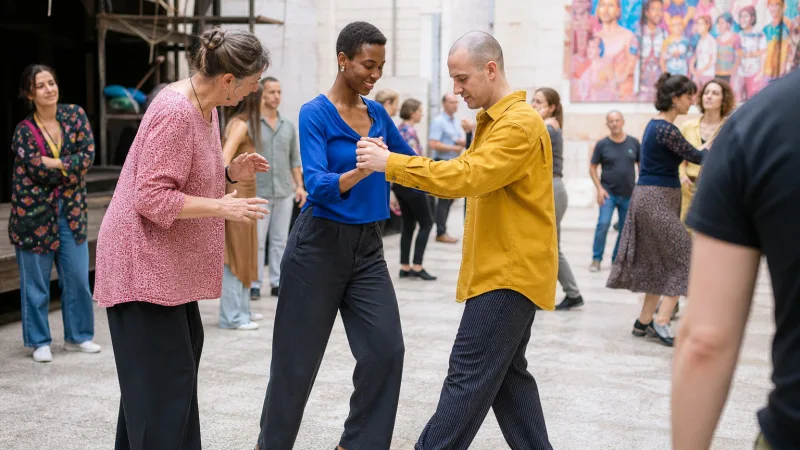
When a step is passed on, a movement also becomes an invitation to learn about its origins.

A Shared Name Does Not Mean a Shared Origin

The word folklore often sounds like a single, unified category. In fact, dances from the same region of the world can differ significantly in their music, movement quality and social function. There are also variations within a tradition. That is why the question “How do you dance folklore?” rarely has a single answer. It is more helpful to ask: Which specific dance form is being taught, what context does it come from, and how is it danced today?

This also matters when learning. A step that seems easy in one group may require a particular weight shift or shared timing. If you only copy the outward form, you often miss the rhythm that carries the movement. At the same time, you do not need to be an expert beforehand. A good introduction names the dance, demonstrates the basic movements and leaves room for questions, rather than reducing a culture to a costume or a supposedly typical gesture.

So when you compare classes, pay attention to the class description. Does it say whether beginners are welcome, what music is used and whether the cultural background is explained? Details like these help you choose a suitable class. For more guidance on the format of dance events, you can use the comparison of different dance evenings.

Understanding tradition without oversimplifying it

Do this

  • Ask about a dance’s origins and meaning
  • Let different regional variations coexist
  • Ask about the teaching approach and context in a class
  • Try the steps respectfully and ask questions openly

Not like this

  • Treat all folklore as the same kind of folk dance
  • Assign a dance to an entire region as a blanket generalization
  • Choose based only on costume or music style
  • Adopt the steps and ignore the cultural background

When we explain where a dance comes from, taking part becomes more mindful and the movement easier to understand.

Dance educator for international folklore

From Watching to Dancing Yourself

You don't have to commit to a course right away. An event can be a great first impression: observe whether the audience is invited to join in or whether the dances are presented as a stage program. At the annual TanzFolk festival at the Dietrich-Keuning-Haus, groups perform dances from different continents. The program is a good way to discover different forms without assuming that every tradition is offered as a regular course in Dortmund.

If a dance catches your interest, write down its name and ask whether there's an open class you can join. When comparing courses, practical questions can help: Is the basic step explained slowly? Is partner work required? What shoes are suitable for the floor? Can you watch or try a class? The answers will show whether the lessons suit your experience and expectations.

To search for current options, you can check the course overview for Dortmund. Check the details directly with each provider, since a cultural festival doesn't automatically mean there's an ongoing course available. That way, folklore remains more than just a label: you'll discover a specific dance form and can decide whether you want to keep watching or join in yourself.

Two ways to experience folklore

Join in

Learn steps together

The focus is on movement and a sense of togetherness

In the class, you learn sequences of steps by watching them demonstrated, repeating them, and dancing together. Questions about rhythm and origins help keep the movement connected to its context.

Watching

Experience traditions on stage

The focus is on form and expression

At a performance, you can see how music, formation and movement work together. Afterwards, you can ask more specific questions about which tradition is being showcased and where you can learn the steps yourself.

Frequently Asked Questions

  1. Folk dances are traditional dances passed down within a community. They may be performed at celebrations, in social settings or on stage. What matters is not just the clothing, but also how the dance is passed down and its cultural context.

Discover dance classes in Dortmund

Compare current offers and see if you can try the dances yourself.

Find your way into dance

On udansa, you can compare current dance classes and events in Dortmund. That way, you can find out where you can try folk dance yourself or experience a performance first.

Find your way into dance