Equality Dancing5 minutes

Queer dancing in Frankfurt: Understanding Equality

By Mary De LucaUpdated

In short
  • Queer dancing in Frankfurt can mean partner dancing where gender does not dictate a fixed dance role.
  • With Equality Dancing, you decide whether to lead, follow, or try both roles.
  • To find suitable options, ask about role choice, partner rotation, and how same-gender couples are welcomed.
  • Find current courses and dates in Frankfurt using the course filter on the page.

For many, the biggest hurdle isn’t the basic step, but the unspoken assumption about who should lead. A good course makes it possible to talk about roles and expectations before they lead to an awkward moment.

DefinitionEquality Dancing

Equality Dancing refers to partner dancing where lead and follow roles are not tied to gender or couple configuration. Dancers can choose the role that suits them and switch it if needed.

Equality Dancing separates dance roles from gender

Traditional ideas about dance roles often assume that a man leads and a woman follows. Equality Dancing challenges this assumption: the roles describe tasks in the dance, not genders. Lead gives movement cues and direction, while Follow responds to them and helps shape the movement. The dancers decide for themselves who takes which role.

This does not mean that everyone has to dance both roles or that one is more modern than the other. Some people feel comfortable with one role, while others switch depending on the music, their partner, or the figure. So in Frankfurt, it is worth looking not only at the dance style when choosing a class, but also at how the lessons teach the roles.

Queer dancing can refer to same-gender couples, non-binary dancers, or an overall open approach to roles. The terms overlap, but they are not interchangeable: a class may welcome same-gender couples without teaching role switching. Conversely, a class may offer free choice of roles without being explicitly advertised as an LGBTQ offering. This distinction helps clarify expectations before signing up.
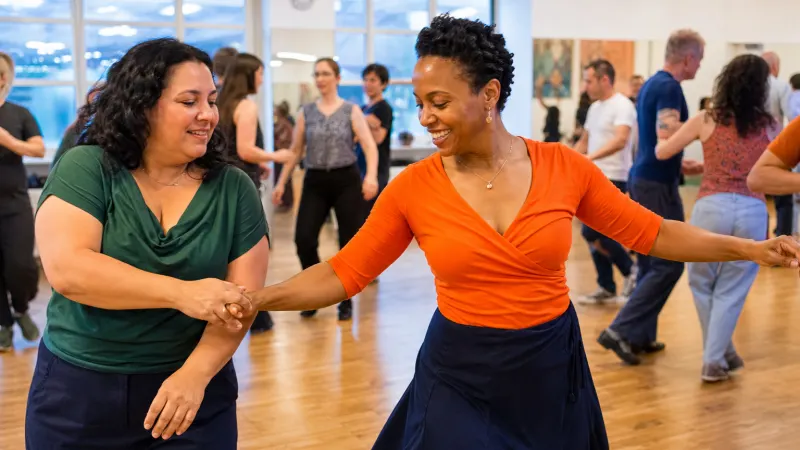
When roles are open to negotiation, a dance move becomes a shared decision rather than an unspoken expectation.

In Frankfurt, a concrete invitation to participate matters

When searching in Frankfurt, it helps to distinguish between a general dance offering and a format explicitly geared toward queer or equality-focused dancers. The city profile lists Tanztag Rhein-Main, a day of action centered on dance, and the dance parties for everyone by Dresden Frankfurt Dance Company at Bockenheimer Depot. These point to public opportunities to participate, but they do not prove that any particular event is intended specifically for LGBTQ dancers. So check the current program and participation requirements each time.

When reading course descriptions, look for specific details: Are Lead and Follow offered regardless of gender? Can you participate on your own? Are there partner rotations, and can you choose your own role? If this information is missing, it’s a good idea to send the provider a quick message. Ask for a clear answer rather than relying on terms like “open” or “for everyone” alone.

The overview of dance classes in Frankfurt can help you narrow down formats by style and level. If a course seems like a good fit, clarify the role practices directly. Offerings and dates change, so the current information in the course filter and from the respective provider is what matters.

How to spot an open dance practice

Do this

  • When someone starts, ask which role they prefer
  • Offer lead and follow roles regardless of gender
  • Explain that switching roles is a normal option
  • Pair same-sex couples as a matter of course

Not like this

  • Assign roles without asking about gender
  • Make a role a prerequisite for participation
  • Treat role switching as a disruption
  • Allow same-sex couples only upon request

If both roles are possible, first ask which movement you want to learn, not which gender role is right.

Dance educator for Equality Dancing

Clear communication makes meeting new people easier

A first contact doesn't have to begin with a long explanation. Say which dances interest you, what level you're at, and whether you want to dance one or both roles. This gives a potential dance partner something specific to respond to. If you'd rather start by dancing in a group, you can say so openly too.

For a course inquiry, a few short questions can help: “Can I come on my own?”, “How are partners assigned?” and “Is it possible to switch roles?” If it's important to you, add that you'd like to dance with someone of the same gender. A respectful response should address your question objectively and shouldn't ask you to justify your identity.

To get in touch through udansa, you can look for suitable contacts in the section for dance partners and the community in Frankfurt. Instead of describing a general ideal, be specific about what you'd like to do: for example, practice together, go social dancing, or attend a course. That way, you can find out early whether your expectations match, without assuming that you're looking for a permanent duo or competition partner.

Find a role or try out both

Focus

Deepen one role

Clarity can bring confidence and focus.

You stick with Lead or Follow for now and can focus on timing, body contact, and movement cues. This is an equally valid choice if one role feels right for you.

Switching

Try out both roles

Switching lets you experience different perspectives.

You learn to lead and follow, and get a better sense of how the same figure feels from both positions. The pace can be slower so that communication and movement don't get mixed up.

Frequently asked questions

  1. No, you can focus on one role or try both. What matters is that the choice is not automatically tied to your gender. If a class includes role switching, ask in advance whether you can stick with one role throughout.

Partner Dance Classes in Frankfurt

Compare classes and check directly with the provider whether the role options and partner arrangements are right for you.

Dance roles can be open

On udansa, you can compare partner dance offerings in Frankfurt and check with the provider whether the role options and atmosphere suit you. When making new connections, what matters in the end is being able to clearly express what you want.

Dance roles can be open