Short pieces, new perspectives
On udansa, you can find dance events in Freiburg im Breisgau. That way, you can look for an evening of performances featuring different movement styles.

By Mary De LucaUpdated
On udansa, you can find dance events in Freiburg im Breisgau. That way, you can look for an evening of performances featuring different movement styles.
You can watch a dance evening closely without being able to interpret every movement. Short pieces in particular let you experience how a glance, a pause, or a shift in distance can create a stage moment of its own.
The independent professional dance scene refers to professional dance artists and ensembles who develop their own productions outside a permanent theater company. They can work with cultural venues and networks to do so.
If you want to understand contemporary dance in Freiburg im Breisgau, it helps to distinguish between a venue and a working structure. E-Werk Freiburg, a cultural center for dance, theater, music and visual arts, was a cooperation partner of Tanznetz Freiburg. The network brought together support for independent professional dance artists and organized its own performance formats. The two names therefore refer to different roles within the same artistic collaboration.
A nonprofit organization and funding from the city and federal government through TANZPAKT Stadt-Land-Bund were involved in establishing Tanznetz. Artistic work here was therefore about more than the performance audiences could see: time to develop and rehearse was also part of the support. This explains why a network and a venue can both be important without offering the same thing.
E-Werk provided the physical space, while Tanznetz connected work opportunities with public presentations. This distinction is helpful for you as a viewer: a venue’s name tells you where something was shown, while the context of a production explains the conditions in which dance artists were able to develop their work. This alone does not indicate what events are currently on offer.
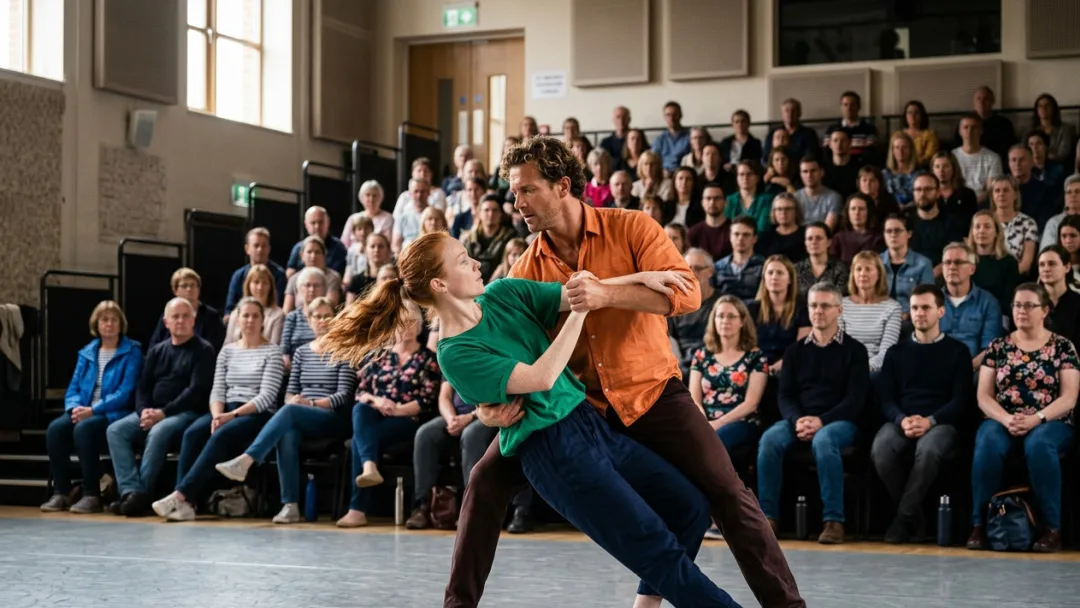
tanzwuchs made the connection between development and performance tangible. Starting in 2018, the format by Tanznetz Freiburg presented short pieces by young choreographers and other dance professionals from the independent professional scene. In the format described, the works were created during a three-week working period and presented over two to three evenings at SÜDUFER, a venue of the E-Werk. These are features of this format, not an announcement of its next edition.
A short piece sets a more contained framework than a full-length work. For example, it can follow an impulse for movement, distill an encounter or transform a spatial arrangement. These possibilities explain the format in general, they are not claims about individual tanzwuchs productions. The short duration alone says nothing about the difficulty or artistic quality.
When several short works come together, you may encounter very different artistic styles. One piece works with restraint, another with clear contrasts. The distinction between partner dancing and show is similarly important: a stage work is designed to be experienced by an audience and does not have to represent a dance situation for audience participation.
Yes, like that
Not like this
A movement doesn’t have to mean anything in particular for you to feel its impact on stage.
On a contemporary dance stage, an everyday walk can stand alongside a demanding floor movement. What often determines the effect is how they are arranged: Who begins, who waits, which direction is taken? A body can invite closeness and withdraw at the same time. You can recognize a relationship in this without having to turn it into a definitive story for every audience member.
A common misunderstanding arises when free is equated with arbitrary. Improvised movement can also be structured by tasks, spatial boundaries, or agreements. Conversely, not everything that looks spontaneous is actually invented in the moment. A precisely choreographed sequence can deliberately appear hesitant. From your seat, you see the result, not necessarily the method behind it.
Costumes and lighting can also change how you perceive a piece. The article about costume changes as transformation in show dance explains how a visible change can mark a dramatic turning point. Contemporary pieces do not have to use these devices. Instead, you can pay attention to the relationship between movement, space, and time, and arrive at a different interpretation from the person next to you.
Weight, breath and tension provide orientation
An abrupt stop or a slow descent may speak to you immediately. You observe how much force a movement takes and how the bodies relate to one another. You don't need to recognize an action.
Repetition and variation become visible
You pay attention to which elements return and what shifts along the way. A gesture might appear alone at first, then later in a duet. This creates a sense of connection through the arrangement, even without a story being told.
You don't need any dance experience to follow a contemporary dance evening. Visible changes such as proximity, tempo or tension offer an immediate point of access. Technical terms can help you describe what you see later, but they aren't a prerequisite for your experience.
Contemporary dance can take place with music, speech, sounds or in silence. Breathing and footsteps can themselves become audible elements of a piece. So the absence of a melody doesn't mean the movement lacks rhythm or structure.
A short piece can be a work in its own right and doesn't have to be an excerpt. It can deliberately condense a limited idea, such as a relationship or an impulse to move. You can't tell from its length alone whether it's complete or intended as a work in progress.
Independent dance artists can perform solo, in duets or in larger groups. The word independent describes how they organize their work, not the number of performers. A piece developed together by several collaborators can also be part of the independent professional dance scene.
 Choosing a Dance Style in Freiburg im Breisgau
 Bachata in Freiburg im Breisgau Has Its Own Dance Language
 Choosing Salsa or Bachata in Freiburg im Breisgau
 Kizomba in Freiburg im Breisgau: Music and Roots
 How Forró connects Freiburg im Breisgau with Brazil
 Forró or Kizomba in Freiburg im Breisgau: Which suits you?
 How Salsa in Freiburg im Breisgau connects classes and the scene