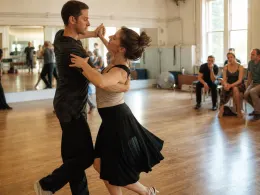
Dance partner search5 minutes

Find a dance partner to practice with in Hamburg

By Mary De LucaUpdated

In short
  • For regular practice, you need someone with a compatible dance style, similar training goals and a reliable schedule.
  • In your post, describe your level, preferred dances, practice routine and the kind of practice you’re looking for.
  • At an informal meetup, agree on how you’ll give feedback, what you’ll practice and how committed you’ll be to keeping appointments.
  • In Hamburg, you can post your request through udansa and also ask for practice partners in classes or at dance meetups.

A good practice partner doesn’t have to master every move equally well. What matters is that you’re both working toward the same kind of progress and structure your practice time so you both benefit.

DefinitionRegular Practice Partner

A regular practice partner is someone you practice dance material with regularly and by mutual agreement. The partnership can exist independently of a personal relationship or joint course enrollment.

A Training Partner Needs More Than the Same Dance Style

When you’re looking for a dance training partner in Hamburg, don’t start with the dance style alone. What matters is whether you have similar expectations for your time together. Do you want to dance individual figures more cleanly, work on posture and timing, or repeat a longer sequence? Someone who mainly wants to collect figures won’t necessarily be a good fit for someone who wants to deepen their technical foundations.

In your post, say which dances you train, how you assess your level, and whether you already practice regularly. Also say whether you’d like feedback or would rather experiment together. That’s more helpful than a vague description like “ambitious,” since people understand very different things by it.

To start your search, you can describe what you’re looking for on udansa and also ask about connections in a suitable class. The guide to finding a dance partner in Hamburg in general covers other ways to meet people who are a good fit. For a training partner post, the most important thing is to make clear that you’re looking to train, not for a partner to accompany you to a single dance evening.

A group of female dancers gets ready for a performance in front of a vanity mirror in a dressing room
When an exercise doesn't quite click, they break it down together: that's how repetition becomes a concrete step in learning.

Agreements turn meetups into regular practice

A regular time slot alone does not make for a good practice session. First, agree on how long you want to practice, how firmly you are committing to meetups, and what happens if someone cancels. Also discuss whether you need a room, music, or specific shoes. This helps avoid one person taking care of all the preparation while the other simply shows up.

Set a manageable topic for each practice session. Start with a short review, try the movement slowly, and only then increase the tempo or add music. If something is not working, describe the specific part: for example, the timing of the weight shift or the distance between you. General judgments like “This feels wrong” are less helpful than an observation and a follow-up question.

Feedback also needs an agreement. Some people want to be stopped right away, while others prefer to hear what stood out after a full run-through. Regularly check that you both have time to speak and influence the content. If you also want to take lessons, you can find out about dance class options in Hamburg and consider what a class could add to your practice sessions.

How to recognize a lasting training partnership

Do this

  • Agree on a shared practice goal before getting started
  • Describe difficulties specifically and ask questions
  • Confirm or cancel sessions well in advance
  • Both have an equal say in choosing content and roles

Not like this

  • Just dance as often as possible without agreeing on it first
  • Comment on mistakes without asking how it feels
  • Leave plans up in the air or cancel at short notice
  • One person always sets the pace and what to practice

A good practice session starts with both people being able to say what they’d like to practice today.

Partner dance instructor

Compatibility shows in how you handle progress and boundaries

At your first meeting, nobody needs to give a perfect performance. Instead, notice how you handle an unfamiliar move, different opinions, and small mistakes. Can you pause, ask a question, and try again? Do both of you stay involved, even if one person understands something faster? These impressions say a lot about whether regular practice can be enjoyable and productive.

A difference in skill level is not automatically an obstacle. It becomes difficult when one person is constantly explaining and the other only follows, or when exercises are consistently too easy for one partner. So talk about what each of you wants to learn, and plan activities that challenge you both. In partner dancing, switching roles for individual exercises can also show how movement and leading feel from both perspectives.

After a few practice sessions together, it’s worth having a quick conversation: What helped, what was too much, and what would you like to work on next? You don’t need to turn this into a rigid training plan. Honest feedback and the option to adjust your agreement keep the collaboration fair. If your goals remain incompatible, you can end your training together without devaluing the time you spent dancing.

Two ways to achieve a shared training goal

Structure

With a set practice plan

Useful if you want to work on clearly defined areas for improvement.

You decide on a topic and a sequence in advance, for example, basic movement, transitions, and repetition with music. This provides guidance, but should leave room for spontaneous questions.

Openness

By trying things out together

Great when you want to explore ideas first.

Take turns bringing movements or music and see what you want to work on further. At the end, take a moment to note what felt good and what you want to revisit next time.

Frequently Asked Questions

  1. Mention the dance style, your approximate level, and what you’d like to practice regularly. Add whether you’re looking for informal practice or lessons with an instructor, and which times generally work for you. A friendly invitation to meet with no obligation makes it easier for someone to reply.

Partner Dance Classes in Hamburg

If you're looking for lessons in addition to open practice, compare suitable partner dance classes in Hamburg.

Good practice starts with being in sync

On udansa, you can look for dance partners in Hamburg and describe what you're looking for in a practice partner so your style, level, and intentions are clear. You can also compare classes if you'd like to complement your own practice.

Good practice starts with being in sync