

Together to the dance badge
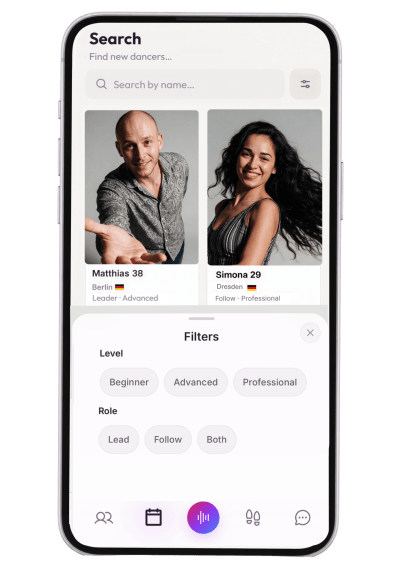
Here you will find like-minded people who keep the beat with you and strive for the next level of the badge. Sign up and discover dance partners as well as suitable courses in your area.

The path to your own dance pin is a personal milestone on the dance floor. Find out here how the badge is structured and how you can impress the examiners with your posture and sense of rhythm.
The DTSA Standard Dances is the German Dance Sport Badge, which is awarded by the German Dance Sport Association as proof of progress in the standard disciplines.
The German Dance Sport Badge (DTSA) is the official award from the German Dance Sport Federation for dance achievements in recreational sports. Unlike in tournaments, you do not dance against other couples here, but present your skills to a licensed examiner. For the standard disciplines, this means: You show that you can move harmoniously in the room and execute the characteristic rhythms cleanly. The badge is based on the World Dance Program badge and is the ideal way to take your own dancing to a new level without tournament pressure.
The examination is open to all age groups. It is primarily about maintaining the typical standard dance posture for the entire duration of a song and keeping your balance. A big advantage: After the assessment, you receive qualified, written feedback that shows you exactly which subtleties you can still work on for the next level.
The system is logically structured and increases in its requirements for variety and musicality. The badge starts with Bronze, followed by Silver and Gold. Each level requires a higher number of dances and more complex figures from the standard repertoire, which includes Waltz, Tango, Viennese Waltz, Slow Foxtrot and Quickstep. While Bronze focuses on the absolute basics, the higher levels require a distinct understanding of floorcraft and rhythm changes.
Those who want to continue after Gold can aim for the repeat examinations or the Gold badge with wreath. For the start, however, it is advisable to work through the classic levels step by step to cleanly internalize the fundamental Standard dance steps.
Film yourself during the dress rehearsal in training. Often, when watching the video, you will notice small posture errors that can be easily avoided in front of the examiner.
The dance badge is not an unapproachable competition, but a wonderful celebration of dancing together, where everyone is rewarded for their personal progress.
On the day of the assessment, there is usually a supportive, communal atmosphere. Couples typically step onto the floor in groups of three to four pairs at a time. The examiner stands at the edge and evaluates each couple individually. Flawless professional dancing is not expected, but rather a rhythmic, harmonious overall impression. A small timing error that is quickly corrected rarely leads to failure, as long as the joy of movement and the basic posture are correct.
Musically, a fixed duration of about one and a half to two minutes is required per dance. The examiner pays particular attention to whether the couple masters recognizing the beat in ballroom dancing and moves in the flow of the music. After the joint performance of all required dances, the results are announced and the certificates as well as the shiny pins are awarded.
The entry point for hobby dancers
Here, the focus is on the absolute basics. You present three dances with simple basic steps and show that you can move confidently to the rhythm of the music.
The crown of recreational sports
The highest standard level requires the full program of five dances. In addition to clean footwork and complex figures, a high degree of harmony within the couple is required here.
For bronze you need to show three dances, for silver it is four, and for gold you present all five standard dances. For each dance, the examiner requires a set minimum number of different figures.
Prepare yourself optimally for your badge with the right course and a dance partner.
Sunday · 14:30-16:00 · Nov 15, 2026 - Jan 17, 2027
Limbach-Oberfrohna
Sunday · 14:30-16:00 · Sep 6 - Nov 8
Limbach-Oberfrohna
Sunday · 14:30-16:00 · Nov 15 - Nov 29
Limbach-Oberfrohna
 Teen dance courses: The perfect start at a dance schoolTeen dance courses open the door to a new social world for young people. Find out how starting at a dance school works, what it costs, and why it is so much fun.
 Ballroom Dance Posture: How to build the perfect frameProper posture and a stable frame are the foundation of every ballroom dance. Learn how to glide elegantly across the floor with the right body tension and orientation.
 Ballroom dance steps: The basics for the dance floorThe five ballroom dances fascinate with their elegance and dynamics. Learn everything about the most important steps, figures, and typical movement sequences of Waltz, Tango, and more here.
 Ballroom Dance Competition: Your Path to the PodiumThe path from recreational to competitive ballroom dance requires targeted training and a clear structure. This guide shows you how to successfully master dance badges and competition classes.
 Preparing for your dance badge exam: Your path to successIs your practical dance badge exam coming up? With our structured guide, you and your partner can prepare perfectly and impress the examiners with your technique and charisma.