Ready for the finals with udansa
On udansa, you will find ambitious dance partners and professional clubs near you who share your passion for competitive dance. Get started now and take your performance to the next level!

By Mary De LucaUpdated
On udansa, you will find ambitious dance partners and professional clubs near you who share your passion for competitive dance. Get started now and take your performance to the next level!
A standard tournament demands everything from your body. With this dance-specific training plan, you build the necessary muscular endurance to shine with dynamism and presence in the final until the very last second.
If you want to reach the top in ballroom competitions, you cannot rely on technique alone. A single final demands everything from your body: five dances in direct succession, each around one and a half minutes of peak performance under the strict eyes of the judges. Without targeted conditioning for ballroom dancers, your posture will collapse in the final round, your steps will lose their dynamic, and the dream of the podium will move far out of reach. To build the necessary muscular endurance, normal dance training is often not enough. A structured, dance-specific fitness plan closes this gap by specifically strengthening anaerobic endurance and arm stability.
A modern ballroom dance fitness plan starts exactly where the strain is greatest. In competitive dance conditioning, it is not about the monotonous running of marathon distances, but about the ability to survive short, extremely intense phases of exertion unscathed. Through the combination of interval training and functional muscular endurance, you prepare your cardiovascular system perfectly for the dynamics of Waltz to Quickstep.
Start every training session with ten minutes of moderate running or jump rope. This gets your circulation going and prepares your muscles for the upcoming exertion.
Use the treadmill or exercise bike for intervals. Push yourself for 90 seconds at 85 to 90 percent of your maximum heart rate, followed by 30 seconds of light movement.
Strengthen your core with planks and side planks. Hold the positions for 60 seconds each to activate the deep muscles that stabilize you in the Waltz.
Use light dumbbells and hold your arms in the exact tournament position for three minutes straight. This trains your shoulders for the perfect frame.
Finish the session with five minutes of light cooling down and focused breathing. This lowers your heart rate and initiates your body's recovery process.
Find the right course to test your new fitness directly on the dance floor.
Student DanceBurgstädt · Germany
Aufbaukurs Burgstädt Montag Schuljahr 2026/27Monday · 13:30 · Nov 9, 2026 - Jan 25, 2027
Burgstädt
BallroomMeissen · Germany
Fortgeschrittenen-Kurs | ADVANCEDTuesday · 18:30 · Nov 10, 2026 - Jan 19, 2027
“Ein Haus für Vieles” - Saal Tanzkurse
Student DancePenig · Germany
Aufbaukurs Penig Schuljahr 2026/27Monday · 14:30 · Nov 9, 2026 - Jan 25, 2027
Penig
Like this
What not to do
Preparation
During
Arrival
Three times a week is ideal. Train your endurance using intervals on two days, and dedicate one day to the muscular endurance of your core and shoulder girdle to keep your frame stable.
Yes, pure jogging improves your basic endurance, but it is not enough for the anaerobic peaks in a competition. Make sure to supplement your training with high-intensity interval training (HIIT).
The first noticeable improvements in your muscular endurance and lung capacity usually appear after four to six weeks of consistent training. Therefore, plan your schedule well in advance of the competition season.
 Ballroom Dance Competition: Your Path to the Podium
 The Skating System in dance sport: How it works
 Tournament day schedule: From rehearsal to finals
 From Social Dancing to Competitive Sport: My Journey to the Dance Floor
 Trends in Competitive Dance Training 2026: Modern Coaching
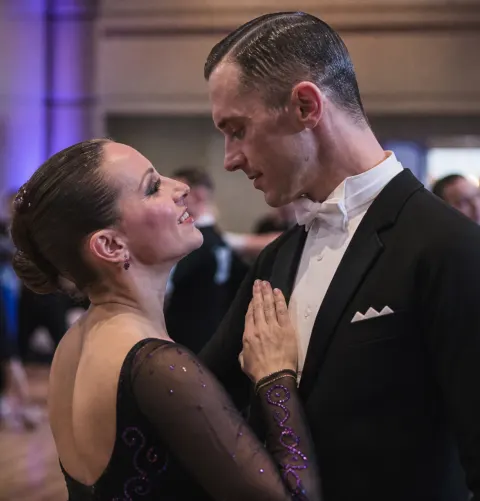 Stage fright at dance competitions: 5 mental strategies to beat stress
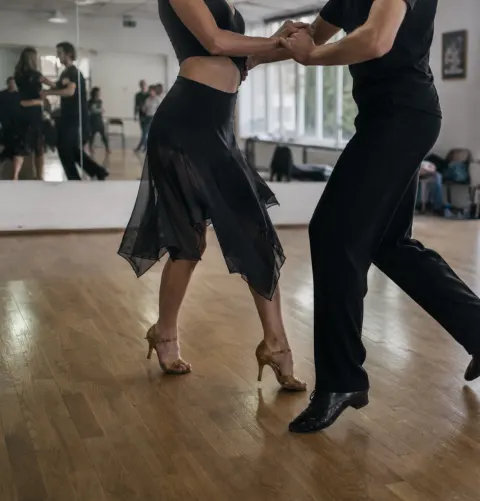 Which ballroom dance suits you best? Take the test