Choosing a Course5 minutes

Senior Dance in Nuremberg: Which Class Is Right for You?

By Mary De LucaUpdated

In brief
  • In senior dance classes in Nuremberg, pace of movement, breaks and class structure matter more than an age label.
  • The physical demands come from stride length, turns, weight shifts and the duration of continuous dance segments.
  • Suitable classes allow for smaller movements and breaks without losing sight of your learning goal.
  • You can agree on specific adjustments with the instructor based on your dance experience and physical capabilities.

You want to understand a sequence of steps and dance to the music without constantly playing catch-up. For that, lessons don’t need to go easy on everyone across the board or start from a fixed idea of what older people can do.

DefinitionWeight Transfer

Weight transfer means shifting your body weight from one supporting foot to the other. This frees the foot that’s no longer supporting your weight for the next step.

The Age Label Does Not Describe the Dance Class

If you're looking for senior dance classes in Nuremberg, you'll first encounter a target group. That alone doesn't tell you how the class is structured. The label can refer to sequences danced together, partner dances, or exercises set to music. How challenging a class is depends on which tasks are combined.

A side step calls for something different than a cross step followed by a change of direction. Add arm movements, and you have to coordinate several sequences at once. That can be demanding even if you cover very little ground. Conversely, a larger movement can sometimes be manageable if it's familiar and you have enough time for it.

Your age alone doesn't describe what you need when dancing. Maybe you already know the rhythm but would like to do less turning. Maybe you enjoy moving for longer, but need several repetitions to learn a new sequence. These are different starting points that don't automatically go together.

Mobility, too, isn't a fixed trait that affects every movement in the same way. The guide to improving mobility through dance explains this connection in more detail. When choosing a class, the first thing to consider is which movements actually come up in class and how they're taught.

Well-fitting shoes leave room for the toes without the foot slipping sideways inside them.

Slow Music Does Not Automatically Make Movements Easy

Music tempo and movement tempo are related, but not identical. A slow piece can call for longer, controlled weight transfers. A faster piece can be danced with small, repeated steps. The number of movements also matters: not every dance sequence adds a new step on every audible beat.

When transferring your weight, it is not enough to place your free foot somewhere. Your body needs to move over the supporting foot before the other foot can move again. Large steps make this journey longer. If the next movement begins while your weight is still between both feet, even familiar music can suddenly feel too fast.

Turns have a similar effect: they combine traveling with a new orientation. When direction, foot sequence, and arms are all explained at the same time, the task becomes harder even without a faster song. The article about music tempo and difficulty in Slowfox explains why tempo alone reveals little.

Suitable lessons separate these demands at first. You can learn the foot sequence with small steps before adding more space or extra arm movements. This makes a movement easier to understand without permanently limiting it to a simplified version.

How to recognize suitable adjustments

That's right

  • Take smaller steps and keep the rhythm
  • Replace turns with an agreed step variation
  • Pause at the edge and join in at a familiar point
  • Learn the footwork first, then add arm movements

Not like this

  • Take bigger steps to keep up with the tempo
  • Force a turn by pulling on your partner's arm
  • Suddenly stop in the middle of the movement path
  • Force your feet, arms, and a new direction all at once

A useful adaptation changes the movement task so you can keep learning instead of simply participating less.

Editorial team for dance guides

Clear agreements help you keep your place in class

A break changes not only the physical effort, but also the learning process. While you sit, the group may repeat a familiar sequence or learn a new element. This makes a difference when you rejoin: a familiar basic movement offers orientation, while a newly introduced combination may not.

That’s why a useful break plan includes a clear point for returning. This could be the start of the repeated sequence or a group restart after the explanation. You don’t have to join in midway through a turn to stay part of the class. Taking breaks at the edge also keeps the movement paths clear.

Agree on specific movements with the instructor that you’d like to simplify or replace, and how you’ll rejoin after breaks. One useful way to put it is: I can follow the basic steps comfortably, but I’d like to replace longer turn sequences with steps without turns. This describes a teaching adjustment rather than a blanket limitation.

Your learning goal can still be something positive: keeping the rhythm, recognizing a sequence, or making weight shifts with more confidence. This way, adjustments remain connected to dancing. They determine the path to the movement, not a lower standard based solely on your age.

Two class formats, different focuses

Together

A sequence in time with the group

Finding your bearings through music and recurring patterns

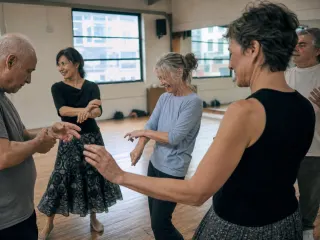
A sequence danced together gives you fixed reference points: everyone changes direction at the same point. Repetition can help you focus less on individual steps. It’s important to be able to pause without blocking the others’ path.

Together

Coordinate Movement as Dance Partners

Finding Your Orientation Through a Shared Weight Shift

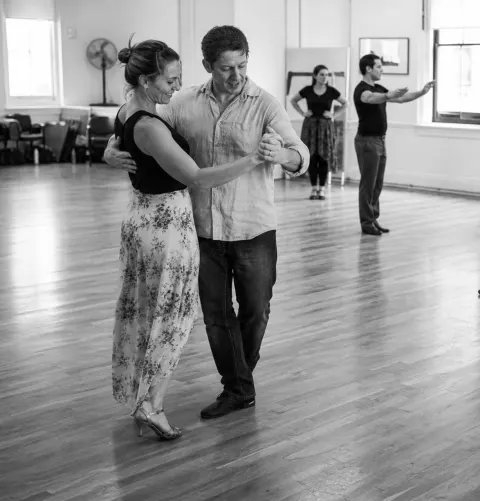
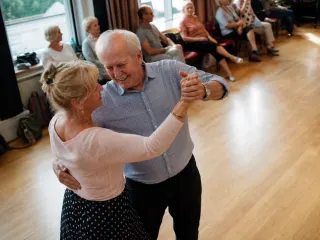
In partner dancing, the tempo also emerges between two people: you need to be able to carry the next step together. Small movements can be coordinated with each other. An agreed variation without a turn can maintain the connection while you continue dancing to the same music.

Frequently Asked Questions

  1. There is no universal age limit for suitable senior dance. A course title may name its target group, but it does not tell you anything about your movement experience. What matters is whether the tasks, pace of explanations and connected dance sequences suit you, not whether you have reached a certain age.

Dance Courses for Seniors in Nuremberg

Use the course filter to find current courses and dates in Nuremberg for your next step in learning to dance.

Your pace needs coordination

On udansa, you can find dance partners in Nuremberg to agree on small steps, repetitions, and breaks as part of your shared practice.

Your pace needs coordination