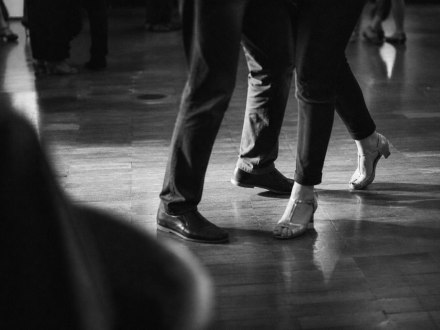
Active together at the best age
On udansa you will discover age-appropriate dance courses and events in your area that perfectly match your needs. Take the first step and find a community that shares your joy for healthy movement.


Movement is the key to a pain-free and active life in old age. Learn how you can protect your joints, strengthen your balance, and recharge your energy through rhythmic steps with udansa.
Fall prevention in old age includes all preventive measures to avoid falls and their associated injuries. At udansa, this happens playfully through building muscle strength, training the sense of balance, and improving reaction speed.
Anyone deciding to take up exercise in their later years is often looking for a method that challenges the entire body without overloading it. Senior dance for health proves to be an ideal all-rounder in this regard. It combines gentle endurance training with coordinative challenges that strengthen the cardiovascular system while simultaneously promoting the flexibility of the spine. In contrast to monotonous training on fitness machines, the music encourages constant, subtle adjustments in posture, which stabilizes the deep core muscles in a completely natural way.
Furthermore, the continuous change in rhythm stimulates blood circulation and improves oxygen uptake in the blood. The gentle turns and steps stimulate the production of synovial fluid, which keeps the cartilage elastic. Because the focus of dance for seniors is on fitness without any performance pressure, the exertion always remains in the aerobic range. This is easy on the heart and ensures that you go home feeling refreshed instead of completely exhausted after the class.
Many people in their prime hesitate to enter a dance school because they suffer from osteoarthritis or stiffness. But the opposite is true: dancing in a joint-friendly way is possible with almost any physical condition, as long as the technique is right. The secret lies in the soft cushioning of the steps and the conscious shifting of weight. Instead of landing hard on the heel, experienced dancers glide across the floor and use their knee joints like shock absorbers. Anyone who masters this can also use gentle rolling of the feet while dancing to take pressure off the ankles and knees.
Dancing with joint problems only requires a little mindfulness and the avoidance of abrupt stops or extreme turns. Modern courses in senior dance sports are tailored exactly to these needs. The step sequences are adapted so that the hip and knee joints are moved in their natural axes. This strengthens the surrounding supporting muscles and often leads to a noticeable reduction in pain in everyday life in the medium term.
When dancing, use flat shoes with a sole that is slightly slippery but not too smooth. This gives you optimal grip and protects your knees during turns.
Dancing is the only sport where we dynamically train our balance in space while moving to music. That makes it the best medicine against falls.
An underestimated but vital aspect of physical activity in old age is the prevention of falls. Targeted balance training for seniors on the dance floor trains proprioception, which is the unconscious perception of your own body in space. Through constant weight shifts, walking backwards, and gentle changes in direction, the brain learns to react to losses of balance in a flash. This improved responsiveness is the best fall prevention in old age.
When dancing, the interaction between the visual system, the balance organ in the inner ear, and the muscle receptors is trained intensively. Those who dance regularly stand more securely on their feet in everyday life, can better compensate for uneven surfaces, and do not lose their footing even when suddenly distracted. This is how the dance floor becomes a safe practice field for a self-determined, mobile life.
Joint-friendly movement quality
Focus on fluid movements, a soft rolling motion of the feet, and an upright, relaxed posture. Keep your joints slightly bent to gently cushion any impact.
Risks for bones and tendons
Avoid jerky changes of direction, long jumps, and landing hard on your heels on the dance floor. Impact stress should be consistently avoided.
Yes, dancing with joint issues is actually highly recommended. Smooth, gentle movement stimulates the production of synovial fluid, which nourishes the cartilage and can alleviate pain. It is important to focus on low-pain, fluid movements.
Find the right course that promotes your health and fits your pace perfectly.
 Dancing gently on your joints: Tips for healthy knees and hipsDancing keeps you fit and healthy as you age, provided you look after your knees and hips. Discover simple adjustments to stay active and graceful on the dance floor.
 Hit the dance floor safely: The best warm-up routine for dancers over 50Feel secure with every step: With this simple and joint-friendly warm-up routine, you can optimally prepare your body for dancing over 50.