Dance Partnership5 minutes

Find a Dance Partner for Regular Practice in Shanghai

By Mary De LucaUpdated

In short
  • In Shanghai, a regular dance partner is a good fit when you have similar training goals and a comparable learning style.
  • Agree in advance on how often you want to practise, how long each session should last, and how to cancel.
  • Clarify whether you want to practise specific figures, technique, or musical timing.
  • Try dancing together in a trial lesson, then talk openly about what felt right.

A training partnership calls for more reliability than a spontaneous dance meetup. Good compatibility shows in how you learn together, talk through mistakes, and protect your time.

DefinitionPractice Partnership

A practice partnership is an ongoing arrangement between two dancers to work together on specific skills or a shared dance goal. It thrives on aligned expectations and regular check-ins.

Learning compatibility matters in Shanghai

A good training partner doesn’t need to have exactly the same dance background as you. What matters more is whether you can agree on a shared goal: for example, cleaner weight changes, better orientation to the music, or more confidence with a particular sequence of figures. If one person mainly wants to work on technique and the other is looking for new figures in every session, frustration can set in quickly, even if both dance well.

So before you start training regularly, talk about what progress means to you. Would you like to repeat a movement until you can do it reliably, or would you rather try different approaches? How direct can feedback be? Does every session need to be planned, or should some of it stay spontaneous? Your answers will show whether your learning styles are a good fit.

For an overview of the local dance scene, check out the Shanghai overview for finding dance connections. If you haven’t settled on a dance style yet, the comparison of dance styles in Shanghai gives you a place to start. But a training partnership that works starts with the agreements you make together, not with finding someone whose profile is as similar to yours as possible.
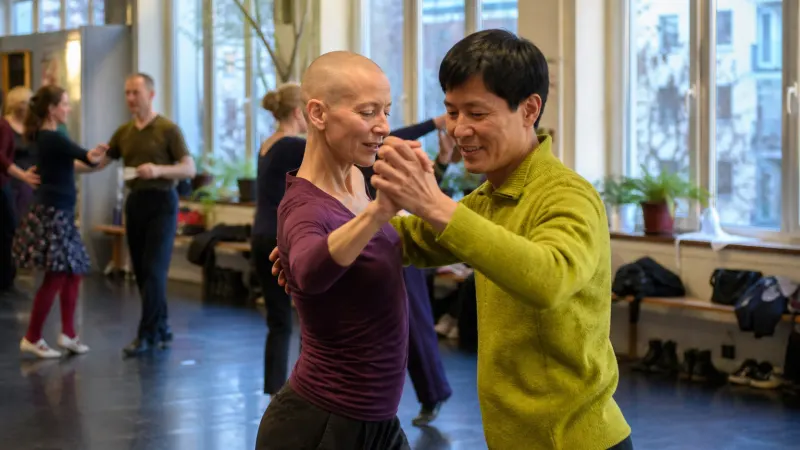
Matching steps alone aren’t enough: only a shared understanding of tempo and feedback makes practice productive.

Regular training needs a clear agreement

A casual arrangement may be enough for a night of dancing together. For longer-term training, though, you need a framework that still makes sense during busy weeks. Talk about how often and how long you’ll train, how far in advance you’ll plan sessions, and when a cancellation can still be easily arranged. What matters is not that you’re always available, but that you both know what you can count on.

Also agree on roughly how each session will go. A short warm-up, a shared focus, and time for repetition give you direction without locking you in. Decide, too, whether you’ll choose the music together or take turns preparing it. If you’re taking a course, clarify whether you want to work on the course material together afterward or train independently of it.

These agreements distinguish a regular training partnership from occasional social dancing: you don’t just meet when it happens to suit you, you’re working toward something together. It doesn’t have to be strict. An honest message when plans change and a clear suggestion for your next session keep things reliable without turning dancing into an obligation.

How to Tell if a Practice Partnership Is a Good Fit

Do this

  • Agree on a specific shared learning goal for the next training phase
  • Agree on the pace and desired intensity before practicing
  • Offer corrections as suggestions and ask for feedback
  • Let each other know about cancellations early and find a replacement date together

Not like this

  • Just saying you want to dance better, without a goal or focus
  • Simply practicing faster or more intensely without discussing it first
  • Commenting on mistakes without being asked or interrupting every repetition
  • Canceling at short notice and expecting the other person to wait

I know a training session has gone well when both people know what they want to work on next time.

Partner dance instructor

Progress comes from coordinated feedback

Dancing together does not automatically mean that both people experience the same movement in the same way. One person may feel that an impulse came too early, while the other is mainly focused on their own step. So keep your feedback specific: Describe what you noticed instead of giving the other person a blanket judgment. “The change came before the musical accent for me” is something you can explore together; “you’re doing it wrong” is more likely to end the conversation.

Roles and tasks can also switch during practice, if you both want that. Whoever usually leads can try a passage the other way around or focus specifically on the other person’s perception. This is not a must and should suit the dance style and your agreements. What matters is that nobody feels overlooked and that both of you have a chance to share your own observations.

After a practice phase, it’s worth having a quick chat: What has improved, which areas still need work, and does the agreed rhythm still suit you? This review is not a test of your partnership. It helps you adjust what you practice before small misunderstandings turn into unspoken expectations. If your goals start to diverge, you can renegotiate instead of simply carrying on as before.

Two roles, one shared training rhythm

Leading

Give clear, measured cues

A suggestion is not an instruction

When you lead, you can make a cue clear enough for the movement to be easy to read, without forcing it. In training, it helps to ask after a repetition whether the direction and intensity were clear.

Following

Notice and give feedback on movement

Contribute instead of just reacting

The person following picks up the lead and can describe what came through or remained unclear. This feedback helps both partners see more clearly which change to try on the next attempt.

Frequently Asked Questions

  1. A practice session together reveals more than a self-assessment. Choose a familiar basic figure and see whether you can repeat it at a similar pace and whether you are both willing to work on the fundamentals. Different skill levels do not have to be a dealbreaker if your learning goals align.

Partner dance classes in Shanghai

A shared class can give you a regular learning structure while you coordinate your own training routine.

Practising together takes a beat

On udansa, you can compare dance partners and suitable partner dance classes in Shanghai. This makes it easier for a first meeting to become a training routine that fits your goals.

Practising together takes a beat