Circle of Friends6 minutes

How dance friends help you feel more at home in Stuttgart

By Mary De LucaUpdated

In short
  • Dance friendships in Stuttgart can develop through repeated encounters, when personal conversations become part of dancing together.
  • Partner changes and solo choreographies danced together help you connect without needing a regular dance partner.
  • Dance connections are more likely to become friendships when interest, invitations and reaching out come from both sides.
  • A good connection while dancing does not necessarily mean personal closeness outside the class.

When you hear your name in a group, it changes how it feels to arrive. You don't have to explain who you are all over again each time, and a misstep becomes a shared memory instead of a moment of embarrassment endured alone.

DefinitionPartner Switching

Partner switching refers to changing dance partners during a class exercise or between dances. The interaction is limited in time and does not imply a lasting personal connection.

Seeing Each Other Again Creates Shared Reference Points

If you want to meet people while dancing in Stuttgart, it helps to be in a setting where you see each other again. A single evening can be enjoyable, but when you meet again, you already have something in common. You remember the same music, a difficult step sequence, or the moment when you both started in the wrong direction at the same time. That way, a conversation does not have to start from scratch every time.

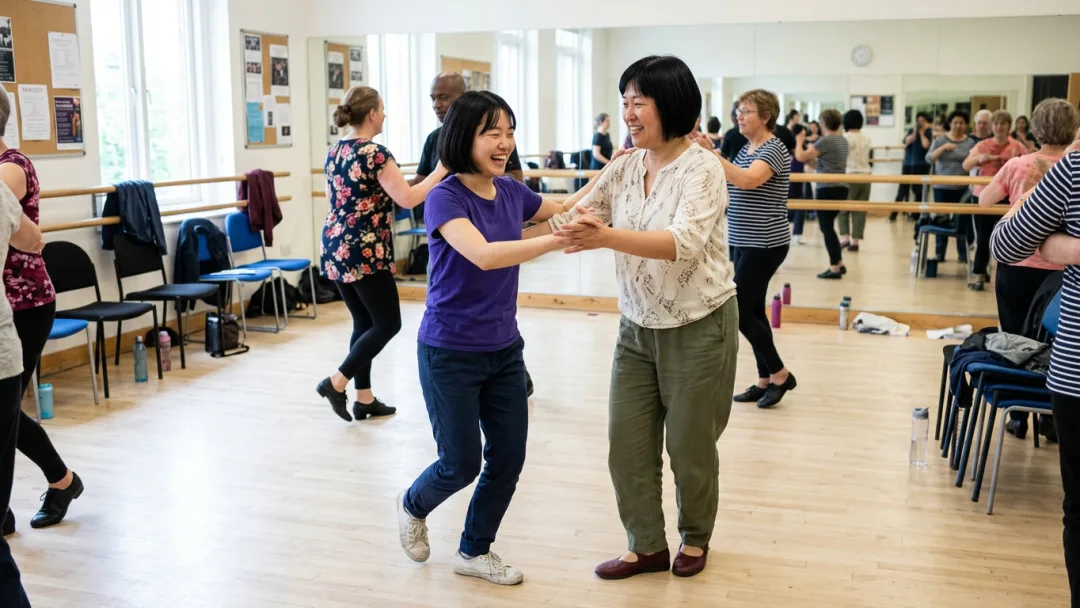
Classes provide a manageable setting for this. An exercise has a beginning and an end, and short opportunities to chat open up between exercises. A comment like “That cue after the break got me again this time” invites a reply without demanding personal openness. While the instructor is explaining, though, attention stays on the class.

Seeing each other repeatedly makes it easier to become familiar, but it does not guarantee friendship. Some people mainly want to dance and then head home. Others stop for a moment, pick up an earlier conversation, or ask how your week has been. Small continuations like these give the connection a personal history.

So, what matters in your everyday life is not collecting as many new faces as possible. A dance session you can actually return to offers better chances of recognizing each other than constantly changing encounters. This does not mean you have to attend without missing a session: even after a break, you can pick up where a shared experience left off.
A drink break is part of an evening together too, even when you're not dancing.

A Dance Pairing Is Not Yet a Committed Relationship

In partner dancing, a brief encounter can feel very attentive: you coordinate your steps, maintain a connection, and respond to the music together. At first, this concentration is part of the dance itself. A successful dance therefore says little about whether someone also wants personal contact away from the dance floor.

Partner changes can make this distinction clear. You dance with different people one after another and get to know several ways of moving. The temporary pairing has a clear framework, while contact with the whole group continues. No one has to infer a lasting partnership from it. The article about fair solutions for uneven participant numbers explains how rotating pairs work when there is an odd number of participants.

Solo choreographies learned together also offer shared reference points. You count the same rhythm, work through the same sequence of movements, and can talk about a transition without making physical contact. However, being part of the same group alone does not create an exchange: that happens through conversation before, between, or after the exercises.

Having a regular partner is therefore not the only way to meet people. Classes explicitly designed for couples follow different routines; a separate guide covers what is possible when you attend a partner dance class without your partner. For friendships, what matters is whether there is room to get to know each other beyond the steps.

How to tell when the connection is mutual

Like this

  • Ask someone's name and introduce yourself
  • Invite someone and accept a no
  • Bring others into a conversation on the sidelines
  • Ask permission before giving technical feedback

Don't do this

  • Don't approach people solely based on their appearance
  • Don't keep pressing with further invitations after being turned down
  • Don't close off the conversation circle to newcomers
  • Don't correct every mistake the other person makes without being asked

One sign of whether a dance connection turns into a friendship is whether both people pick up the conversation again.

Dance advice editorial team

Friendship Takes Mutual Interest

A closer connection grows when you see each other as more than just suitable dance partners. You might notice it when someone picks up a story you told earlier, starts a conversation themselves, or says hello even when you are not about to dance together. What matters is not one single sign, but a pattern of mutual interest.

A small invitation can open up contact beyond the practice session: “I’m going to stay and chat for a little while, would you like to join me?” It gives the other person an easy choice and keeps a brief break from turning into a big plan. You don’t have to start a private dance group or bring several people together right away.

Shared interests can also extend beyond dancing yourself. In Stuttgart, the Noverre Society was founded in 1958 as an association of ballet enthusiasts. This history shows another way of connecting through dance: people can also find common ground by watching and discussing choreography. You can’t infer any current offerings from this, but it does provide a conversation topic beyond your own steps.

Mutual interest doesn’t mean every message gets answered just as quickly. People have different amounts of time and different habits. But if you’re always the one starting conversations and arranging to meet, you can let the contact become more casual. A friendly acquaintance is still a valuable connection, even if it doesn’t turn into a close friendship.

Two Equally Valid Forms of Belonging

Familiarity

Familiar faces in your class

Connected, without private contact

You greet each other, remember exercises you’ve done together, and look forward to seeing each other again. Outside of dancing, you keep things casual. This kind of sense of belonging can enrich your everyday life too, without needing to turn into a closer friendship.

Friendship

You share everyday life too

Your connection extends beyond dancing

You talk about things that have nothing to do with steps, and you keep in touch even when you don't have a class coming up. Spending time together no longer has to involve music. The connection grows at a pace that feels comfortable for both of you.

Frequently Asked Questions

  1. Yes, you don't have to speak in front of a whole group straight away. A short comment about the shared exercise is enough to start a conversation. Seeing the same people regularly gives you the chance to speak to someone again later, without having to start a completely new conversation every time.

Dance classes for new connections in Stuttgart

In the course filter, you can find current classes and dates in Stuttgart that fit into your daily routine.

A familiar face becomes someone you know

On udansa, you can find people in Stuttgart to dance with again and again and get to know in person. That can grow into a casual dance connection or, if the interest is mutual, a friendship.

A familiar face becomes someone you know