Ballet training5 minutes

Ballet barre or center floor: The training comparison

In short
  • Training at the ballet barre serves to precisely build strength, turnout, and muscle memory under controlled conditions.
  • In the center of the room, the body must maintain balance without aids, which extremely challenges the deep muscles and coordination in space.
  • The barre allows for learning techniques in a joint-friendly way, while the center translates these into free, dynamic dance.

The path from the secure hold of the wooden barre to the open center of the dance studio is the most exciting journey in ballet. It transforms isolated strength into fluid, weightless art.

DefinitionBallet barre

The ballet barre is a horizontal waist-high structure, usually made of wood, attached to the walls of the dance studio, which serves as a support for dancers to maintain balance and posture during the first half of the class.

Safety at the barre as the foundation of technique

Every classical ballet class follows a fixed, centuries-old rhythm that is structured this way for good reason. Training begins at the barre. But why do you train at the ballet barre before venturing into the open space? During the first half of the class, the barre serves as a physical partner that takes the burden of balance off you. This allows you to concentrate fully on the isolation of individual muscle groups and the precision of your movement. The ballet foot positions are built cleanly here, without you having to worry about losing your balance.

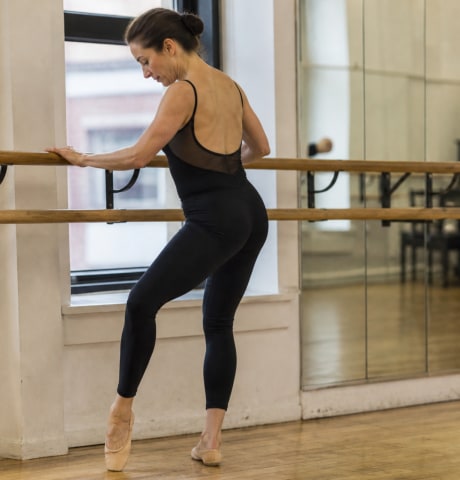
Ballet barre training offers invaluable benefits for muscle memory. By resting one hand loosely on the wood, you stabilize your pelvis and can control the outward rotation from the hip. It is a protected space in which you build and refine the necessary body tension when dancing before the body has to reproduce this strength while standing freely.

Close-up of a wooden ballet barre in the studio
The firm grip on the barre gives the body the necessary stability to align the hips correctly and target the muscles precisely.

Taking the plunge into the center of the room

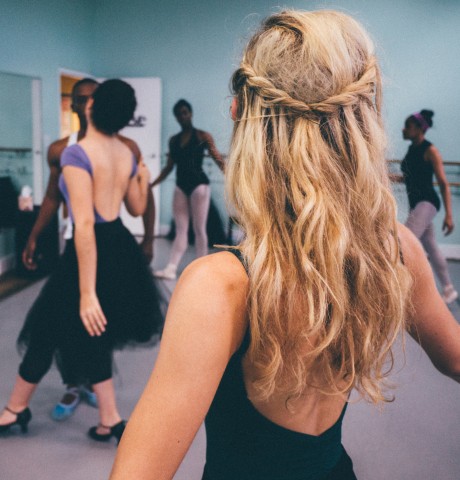
Moving from the barre to the center of the room, known as the center, marks the transition from analysis to synthesis in ballet. Suddenly, the wooden support is gone, and your own body must take over all the balancing work in three-dimensional space. For many adult beginners, this moment feels at first as if you have to learn to walk all over again. The movement sequences that seemed effortless at the barre challenge your entire core musculature in the center.

In the center, it is no longer just about the isolated strength of one leg, but about the interplay of the entire body in motion. Ballet center training for beginners therefore starts with slow, fluid exercises while standing, the adagio. Here, you learn to shift your weight precisely from one foot to the other, to coordinate your arms harmoniously with your legs, and to maintain your orientation in the room. Every movement requires an active, conscious centering of your core.

The right way to handle the pole and the space

Training correctly

  • Rest your hand lightly on the barre
  • Actively engage your core for strength
  • Look away from the mirror while in the center and use the space

Avoiding mistakes

  • Clinging desperately to the pole
  • Letting your posture collapse as soon as you lose support
  • Staring rigidly at the floor or your own feet in the middle

The barre is your teacher for the geometry of the body, but it is only in the center that you learn to paint the air with this geometry.

Ballet teacher, Hamburg

Two worlds in direct comparison

Anyone who looks at the differences in detail will quickly realize that ballet barre training vs center work focuses on completely different coordinative priorities. At the barre, you work two-dimensionally: you mostly move in a clear plane forwards, to the side, or backwards. The movement is controlled, focused, and serves the pure development of strength and technique. In the center, however, the training becomes dynamic and three-dimensional. You use the entire space, change your line of sight, and build up your first small movements.

For balanced training in adulthood, both phases are indispensable. The barre gives you anatomical precision and protects your joints while learning new sequences, while the center teaches you to translate this technique into real, free dance. Only through the interaction of both worlds does ballet unfold its full effect on posture, strength, and elegance.

The two dimensions of ballet training

Barre

The biomechanical workshop

Focus on isolation and precision

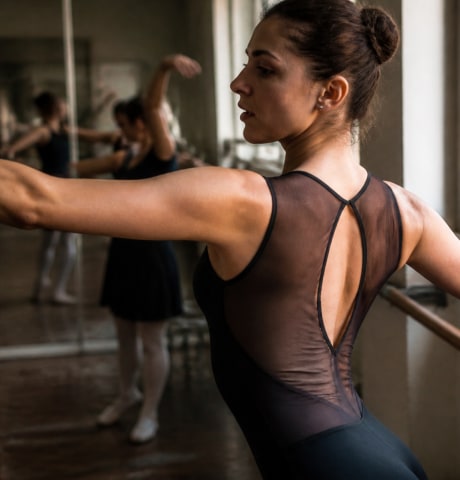
At the barre, you train with a high level of focus. The firm support allows you to work on the exact alignment of your pelvis and the maximum extension of your legs, without being distracted by balance issues.

Middle

The freedom of dance

Focus on balance and dynamics

In the middle, you experience the freedom of movement. Here, you combine the technique you have learned with spatial paths, turns, and fluid transitions, which turns steps into real dance.

Frequently Asked Questions

  1. Training at the ballet barre builds the necessary strength, flexibility, and muscle memory. Without this supported framework, it would be nearly impossible for beginners to learn the complex turnout and precise foot positions cleanly and without injury.

Ballet classes for adults near you

Discover studios that gently guide you from your first steps at the barre to the center of the room.

See all matching classes

Find your ballet training in the vicinity

On udansa, you will find the right ballet class in your region that caters exactly to your needs and guides you step by step from the barre to the center.

Find your ballet training in the vicinity

Read more