Ballet training4 minutes

Executing plie and releve correctly: Gentle on the joints for adults

In short
  • Correct plié technique requires the knees to point exactly over the center of the feet.
  • The outward rotation must always begin in the hips and must not be forced through the feet.
  • During a relevé, the ankles must remain stably upright and must not buckle inward or outward.
  • The ballet barre serves only as a light balance aid when stepping up and down, not for pulling yourself up.

If you start ballet at a mature age, you are often looking for the perfect balance between aesthetics and health. Precise training at the barre protects your joints from strain and gives you new strength.

What you need for training

  • Flat ballet slippers with split suede soles
  • A sturdy ballet barre or a stable chair back as a substitute
  • A non-slip surface like parquet or a gymnastics mat
  • Basic understanding of the first and second foot positions

Why the correct axis direction protects your joints

Classical ballet for adults is not about extreme ambition, but about precision and your own well-being. If you want to combine elegant arms in ballet with stable footwork, you must master the foundation. An uncontrolled plié, where the knees collapse inward, or a wobbly relevé on unstable ankles place massive strain on the musculoskeletal system. The solution lies in a conscious outward rotation that begins in the hips and is not forced in the feet. When you learn to activate your deep muscles in the pelvis, you noticeably relieve your joints and create the basis for fluid movements in space.
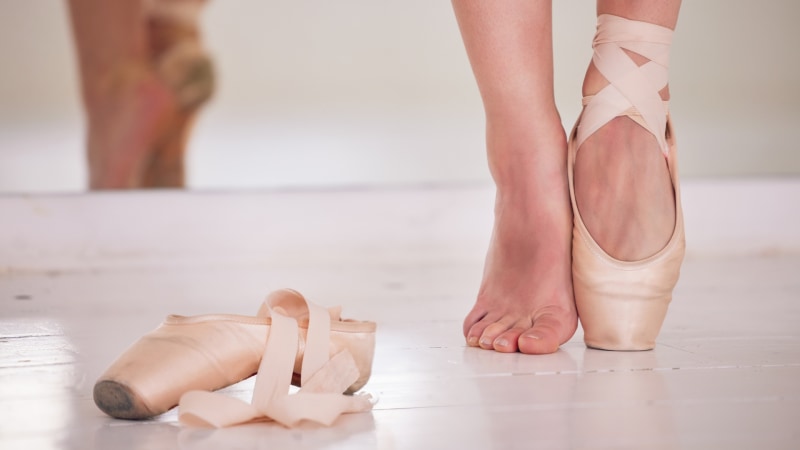
Close-up of a ballerina's feet in pointe shoes after a dance performance
The precise alignment of knees and toes at the barre prevents strain on the cartilage tissue.

Step by step to clean execution

  1. Setting up turnout from the hip

    Stand upright at the barre and align your pelvis neutrally. Engage your inner thighs and rotate your legs out from the hip only as far as you can maintain without pain in your knees.

  2. Initiate the demi-plié with control

    Bend your knees slowly while keeping your heels firmly in contact with the floor. Pay meticulous attention to ensuring your kneecaps point exactly over your second toe to relieve the ligaments in your knee.

  3. Return upright to the top

    Push yourself back up using the strength of your soles and thighs, without completely locking your knees at the highest point. The upward movement should feel like a gentle resistance.

  4. Lift the relevé straight up

    Lift your heels off the floor in a controlled manner by increasing the pressure on the balls of your big and second toes. Keep your ankles absolutely stable and do not let them collapse outward.

  5. Lowering gently and in a controlled manner

    Lower your heels slowly and with resistance back to the floor, as if you were gliding through thick honey. Absorb your weight softly to protect your joints upon landing.

Secure execution in direct comparison

That is how

  • Bend your knees exactly in the direction of your toes
  • Gently rotate your turnout from the hip joint
  • Lift into relevé using active calf and foot muscles
  • Use the barre only as a light support for your balance

Don't do this

  • Letting your knees fall inward while bending
  • Forcing your feet outward on the floor
  • Bouncing upward with momentum and twisting your ankles
  • Pulling yourself up on the bar with all your strength

Your checklist for joint-friendly training

Before the exercise

Preparation

During the plié

Meanwhile

During relevé

Meanwhile

Frequently Asked Questions

  1. A plié is gentle on the knees when the knees point exactly over the second and third toes throughout the entire bend. In addition, the buttocks must not shift backward, as this puts too much strain on the kneecaps.

Ballet classes for adults near you

Find the right class that perfectly matches your skill level.

View all matching classes

It is easier to train together

Find like-minded dance enthusiasts on udansa who train with joy and mindfulness just like you, as well as the right studios in your area.

It is easier to train together

Read more