Ballet school5 minutes

Elegant arms in ballet: Port de Bras for beginners

In short
  • The classic arm positions in ballet form a fixed system from the preparation to the fifth position.
  • A correct port de bras describes the fluid and controlled movement of the arms between these positions.
  • The movement of the arms starts anatomically in the back under the shoulder blades, while the shoulders remain low.
  • The elbows are always slightly rounded and point outwards to form a harmonious ellipse.

Arms in ballet are the key to a majestic presence. Anyone who understands the classical positions and the art of port de bras transforms simple movements into pure poetry.

DefinitionPort de Bras

Port de Bras is the French technical term for the carriage and movement of the arms in ballet. It refers to both the defined arm positions and the harmonious transitions between them.

The source of power for graceful upper body movements

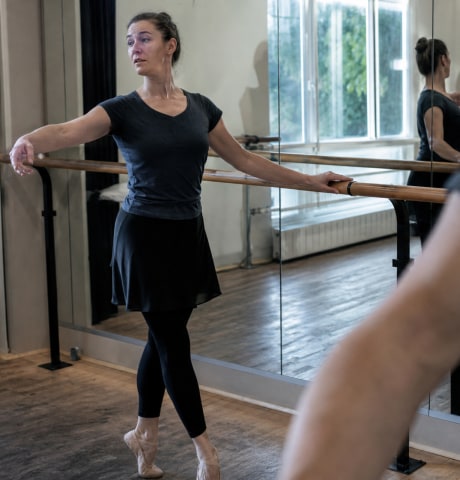
In ballet, the arms are much more than just a decorative accessory, they direct the energy of the entire body, support balance, and give every movement its artistic expression. Anyone entering a ballet studio for the first time often focuses strongly on the floor unconsciously. However, true elegance is created above the waistline. Arm movements are based on a logical system of firmly defined anchor points, the so-called ballet arm positions, the port de bras. Each of these positions creates a harmonious frame for the face and the upper body.

To guide the arms correctly, an understanding of anatomy is crucial. A common misconception is to move the arms purely from the wrists or the forearms. In ballet, however, the movement originates in the back, more precisely under the shoulder blades. The shoulders themselves always remain low and relaxed, while the elbows point gently outwards and upwards. If you maintain this basic tension, your movements will immediately appear fluid and light as a feather.

The elbows always remain slightly raised and supported to give the arms their graceful elegance, even in the widest positions.

From preparation to the fifth position

The term port de bras describes the conscious carrying and guiding of the arms from one position to the next. To make these transitions harmonious, beginners first learn to hold the classic basic positions cleanly. In the preparation position (préparation), the arms rest low in front of the pelvis and form a gentle ellipse, as if you were carrying a large basket. The fingers point towards each other, but do not touch. All further movements unfold from this resting posture.

In the first position, you lift this imaginary circle to the height of your solar plexus. In the second position, the arms open wide to the sides, with the elbows remaining slightly bent to prevent the joints from sagging. The third position combines a high element with one opened to the side. The fourth position continues this asymmetry, while the fifth position closes both arms in a proud, wide arc above the head. An important focus for ballet for adults is to internalize these forms without pulling the shoulders up.

How to master elegant arm positioning in ballet

Correct

  • Consciously let your shoulders sink down, low and relaxed
  • Actively support your elbows outwards and upwards in all positions
  • Keep your fingers soft and in a natural extension

Wrong

  • Pulling your shoulders up to your ears during high arm positions
  • Letting your elbows hang limply downwards
  • Bending your wrists or tensing your fingers

The arms are the frame of the picture that the body dances. They must never appear rigid, but rather allow the music to breathe gently.

Ballet teacher, Hamburg

Smooth transitions and the breath as a metronome

A harmonious port de bras thrives on the fluid connection between individual positions. If you want to learn a ballet arm movement, it helps to imagine moving through a light element like water. The air around you provides a gentle resistance that you shape with the backs of your hands and your fingertips. Every movement is accompanied by your eyes and a subtle tilt of the head, which gives the dance its characteristic soul.

For clean port de bras beginner training, it is advisable to practice the transitions while standing, without footwork, at first. Focus entirely on your breath: inhale as your arms open, and exhale as they lower or close. This synchronization calms your pulse and provides the necessary lightness. If you want to try your hand at contemporary dance, this arm training will also help you tremendously. You can find out more about this in the guide on Modern Dance and Contemporary for adults.

Two sides of arm work in classical dance

Supporting

Forming the round ellipse

Using the supporting power from the back

The arms form soft, unbroken lines. The elbows point outwards and upwards, while the wrists remain stable and the fingers gently extend the movement.

Leading

The fluid port de bras

Creating harmonious transitions without pauses

The arms move fluidly from one position to the next. The path is just as important as the destination, and the fingertips paint soft lines in the air.

Frequently asked questions

  1. The strength for arm positioning comes from the muscles in the upper back, specifically those beneath the shoulder blades. This allows the shoulders to relax downwards while the arms remain stable and appear light.

Ballet courses for adults near you

Find the right course to learn the basics of classical dance from scratch.

View all matching courses

Meet your dance community on udansa

Find like-minded dance enthusiasts and the right courses in your area on udansa to take your posture and your moves to the next level.

Meet your dance community on udansa