Body posture4 minutes

The 7 most common posture mistakes for ballet beginners

In a nutshell
  • An uncontrolled arched back when standing upright is the most common mistake and can be avoided by active core tension and a gently tilted pelvis.
  • Pulling up the shoulders due to tension blocks arm movement and is resolved by consciously pulling the shoulder blades down.
  • Forcing turnout from the knees or feet damages the joints and must instead be initiated anatomically correctly in the hip joints.
  • Clawing the toes or rolling the ankles inward disrupts balance and is corrected by an even distribution of weight across the entire sole of the foot.

Starting ballet as an adult is a wonderful way to strengthen your body awareness and elegance. By avoiding typical posture mistakes from the beginning, you protect your joints and learn the demanding technique in a healthy and injury-free way.

How we selected the posture errors

  • Relevance for adults

    All listed posture errors are based on the typical anatomical challenges faced by adult beginners in classical dance.

  • Health focus

    The tips offer concrete corrections and anatomically healthy solutions that can be implemented directly in your training.

  • Independent selection

    No payments or placement fees were accepted from dance schools or associations for the creation of this overview.

A ballet teacher instructing a young girl in a dance studio during a training session
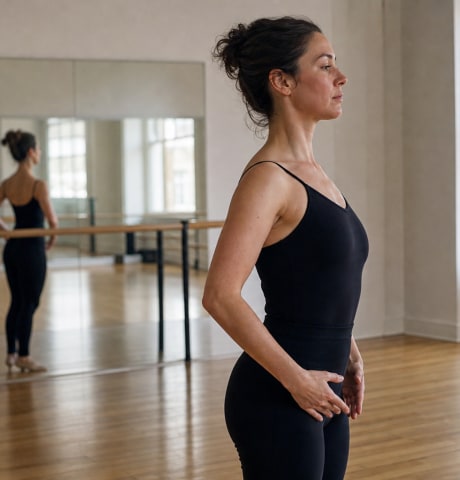
Only those who stabilize their pelvis and activate their core muscles protect their spinal discs and find the perfect balance.

The 7 typical posture mistakes when starting ballet

  1. 01

    The uncontrolled swayback

    Posture error 1: The duck butt in a swayback

    • Pelvis
    • spine
    • core tension

    When trying to stand particularly upright, many beginners tilt their pelvis backward and fall into a swayback. This puts extreme strain on the lumbar spine. The solution is an active core and a tailbone gently aligned downward.

  2. 02

    Raised and tense shoulders

    Posture error 2: Cramped upper back area

    • Shoulders
    • neck
    • port de bras

    During demanding exercises, the shoulders unconsciously migrate upwards towards the ears. This blocks elegant arm movement and leads to painful neck tension. Actively pull your shoulder blades back and down.

  3. 03

    Forced turnout through the knees

    Posture error 3: Forced rotation from the joints

    • Legs
    • knees
    • en dehors

    Anyone who forces their feet outward at a 180-degree angle twists their knees and damages their menisci. Healthy turnout (en dehors) always begins in the hip and should only go as far as the knees can follow the direction of the feet.

  4. 04

    Clawing the toes

    Posture error 4: Cramped foot muscles

    • Feet
    • toes
    • balance

    For fear of losing their balance, many beginners claw their toes into the floor. This blocks footwork and prevents a clean roll-through. Your toes must lie long and relaxed on the floor.

  5. 05

    Ankles collapsing inward

    Posture error 5: Unstable ankles

    • Ankles
    • foot arches
    • stance

    When core tension decreases, the ankles tilt inward. This causes the longitudinal arch to collapse and puts incorrect strain on the knee. Distribute your weight evenly across three points: the ball of the big toe, the ball of the little toe, and the heel.

  6. 06

    Shifted center of gravity

    Posture mistake 6: Incorrect weight distribution

    • Center of gravity
    • balance
    • axis

    To maintain balance, beginners tend to push their buttocks back or lean their upper body forward. However, the weight must rest exactly over the middle of the foot to form a vertical, stable axis.

  7. 07

    The lowered or fixed gaze

    Posture mistake 7: Blocked neck

    • Head posture
    • cervical spine
    • direction of gaze

    A fixed gaze at the floor or into the mirror blocks the cervical spine and disrupts your entire balance. The head should always form the proud extension of the spine, while the gaze remains softly directed into the distance.

Why correction from the start is key

If you start classical dance as an adult, you usually already have a set everyday anatomy. Hours of sitting at a desk, one-sided strain, or a lack of core tension have left their mark. In the ballet studio, this habitual posture is suddenly put to the test. To avoid injuries and make rapid progress, a conscious focus on correct technique is crucial. A typical stumbling block, for example, is forcing the turnout from the knees instead of the hips. To properly relieve your feet, it is also worth taking a look at our guide on ballet shoes for adults, because the right footwear supports a stable stance from the very beginning.

Correcting mistakes in ballet is not a sign of weakness, but an integral part of training. Experienced teachers correct continuously, as postural patterns anchor themselves deeply in muscle memory. If you pay attention to a clean alignment of the spine, an active pelvis, and relaxed shoulders from the start, you protect your joints and build up the necessary deep muscles. Patience is your most important companion here: the body needs time to internalize the unfamiliar, proud movement patterns and to build up balance.

Posture analysis at a glance

Postural errors affect the pelvis
1
Typical error areas on the foot
3
percent focus on healthy anatomy
100%

Frequently Asked Questions

  1. You avoid an arched back in ballet by gently tilting your pelvis and pulling your pubic bone towards your belly button. At the same time, you activate your deep abdominal and core muscles to stabilize and relieve the lumbar spine.

Ballet classes for adults near you

Find the right class and learn proper posture from professional instructors.

View all matching classes

Finding your proud posture together

On udansa connect, you will find like-minded people who, just like you, want to start ballet at a mature age or improve their posture. Exchange ideas in the community and find the perfect companion for your training at the barre.

Finding your proud posture together